There are no reported deaths directly tied to Savannah's infamous "Stone Stairs of Death." However, they often prove to be hazardous, which is why these historic stairs are affixed with a bright yellow warning.
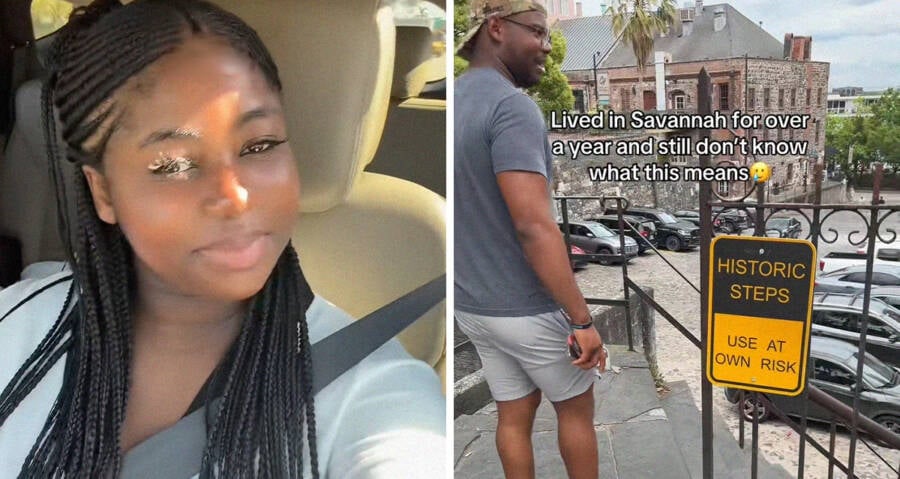
@marie_obviously/TikTokA couple living in Savannah, Georgia, stands at the top of the infamous “Stone Stairs of Death.”
On the riverfront in Savannah, Georgia, there is a set of steep stairs nicknamed the “Stone Stairs of Death.” A couple who has lived in the area for more than a year is now bringing viral attention to this flight of steps after pondering the purpose of its warning sign.
In a short TikTok posted by @marie_obviously, a man encounters a steep set of stairs with a warning sign nearby: “Historic steps, use at own risk.” The couple doesn’t understand why an otherwise innocuous set of outdoor stairs has a bright yellow warning sign affixed to them.
Their video has been watched 2.1 million times.
What Are The “Stone Stairs Of Death”?
The stairs go from downtown Bay Street to the River Street shopping and entertainment district. Located along the shores of the Savannah River, the site has been a port, market, and shopping district since 1733, when the colony of Georgia was founded.
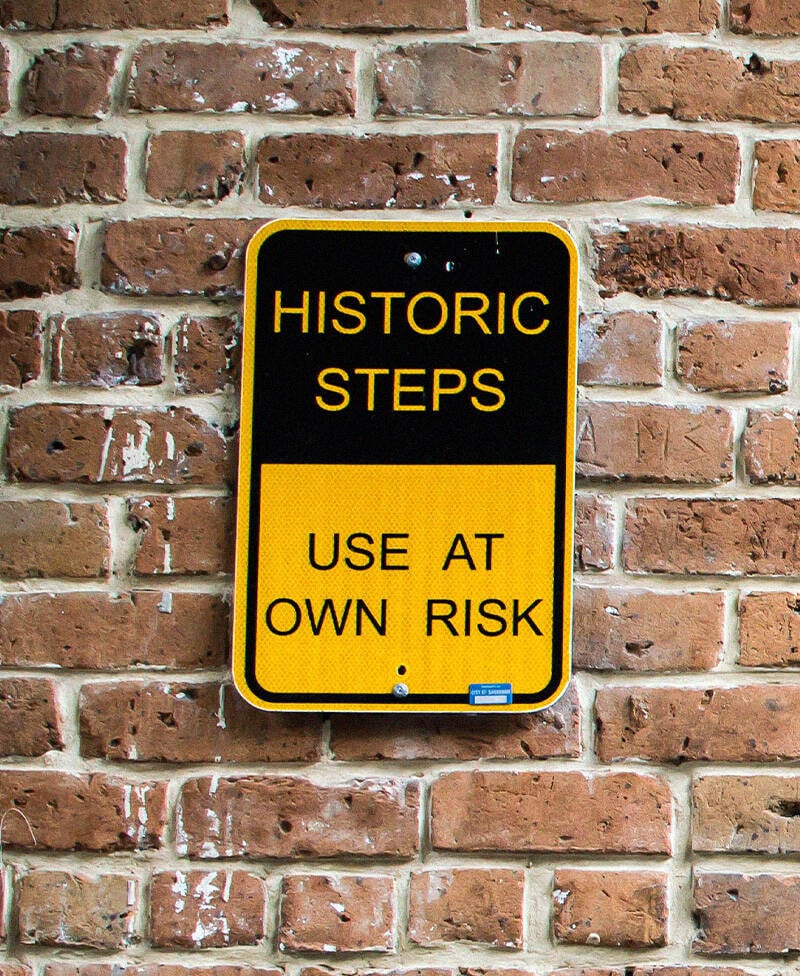
Jazmine/Adobe StockA warning sign for historic steps, like the one found in Savannah.
The builder of the staircase and their exact date of origin are not widely cited. But they were likely originally constructed in the 18th century to connect the bluff and the working waterfront, as there is a whopping 40-foot drop between the two.
The stone stairs, unofficially dubbed the “Stairs of Death,” are treacherous because there are a few dozen of them, they’re uneven, and they become slick in the rain. There are no reported deaths directly tied to the stairs. However, they have proven to be hazardous during busy times in the city, like during Savannah’s notoriously wild St. Patrick’s Day celebrations.
The Early History Of Savannah, Georgia
As one of the southern colonies in the New World, Georgia’s history is complex. Founded by British General James Oglethorpe, the 13th and final British colony was named for England’s King George II, who reigned from 1727 to 1760.
Laid out and planned by Oglethorpe, Savannah is renowned for its series of small squares around which communities lived. They now form the centerpiece of the city’s rich architectural offerings. Oglethorpe himself is credited with drafting the plan for the first four squares, and subsequent city planners followed his design for decades. Originally a plan for military expedience, the squares now help make the city very walkable.
Initially, the colony’s mission “was to offer a new start for England’s working poor and to increase trade. Georgia was also chartered as a buffer zone for South Carolina, protecting it from the advance of the Spanish in Florida.”
Notably, under the city’s original charter, it was a place where “individuals were free to worship as they pleased and rum, lawyers and slavery were forbidden.”
Reminders Of The Brutal Legacy Of Slavery
However, by the late 1740s, enslaved individuals were openly sold in the Savannah markets. By 1750, trade in humans from Africa was legalized. Essentially it “extended an official imprimatur to a reality that already existed.”
Enslaved Africans were used in the grueling cotton and rice industries, and by the mid-1800s, Savannah was the leading exporter of cotton in the world.
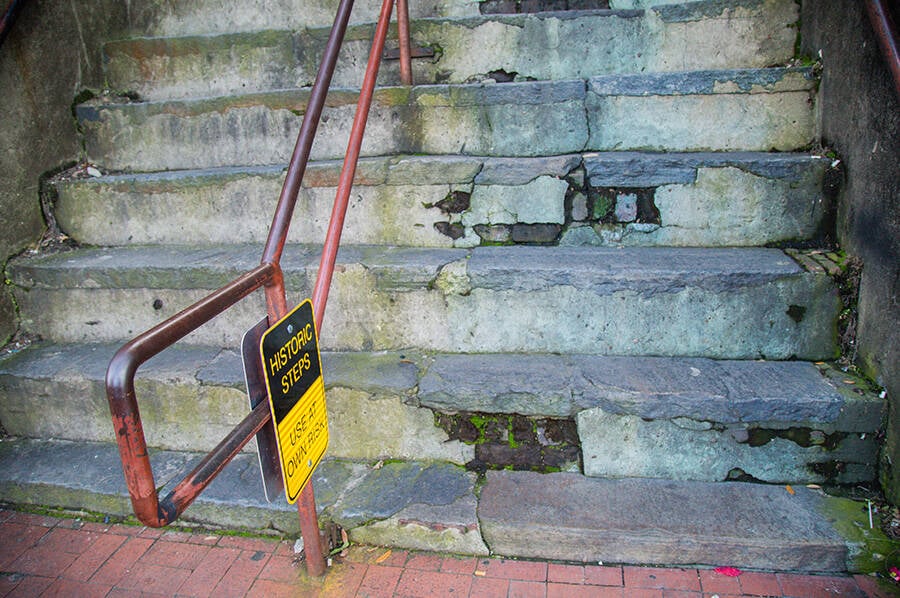
Tamara Sales/Adobe StockThe bottom of the “Stone Stairs of Death,” with a warning sign affixed to them.
Thus, the waterfront was busy with industry and trade. Keeping things running smoothly required infrastructure: warehousing, footpaths, and dockage. So, a stairway for access, even if it’s not up to contemporary codes, was a necessity.
History Buffs And Ergonomic Experts Weigh In On The “Stone Stairs Of Death”
Though the “Stone Stairs of Death” aren’t the only stairs down to River Street, they are perhaps the most noteworthy.
One TikTok viewer, Leo (@eleoheve), quipped, “Modern stairs are designed to lessen fall risks. Historic steps are designed with vibes.”
The larger consensus hinges on the signage posted by the city, “It means if you fall and get hurt you can’t sue the city cause they put a use at own risk sign,” Lesley (@lesley0871) summarized.
There’s even one Savannah resident posting on Facebook under the moniker “Stairs of Death.” Their mission (as they present it): “I live in an apartment next to these steps. From my balcony I observe people ascending and descending the stairs. I post their asinine quotes and pics.”
All That’s Interesting reached out to Marie via TikTok direct message. We will update this when she replies.
After reading about the history behind Savannah’s “Stone Stairs of Death,” read about the complex history of when slavery actually ended in America, or see 55 photos that capture the brutality of the American Civil War.