Burlington Bunker In Britain
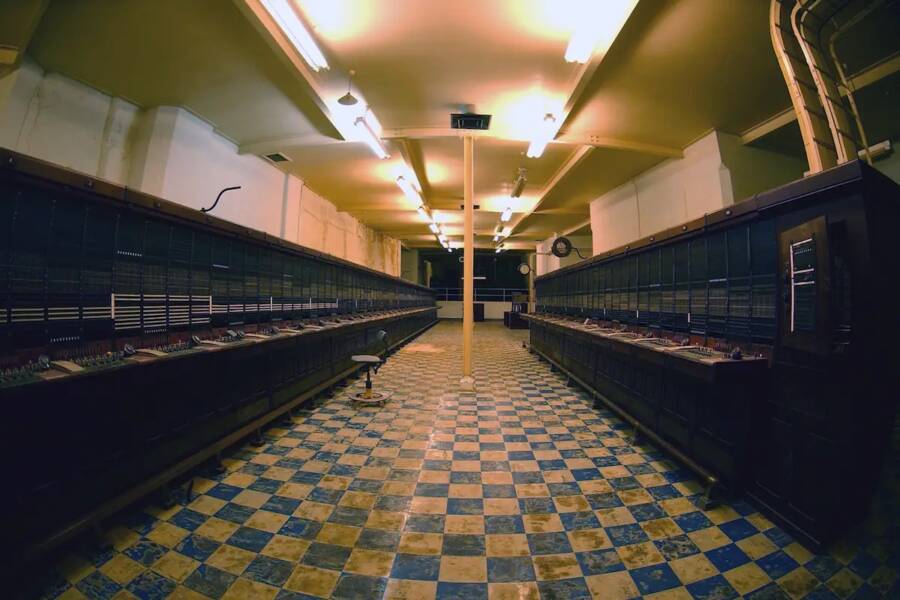
British Ministry of DefenceThe massive 1950s switchboard inside the Burlington Bunker.
At the end of 2004, the British Ministry of Defence posted a short, strange announcement: A “formerly secret Government underground site near Corsham in Wiltshire” had just been declassified. The site was intended to be a potential relocation site for the government in the event of a nuclear war — one that had remained a secret for around 40 years.
Per an Insider report, the story of Burlington Bunker began in the early 1950s, when the Cabinet Office decided to create a new seat of government with a focus on preparing for the possibility of an all-out nuclear war.
Then, in 1955, the Central Government War Headquarters was commissioned to begin work on the Burlington Bunker in earnest, in a 240-acre abandoned quarry. There, they constructed a massive underground facility, equipped to house 4,000 government staff members (without their families) for 90 days if a nuclear attack suddenly fell upon the country.
The reinforced concrete walls were 100 feet deep, and the facility was equipped with a variety of rooms including bedrooms, offices, two canteens, a bakery, a hospital, a BBC broadcasting studio, and a room lined wall to wall with wired telephones and one of the largest switchboards in the world. The site was so massive that it was equipped with electric buggies to transport potential residents through its vast underground streets.
Most of the facility remained unused for years, though maintenance was largely kept up with in the bunker until 1991, when it was deemed by the government to be too run-down and expensive to keep maintaining. Over the next decade or so, it gradually fell into disrepair before being officially decommissioned — and declassified — in 2004.
Following the initial government revelation, they began trying to sell the site and the ground above it to private investors. According to Atlas Obscura, some potential buyers included a data storage site, a European wine seller, a nightclub, and a 1950s-themed amusement park.
Coober Pedy: Australia’s Underground City
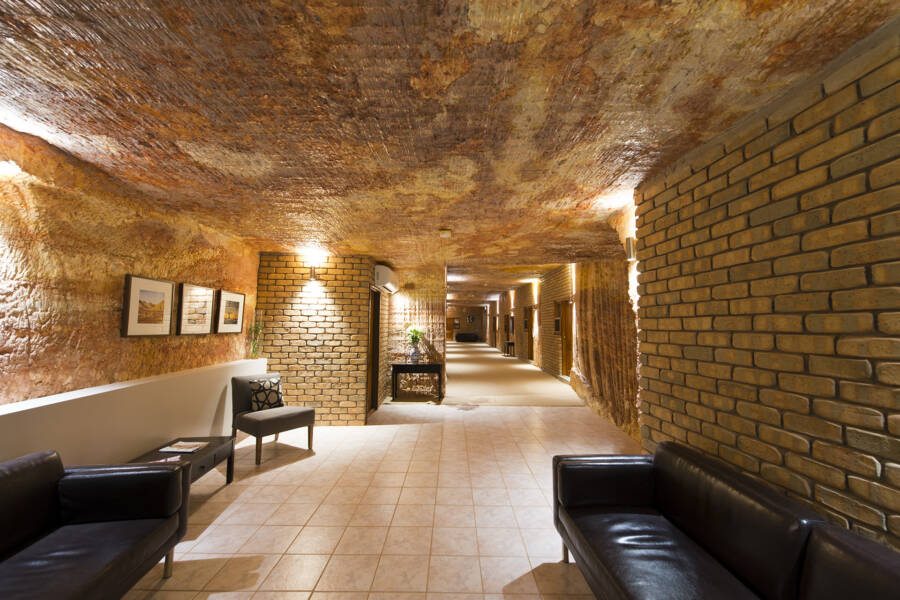
Steve Collis/FlickrA hotel inside Coober Pedy in Australia.
Coober Pedy is a standout example on this list, as it is the one underground city that is still inhabited to this day. Unlike many other underground cities around the world, which have been long completely abandoned, Coober Pedy still houses around 3,500 people of 45 different nationalities.
Most of its inhabitants are the descendants of Europeans who arrived in the 20th century, hoping to make their fortune capitalizing on opals.
About 150 million years ago, Coober Pedy was the bed of a vast ocean, where the tide brought minerals from the sandstone seabed into the cracks of the Earth. Over the millennia, the silica deposits left there hardened gradually, creating thousands of opals that remain embedded in the rock.
Eventually, a massive opal mine was established in the region, with the town of Coober Pedy being officially established in 1915. News of the town quickly spread after a 14-year-old child named Willie Hutchinson struck not gold, but opals, while out with his father and a group of prospectors.
Suddenly, droves of people were flocking to the town hoping to replicate Hutchinson’s good fortune. However, life wasn’t easy in the region. For starters, there was very little rain and the temperatures above ground often reached 104 degrees Fahrenheit or sometimes even higher.
But the opals were plentiful, and some people weren’t willing to give up on their potential riches. They hatched a unique plan to beat the heat — and they began digging a new city below the surface of the Earth.
The early inhabitants took a vote to name their town Coober Pedy, derived from the Aboriginal term kupa-piti, meaning “white man in a hole.”
Living underground has afforded a few benefits to the inhabitants of Coober Pedy, too. The temperatures underground are always around 74 degrees Fahrenheit, meaning their dugout homes don’t require air conditioning, nor are they prone to the dangers of the dust storms above ground.
And they are not short on luxuries, either. Residents carve out whatever they need into the sandstone of their homes, including bookshelves and tables. Some residents have even carved out underground swimming pools.
Incredibly, the network of tunnels grows each year.