A content creator named Zack Fairhurst claims to have swum more than a thousand miles to reach Point Nemo, also known as the most remote location on Earth.

@maddzak/TikTokTikTok user Zack Fairhurst claims he swam to Point Nemo, the farthest place from land on Earth.
A viral TikTok account has racked up millions of views after a man claimed he swam solo to Point Nemo, the most isolated spot on the planet. The internet can’t decide whether to be amazed, skeptical, or worried.
A video by @darkvoid_404, which has more than 3.2 million views, recounts the story of Zack Fairhurst (@maddzak), a creator who claims to have swum more than a thousand miles to reach Point Nemo.
Fairhurst posted more than 200 videos from the open ocean — and then mysteriously went silent last year. A passing sailor allegedly found his camera.
Here’s more on what really happened.
What Is Point Nemo, And Why Are People Fascinated By It?
Point Nemo is located in the South Pacific Ocean, roughly 1,670 miles from the nearest land in every direction.

chocolatefather/Adobe StockPoint Nemo is the most remote location on the planet.
The three closest landmasses — Ducie Island; Maher Island, off Antarctica; and Motu Nui, near Easter Island — are all about equidistant and essentially uninhabited. Few ships and aircraft pass nearby. It is the farthest point between ocean and land.
The nearest humans to Point Nemo at any given moment are often not on Earth at all. They’re astronauts aboard the International Space Station, orbiting about 258 miles overhead.
It also has a second life as a spacecraft graveyard. Since 1971, space agencies, including NASA, have been deliberately deorbiting space junk (like satellites) over Point Nemo, where the items splash down with virtually no risk to humans. More than 260 artifacts have been sent there.
So, how could someone possibly swim to the remote spot?
What Would Happen To Your Body If You Tried This?
Setting aside the question of whether Fairhurst’s stunt is real, it’s worth considering what floating in the open ocean for weeks would do to a human body.
According to Mike Tipton, professor of human and applied physiology at the University of Portsmouth and a sea survival researcher, there is an established hierarchy of what happens to the body in survival mode. Without air, someone can only survive for minutes. Without enough warmth, it’s hours. Without fresh water, it’s six or seven days. And without food, 40 to 60 days. Dehydration, not starvation, is what kills most people lost at sea in warm conditions.

Chris Brown/Wikimedia CommonsBritish explorer Chris Brown and his son, Mika, swam at Point Nemo in 2024 — though they took a boat to the site.
The problem is that the ocean offers no relief. Seawater is more than three percent salt, so drinking it adds to the body’s salt load rather than relieving it.
At just five percent dehydration, a person becomes irritable and lightheaded. At 10 percent, dizziness, faint spells, and rapid, shallow breathing set in. And after that, you’re far gone with hallucinations and delirium. Death from dehydration occurs when fluid loss reaches around 15 to 20 percent of someone’s body weight.
Also, staying in the water rather than on top of it makes things worse. Even in relatively warm temperatures, the body loses heat faster submerged in water than out in the air.
Still, Fairhurst insisted that he swam to Point Nemo. But not everyone believes him.
Was The Sea Expedition Just For Views?
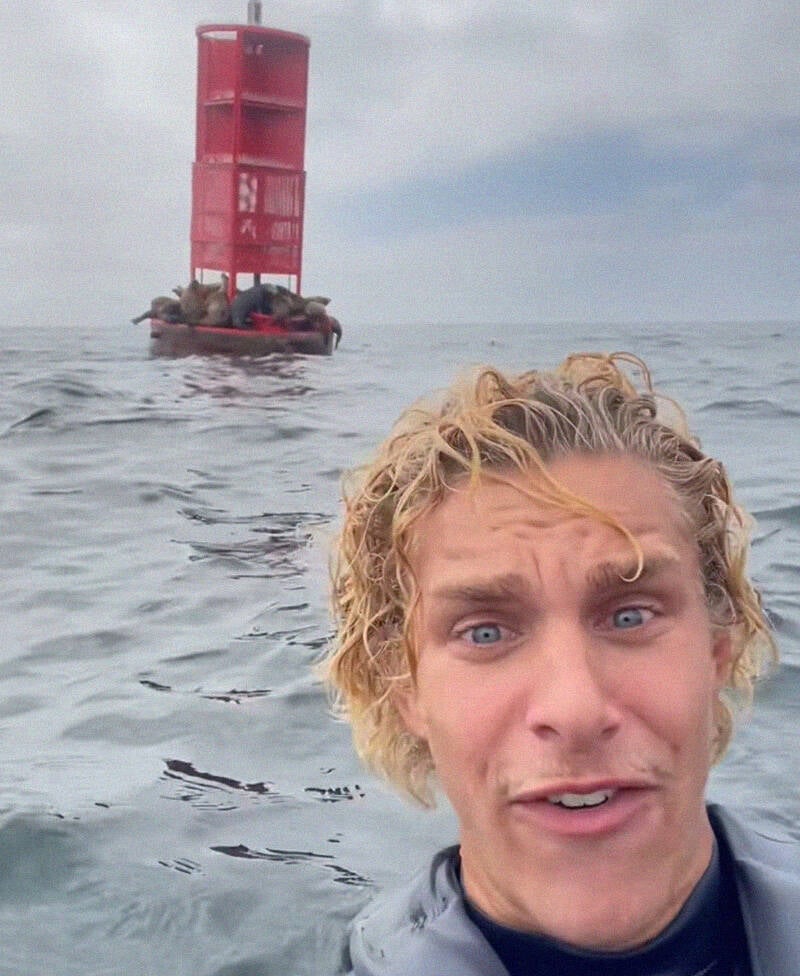
Fairhurst, who is from New Jersey, built his following around the recurring bit that he’s stranded in the middle of the ocean, posting videos of daily life adrift at sea. He has more than 6.3 million followers at the time of publication, and his videos consistently get millions of views.
@maddzak/TikTok
Despite what many think, there is no red buoy — or any other marker — at Point Nemo.
But viewers are skeptical, asking: How does he charge his phone? How does he sleep? Where does his food come from? How does he have access to the internet at the most remote point on the planet?
While some people were worried when he went quiet last year, Fairhurst has since returned to posting. If he really did make it to Point Nemo, he has seemingly returned safely.
After reading about Point Nemo and the TikTok saga surrounding it, learn about Tristan da Cunha, the world’s most isolated inhabited island. Then, explore the six most remote places on Earth.