A figure from 16th-century Spanish literature, Calafia ruled over the all-women island of California — a story that inspired Spanish conquistadors when they explored the western coast of North America.
In Garci Rodríguez de Montalvo’s 16th-century novel Las sergas de Esplandián, the character of Calafia is described as a Black warrior queen who rules over the all-women island of California. With her golden armor and armies of griffins, she’s a formidable fighter who wages war against Christendom. And she’s the likely namesake for the state of California.

Public DomainA mural of Queen Calafia at the Mark Hopkins Hotel, San Francisco, which was painted in 1926.
Her story contains themes of religion, conquest, gender dynamics, and more. So why was California named after this figure from 16th-century fiction?
This is the story of Calafia and the origin of the name “California.”
The Spanish History Behind Calafia, The Black Woman Warrior Of Fiction
The story of Calafia comes from Las sergas de Esplandián (“The Adventures of Esplandián), which was written by Garci Rodríguez de Montalvo around 1510. It was part of a larger series of chivalric romances (Amadís de Gaula) which follow the adventures of King Amadís. Las sergas de Esplandián is a sequel to these books, which follow the life of Amadís’ son, Esplandián.
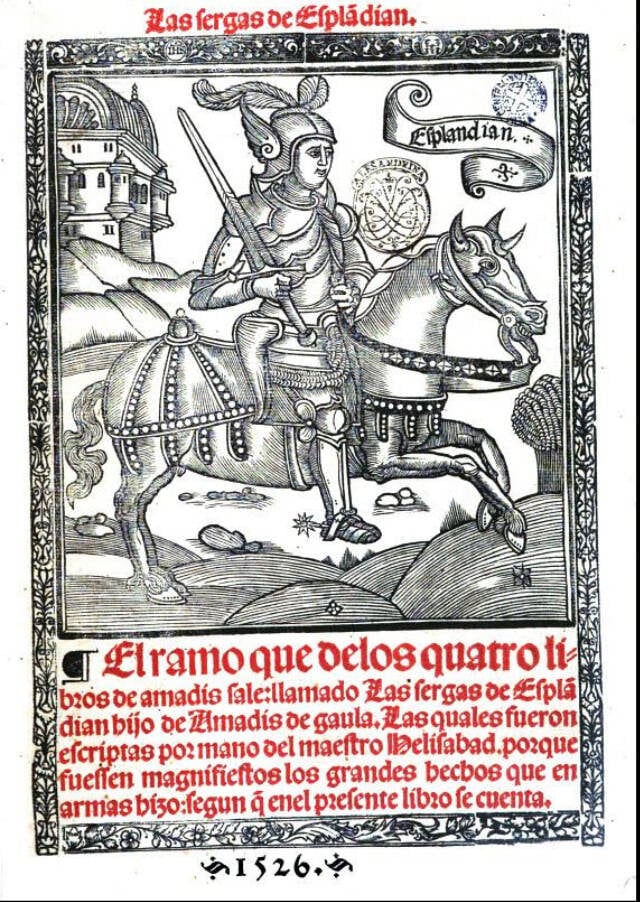
Public DomainA cover of Las sergas de Esplandián.
Montalvo was a soldier during the Reconquista, the struggle by Christian leaders to push out Muslim Moors from the Iberian Peninsula. The Reconquista ended in 1492 with the Christian conquest of Granada, and it seemingly influenced Montalvo as he developed the character of Calafia.
In fact, the Los Angeles Times reports that she may even be based on a real Muslim queen: Sayyida al Hurra, who had been driven out of Spain during the Reconquista, and sought revenge through a network of pirates. Indeed, even her name “Calafia,” may come from the word “Khalif” or “Khalifa” which means “successor” in Arabic and is used to describe a leader of Muslims.
That said, it’s also possible that Montalvo might have gotten the name “Calafia” and her island “California” from the 11th-century poem the “Song of Roland,” which includes a reference to place known as “Califerne.”
But who was Calafia?
The Many Adventures Of Queen Calafia
Calafia, Montalvo wrote, lived on an island called California, “very near to the region of [the Garden of Eden], which was populated by Black women.”
According to Montalvo, these women were similar to Amazons. They were “of vigorous bodies and strong and ardent hearts and of great strength.” They lived on the island with tamed griffins, who were fed male children — or any man who happened upon the island’s shores. And they were ruled by Queen Calafia, the most beautiful of them all.
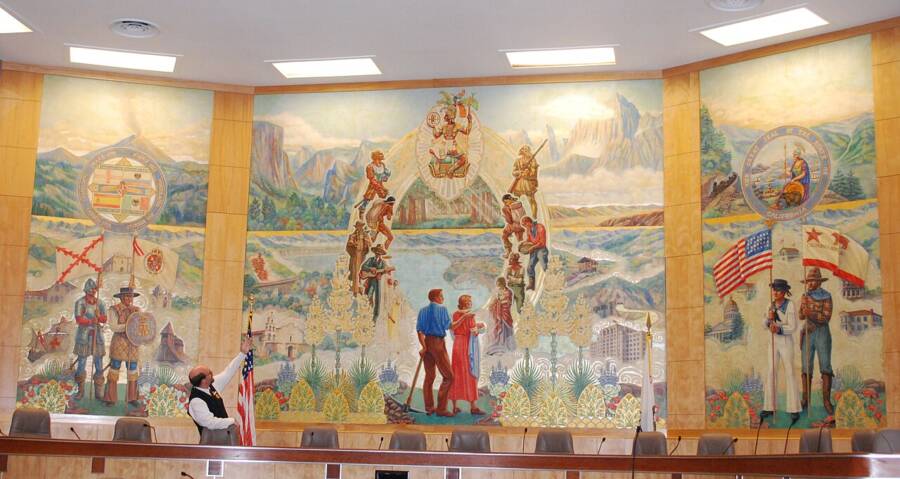
League of Women Voters of California LWVC/Wikimedia CommonsA mural by Lucile Lloyd which includes Calafia, depicted as a Mayan warrior-priestess.
“There ruled on that island of California, a queen great of body, very beautiful for her race, at a flourishing age, desirous in her thoughts of achieving great things, valiant in strength, cunning in her brave heart, more than any other who had ruled that kingdom before her… Queen Calafia,” Montalvo wrote.
In his novel, Calafia and her women warriors travel to Constantinople to fight on the side of the Muslims against King Amadís and his Christian allies. Calafia releases her griffins, but they attack Christian and Muslim men indiscriminately, forcing her to call them back. Ultimately, the Christian forces prevail. Calafia then converts to Christianity, marries a Christian knight, and returns to California, where men are newly welcome.
Montalvo’s novel, with its themes of conquest and Christianity, was a smash hit. A victim of its own success, Las sergas de Esplandián was even included as one of the books blamed for Don Quixote’s madness in Don Quixote by Miguel de Cervantes. In the novel, Las sergas de Esplandián is burned.
But one of its readers was the Spanish conquistador Hernán Cortès.
The Naming Of The State Of California
As USC Libraries reports, Hernán Cortés sought an island “rich in pearls and gold… populated by women, without a single mate” when he set sail in the 1530s. This island sounds an awful lot like Montalvo’s island of California and, indeed, Cortés soon arrived along the coast of Baja California.
According to California Frontier, the region — thought to be an island until the dawn of the 17th century — was widely known as “California” by the 1540s. That said, it’s not clear if Cortés or one of his men gave it its name.
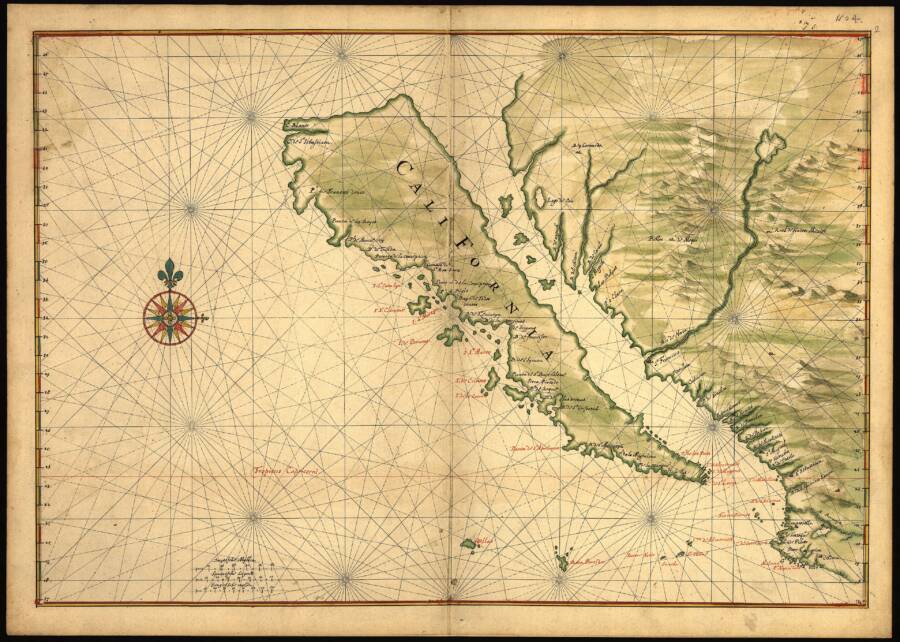
Vinckeboons, Joan; Library Of Congress/Wikimedia CommonsThis early map of California depicts the region as an island.
“Numerous theories exist as to the origin and meaning of the word ‘California,'” a California state legislative document from 2017 states, according to The New York Times. “All that is known for certain is that someone, presumably a Spanish navigator, applied the name to the territory that now comprises the State of California sometime before the year 1541.”
Indeed, it is possible that California was not named for Calafia. The state’s name may come from the Latin phrase “calida fornax,” meaning “hot furnace” or from the Native American phrase “kali forno” which means “high hill” or “native land.” However, as The New York Times notes, scholars largely agree that California state was named for Calafia and her island of California.
And her legacy in the state has not been forgotten.
The Legacy Of Calafia In California Art
Though the story of the connection between Calafia and the state of California is little known today, it has not been forgotten in the state of California itself.
In 1935, muralist Lucile Lloyd painted a mural called California’s Name in the California State Building in Los Angeles. In it, she included Calafia, depicted as a Mayan warrior-priestess. In the early 2000s, Disney also produced an epic film about California’s history called Golden Dreams: A Cinematic California Adventure. The film was narrated by Queen Calafia, as voiced by Whoopi Goldberg.

YesterlandA depiction of Queen Calafia at Disney’s Yesterland.
As such, Calafia remains an important part of California history. Though she was a fictional character, and though historians can’t say with 100 percent accuracy that the state was named after her, her story has endured throughout the ages. Tales of this warrior queen, her tamed griffins, and her women warriors, seemingly left an impression among the Spanish conquistadors, who carried her tale all the way to the New World.
After reading about Calafia, the Black warrior queen of fiction who may have inspired the name of the state of California, discover the story of Tomyris, the warrior queen who beheaded Cyrus the Great. Or, discover the stories of women warriors from history, from Cleopatra to Joan of Arc.