Christopher Knight, The Burglar Who Lived In The Woods For 27 Years

X (Twitter)Christopher Thomas Knight had reservations about stealing supplies, but his need for survival outweighed them.
In 1986, Christopher Thomas Knight, also known as the North Pond Hermit, quit his job and drove from Massachusetts to Maine, only stopping when his car ran out of gas. He was just 20 years old and had informed no one where he was going — not even his parents.
As he later told The Guardian, “I had no one to tell. I didn’t have any friends. I had no interest in my co-workers.”
Knight had always been comfortable being alone. However, that doesn’t explain what compelled him to drive his car as far as he could into the wilderness and abandon it, leaving the keys in the ignition.
Even by his own admission, Knight wasn’t entirely sure why he made his decision.
“I can’t explain my actions,” he said. “I had no plans when I left, I wasn’t thinking of anything. I just did it.”

X (Twitter)Christopher Knight’s camp.
Knight’s goal was to lose himself entirely in the wilderness. He was woefully underprepared for such an endeavor, but he quickly learned to set up camp and get by on his own. That is, until he grew hungry. While he was a decently capable hunter and angler, he hadn’t brought a gun or fishing rod with him. To make matters worse, the broad wilds of Maine were less than bountiful for foraging.
Eventually, Knight’s hunger became so great that he threw away his reservations about theft and started stealing the items he needed to survive. He bathed frequently with snow he melted on a small propane camp stove so that the smoke from a campfire wouldn’t reveal his location. He continued to shave and cut his hair to avoid raising suspicion if anyone spotted him.
In addition to food, Knight stole propane cylinders and other supplies. He would stockpile enough loot to last him from November to March. That way, he wouldn’t have to venture from his camp and leave behind any footprints in the snow.
Knight kept this up for 27 years, until he was arrested on April 4, 2013, after he was discovered breaking into a cabin. He was ultimately sentenced to seven months in jail.
Valerio Ricetti, The Hermit Of Griffith Who Built A Private ‘Utopia’ In A Cave
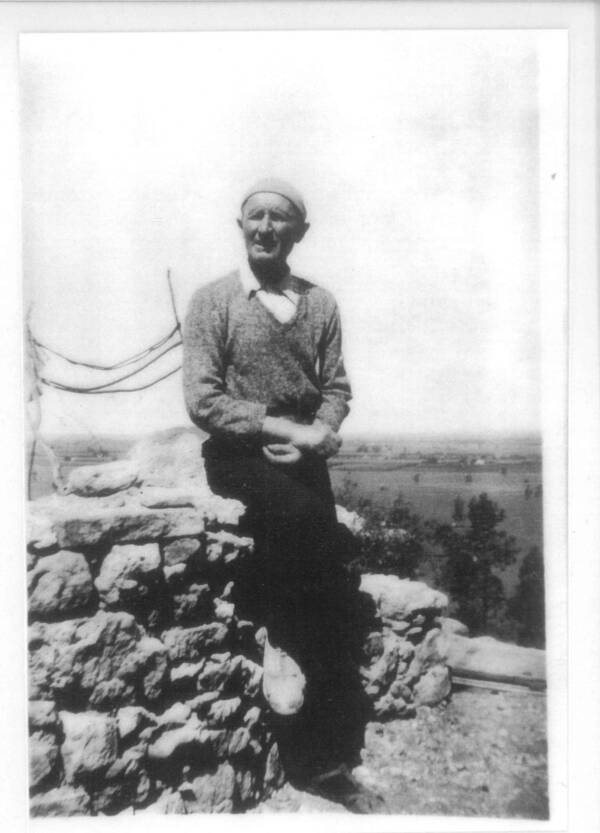
Griffith City CouncilValerio Ricetti, the “Hermit of Griffith.”
Penniless, heartbroken, battered, robbed, cheated, and jailed, Valerio Ricetti arrived on the outskirts of Griffith, New South Wales in 1929. Lonely and disillusioned with society, the Italian man had been another victim of the Depression. He was reaching the end of his rope.
It was a rainy evening, and he sought shelter in a rock overhang. The next morning, when the dark clouds above cleared, Ricetti realized that the overhang was surrounded by rich soil, abundant water, and vast fruit farms.
According to Australian Geographic, Ricetti had accumulated a variety of useful skills over the years. He’d worked as a stonemason’s apprentice, a miner, a fruit picker, a fencer, and a prospector. He realized that he could put these skills to use to craft himself an isolated home atop Scenic Hill.
Ricetti gathered discarded tools from the town dump, including a shovel and an ax head, and started constructing his hermit’s utopia. He built a fireplace within the deepest part of the overhang, trapped rabbits and hunted pigeons with a homemade catapult, and stole fruits and vegetables to supplement his diet.
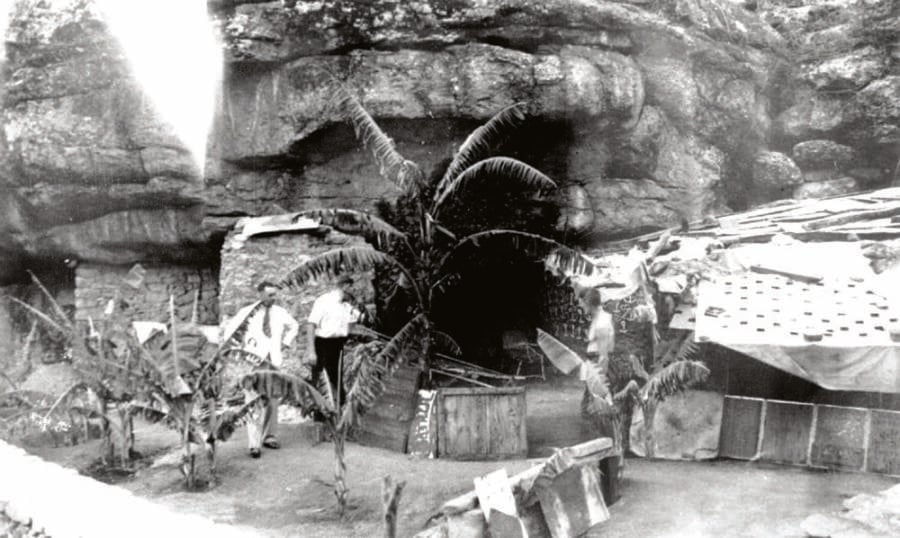
Wikimedia CommonsValerio Ricetti’s “utopia.”
Ricetti worked primarily at night to avoid rousing suspicion, but after some time the people of Griffith began to notice that something was happening atop Scenic Hill. When they came to investigate, however, they found no one, as Ricetti would hide away in one of the secret alcoves he’d dug out.
Eventually, Ricetti expanded his home to include a garden where he grew figs, grapes, peaches, lettuce, sweet peas, and tomatoes. Inside, he decorated the walls of the caves with his own paintings.
This private life of seclusion lasted until 1935, when Ricetti fell off a boulder and broke his leg. He spent the next day calling for help, and someone ultimately found him and took him to a hospital. This small act of kindness led him to realize that perhaps not all people would treat him with disdain.
After the hospital visit, Ricetti became a somewhat notorious figure and began receiving guests at his hilltop home. News reached an old friend of Ricetti’s named Valentino Ceccato, who paid the hermit a visit and offered him a job picking peas on his farm.
Though he interacted with others more frequently due to his new job, Ricetti continued to live in his cave until 1940. Then, in the midst of World War II, he was accused of being an Italian spy and forced into a prisoner-of-war camp.
Five months later, perhaps due to the shocking change in living conditions, doctors diagnosed Ricetti as “deranged” and transferred him to a mental health institution. He was released six months later under one condition: that he live in town under proper accommodations.
His hermit’s life had come to an end. Forced back into civilization, Ricetti died 10 years later at the age of 53.