Cities are filled with construction projects that seem to take decades, if they ever get finished at all. Why did construction go so much faster in the past?
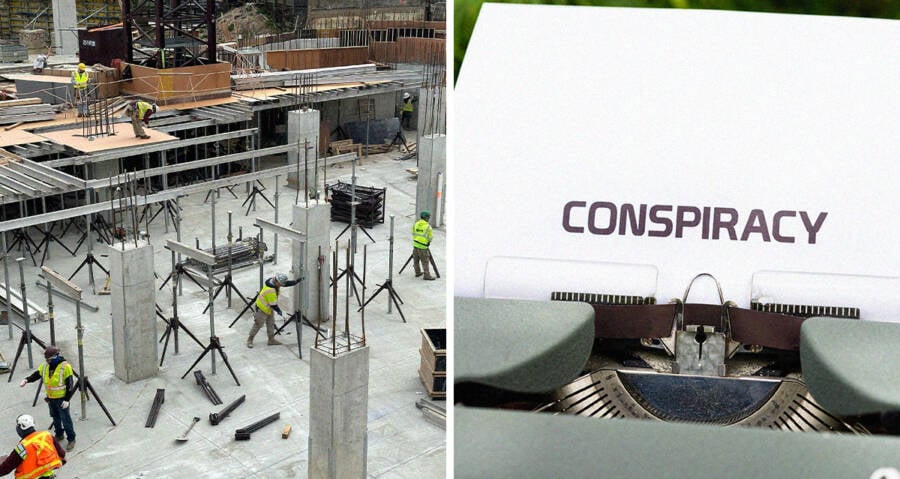
Ray Donnelly/Unsplash, Markus Winkler/UnsplashThe speed of construction in decades past — compared with the slow pace of similar projects today — is becoming fodder for conspiracy theories.
In March 2026, the New York City mayor’s office announced that they would be cracking down on the scaffolding that covers many city sidewalks.
In theory, these “sidewalk sheds” are temporary structures set up to protect pedestrians from falling debris during active construction or renovation. In practice, however, many of these sidewalk sheds have been up for years, with some covering the same spot for 15 years straight.
While the new rules attempt to get rid of some of these sheds, many residents find themselves asking, “Why is this construction taking so long in the first place?”
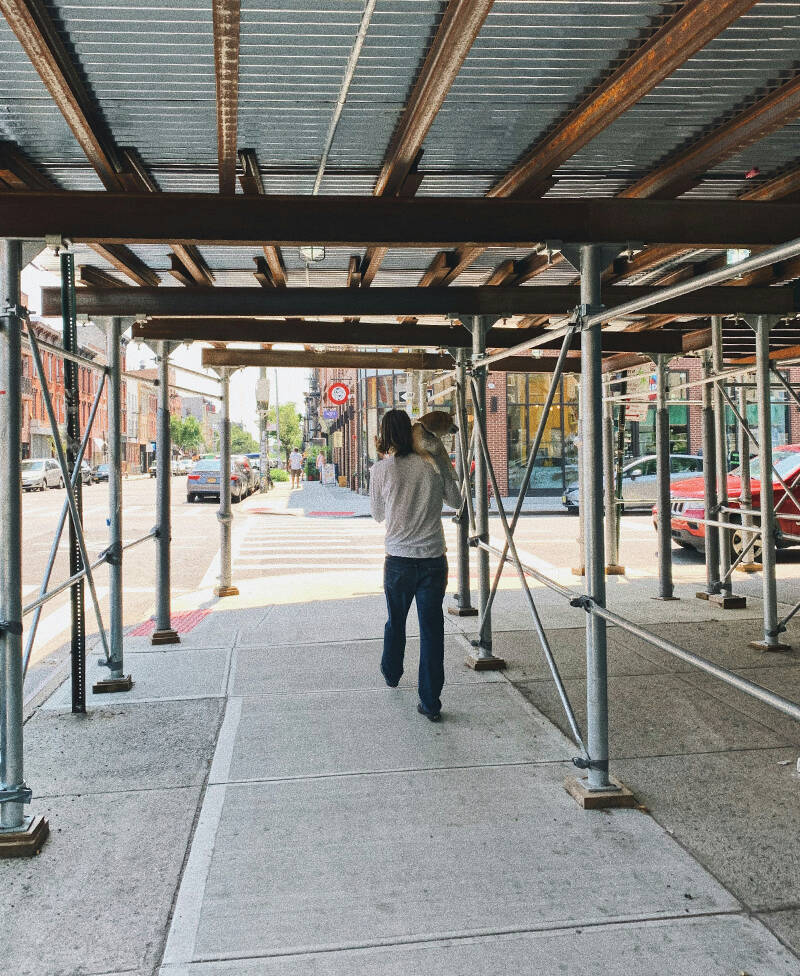
Matthew LeJune/UnsplashA sidewalk shed in New York.
This question has become fodder for conspiracy theorists. Now, some internet users are noting some of the odd timelines of historic construction projects and wondering if they’re really as accurate as they claim.
Construction Used To Be Much Faster
To offer an example of one such theory, @themylunchbreak notes something suspicious about older buildings in a video with over 1.5 million views on TikTok and 67,000 views on YouTube. In short, these old buildings seem to have been constructed at impossibly fast speeds.
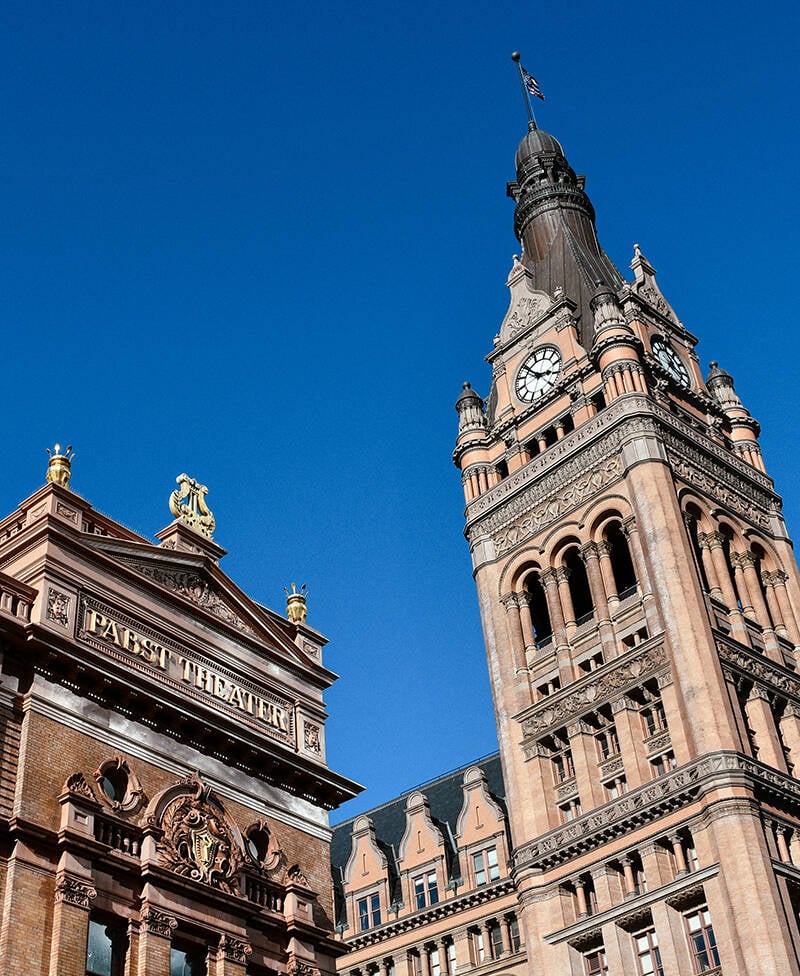
Milwaukee City Hall only took two years to complete.
As evidence for this claim, he shows off some impressive structures that have equally amazing completion times. Construction on the Streator Public Library in Streator, Illinois, began in March 1902 and was completed in January 1903. Milwaukee City Hall, which is over 350 feet tall, began construction in 1893 and was finished by 1895. Other impressive buildings, like the Cathedral Basilica of St. Louis, also boasted rapid construction times.
To @themylunchbreak, this is a sign of deception.
“They build these incredible buildings. They just throw them together in a year, and then they go home and live in a shed suffering in the winters with bonnets,” he summarizes. “The narrative is insane.”
Contemporary Construction Takes Time
The creator contrasts this with modern construction. In his eyes, modern construction projects seem significantly more issue-prone than construction projects of yore. Not only that, but they also seem beset with delays that seemingly didn’t plague earlier projects — labor issues, changes in material costs, pandemics, and more.
“How is it, though, that 200 years ago, this kind of stuff never happened?” he asks. “There [were] no construction issues; they never had a labor issue. They never had a shortage of construction workers. They never had weather issues or anything that would slow the process of construction down.”
Now, he adds, even renovation projects can take years. While a building may have been originally constructed in just a few months, it seems that fixing up the building can take much longer than that. As an example, he offers the Logan County Courthouse.
“This one was built in 1870 — yet it took our civilization six years to renovate it,” he summarizes.
He continues by speculating that this means that people are lying about how long it used to take to build things. But is that really true?
Why It Used To Be Faster To Build
It’s true that, in some cases, it used to be faster to build the ornate structures that can be seen in many Midwestern downtowns.
This is not because historians are fudging the timeline. Instead, this speed is due to a mix of fewer regulations, large labor crews, lower safety expectations, simpler systems, and a streamlining of processes that now take significantly more time.
The late 1800s into the early 1900s were a construction boom in the United States. It was also a time of incredibly lax labor laws. One of the reasons that many buildings could be constructed at such a rapid pace was because workers were tasked with working long hours in dangerous conditions.
This saved time, but it also put workers at risk. For example, the Empire State Building was constructed in just 13 months. During that time, five workers died.
Other impressive projects, such as the Golden Gate Bridge and Brooklyn Bridge, had 11 and 20 deaths respectively. Deaths during construction were so common by the 1930s that according to NPR, it was accepted wisdom that one person would die for every $1 million spent.
Today, improved safety regulations mean that construction sees many fewer deaths than it did even just a few decades ago. These restrictions and regulations extend building times, but they also save lives.
Why Do Renovations Take So Long Today?
On the topic of compliance, many renovations take a long time because older buildings were, despite their detail, much simpler internally.
For example, many older buildings did not require much interior work. By the late 1800s and early 1900s, many buildings would have basic plumbing and electricity — but, apart from windows and walls, that’s about all you’re getting.
When these buildings are renovated, it’s often a complicated task of trying to fit modern systems in structures that really weren’t designed to have them. This could include electricity, HVAC, fire suppression, elevators, data cabling, ADA accessibility, energy code compliance, sprinkler systems, and a whole lot more.
Adding these to any building — let alone a historic building, where there may be both physical and legal hurdles in the way — takes a lot of time.
We Can Still Build Quickly
A final reason why some buildings went up so quickly is that, simply put, everything was close by.
Take, for example, Milwaukee City Hall. It’s an impressive building — it weighs about 41,000 tons, largely due to its structure containing around eight million bricks. But, at that time, Milwaukee was a town with an industrial economy that produced bricks.
The city also had rail and river access, meaning that any materials that couldn’t be obtained locally could simply be ordered and received in a short time from a different part of the country. Contrast that to today, when around a third of all construction materials are imported — occasionally from the other side of the world. Many projects, such as the Carnegie Libraries (of which the aforementioned Streator Public Library is a member), were also designed with construction efficiency in mind.
In places where both of these factors still play a major role, fast construction speeds are common.
For example, by standardizing designs, building at scale, and relying heavily on local construction and manufacturing capacity, China has built almost 12,000 miles of railways in the past five years alone. To offer an even more impressive example, the country recently boasted that it managed to build a 10-story apartment complex complete with plumbing, wiring, and insulation in just 29 hours.
In short, it’s no great mystery why older buildings went up so fast — but achieving that speed today comes with a whole lot of extra steps.
@themylunchbreak Buildings That Shouldn’t Be Here
All That’s Interesting reached out to @themylunchbreak via email.
If you’re interested in more from the annals of lost history, explore the legend of the Tartarian Empire. To see just how unsafe construction used to be, learn about the story behind the iconic photo of construction workers working on New York’s Rockefeller Center.