

For centuries, the famous Easter Island moai statues have stood tall on this remote Pacific landscape — but who built them, how were they moved, and why were they erected in the first place?
In 1722, a Dutch explorer named Jacob Roggeveen set out to find the lost continent of Zuidland. Instead, he stumbled upon a tiny isolated island in the Pacific Ocean which, because it happened to be Easter Sunday, he dubbed “Easter Island.” To Roggeveen’s surprise, this remote island was home to thousands of people. But he was even more astounded by the hundreds of towering, stern-faced statues known as moai.
As Roggeveen wrote: “The people had, to judge by appearances, no weapons; although, as I remarked, they relied in case of need on their gods or idols which stand erected all along the sea shore in great numbers, before which they fall down and invoke them. These idols were all hewn out of stone, and in the form of a man, with long ears, adorned on the head with a crown, yet all made with skill: whereat we wondered not a little.”
Roggeveen and his men weren’t the only ones to wonder about the Easter Island statues. These towering sculptures have inspired befuddled curiosity and speculation for centuries.
Most are more than 10 feet tall — though the tallest stands more than 30 feet high — and they mostly weigh about 12 tonnes, twice as much as a fully-grown African elephant. Meanwhile, the largest of them weighs a whopping 86 tonnes, or 190,000 pounds. But not only are these statues large, they’re also intricately detailed, with lifelike eyes, ears, and mouths. Some of them even bear red stone “crowns” known as pukao.
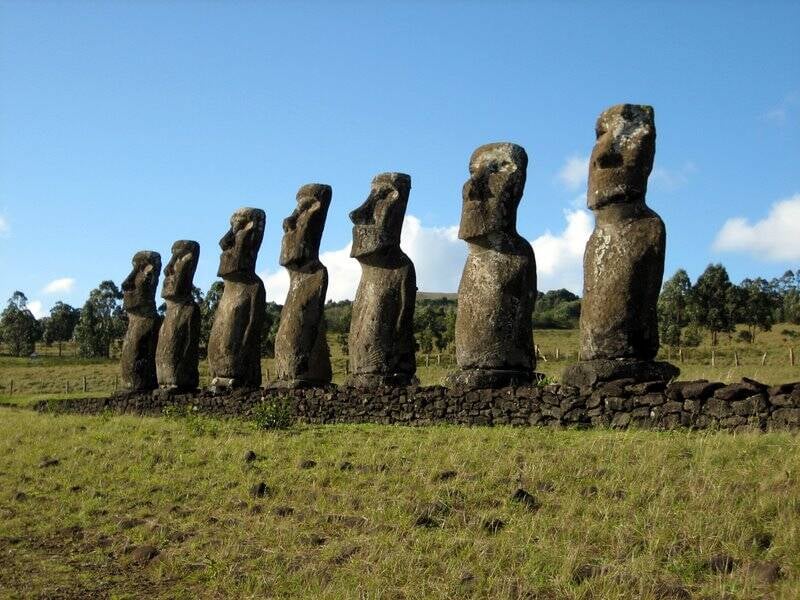
Ian Sewell/Wikimedia CommonsJust a few of the iconic moai statues that dot the landscape of Easter Island to this day.
Naturally, a number of questions about the moai have arisen over the years. Namely, how did the people living on Easter Island manage to move these giant statues without the benefit of modern technology? Could they have built giant wooden rollers? Or perhaps they “walked” the statues into place using an intricate system of ropes?
What’s more, why were the Easter Island statues built in the first place? And why were the moai knocked down sometime between when Roggeveen saw them standing in the 18th century and the end of the 19th century?
To this day, the moai of Rapa Nui — the indigenous name for Easter Island — remain an impressive sight and stand as some of the most famous statues in the world. Nevertheless, a number of intriguing questions remain.
Learn more about the music used in our podcast. History Uncovered is part of the Airwave Media network. Learn more about your ad choices by visiting megaphone.fm/adchoices.