As conditions in the Netherlands soured during the country's "Disaster Year" of 1672, Johan de Witt was attacked by a mob — then killed and cannibalized.
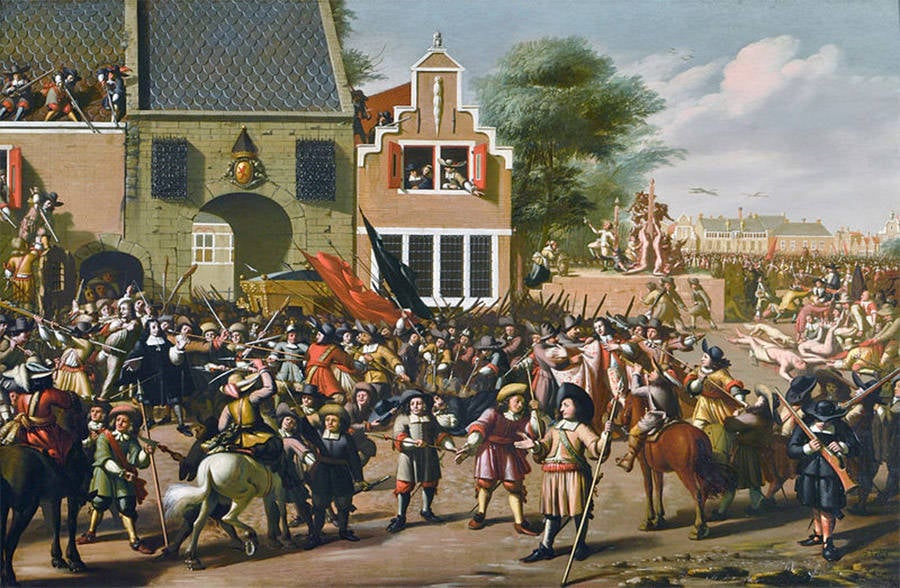
Wikimedia CommonsJohan de Witt and his brother Cornelis were killed by a mob in August 1672.
Johan de Witt was the last leader of the Dutch Golden Age, a skillful politician who helped grow the Netherlands’ naval power during the 17th century. But he’s best known for the gruesome way he died.
By 1672, the tides had turned against him. During the Netherland’s “Disaster Year” (Rampjaar), the country was threatened by invasions on multiple fronts, and many Dutchmen had thrown their support from Johan de Witt to the royal House of Orange-Nassau.
On an August day, the building resentment against Johan de Witt came to a head. Attacked by a mob, he and his brother Cornelis were beaten, stripped of their clothing, strung upside down — and cannibalized.
This is his gruesome story.
A Rise To Power During The Dutch Golden Age
Johan de Witt was born on Sept. 24, 1625, to the powerful De Witt family. His father Jacob was a prestigious politician, a six time-burgomaster, and Johan followed in his footsteps.
Well-educated, well-traveled, and well-read, Johan de Witt came to age during an important moment in the Netherlands’ history. He and his family were republicans who opposed the royal House of Orange-Nassau and the death of William II, Prince of Orange, in 1650 opened an opportunity for them to take power. Indeed, the prince’s death marked the beginning of the First Stadtholderless Period, an era of republican dominance.
It also overlapped with the tail end of the Dutch Golden Age, as well as Johan’s rise to power. In 1650, the year William II died, Johan became the pensionary of Dordrecht at the age of 25. Three years later, he became the Grand Pensionary, which effectively put him charge of the country.
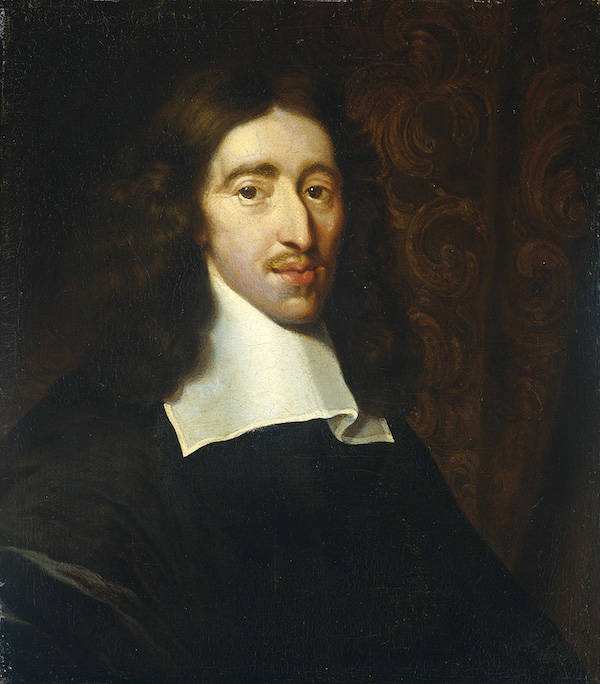
Wikimedia CommonsA portrait of Johan de Witt
He was reelected to the position three times – in 1658, 1663, and 1668.
During his reign, Johan de Witt was able to negotiate peace with England, restore the country’s finances, and oversee the Netherland’s prestigious and powerful naval power. Meanwhile, the Dutch Golden Age brought great prosperity to the country, which enjoyed dominance at sea as well as a richness of art and culture at home.
But the tides of history were changing.
The ‘Disaster Year’ And Johan De Witt’s Fall From Power
The Dutch Golden Age came to an end in 1672, a year known as Rampjaar or “Disaster Year.” As political alliances across Europe shifted, the Netherlands suddenly found itself facing invasion from England, France, and several German states. The mood in the country soured. And many Dutchmen began to question the leadership of Johan de Witt, who had been the Grand Pensionary of the Netherlands for almost 20 years.
Support began to grow for William III of the House of Orange-Nassau, who had been born a week after his father died back in 1650. At the same time, anger toward Johan de Witt began to spread.
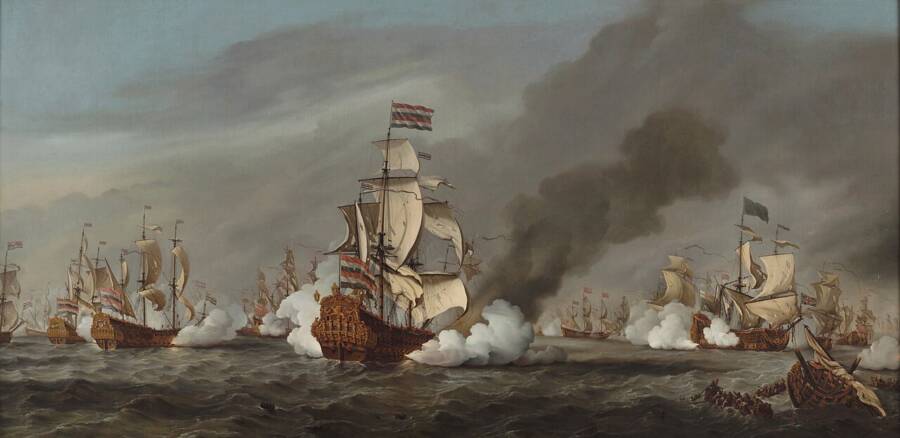
Public DomainA scene from the Third Anglo-Dutch War, which lasted from 1672 until 1674.
As Garritt C. Van Dyk, Senior Lecturer in History at the University of Waikato, wrote in The Conversation in 2025, a smear campaign against de Witt began to permeate the country. Pamphleteers claimed that he and his brother, Cornelis, were corrupt elitists and that Johan, unable to stop the coming warfare, was responsible for “all the bloodshed, killing and injuring, the crippled and mutilated people, including widows and orphans.”
On June 21, Johan narrowly survived an assassination attempt. On July 24, Cornelis was arrested for treason, tortured, and sentenced to exile. Shortly thereafter, Johan resigned from office.
But neither Cornelis nor Johan de Witt would escape the rage of the mob.
The Brutal Death Of Johan de Witt
On Aug. 20, 1672, Johan de Witt went to help his brother prepare to leave the country. But a mob — possibly organized by William III — was waiting.
In his 1850 novel The Black Tulip, the French novelist Alexandre Dumas offered a fictionalized account of what came next.
“Every one of the miscreants, emboldened by his [Johan’s] fall, wanted to fire his gun at him, or strike him with blows of the sledge-hammer, or stab him with a knife or swords, every one wanted to draw a drop of blood from the fallen hero, and tear off a shred from his garments,” Dumas wrote. “After having mangled, and torn, and completely stripped the two brothers, the mob dragged their naked and bloody bodies to an extemporised gibbet, where amateur executioners hung them up by the feet.”
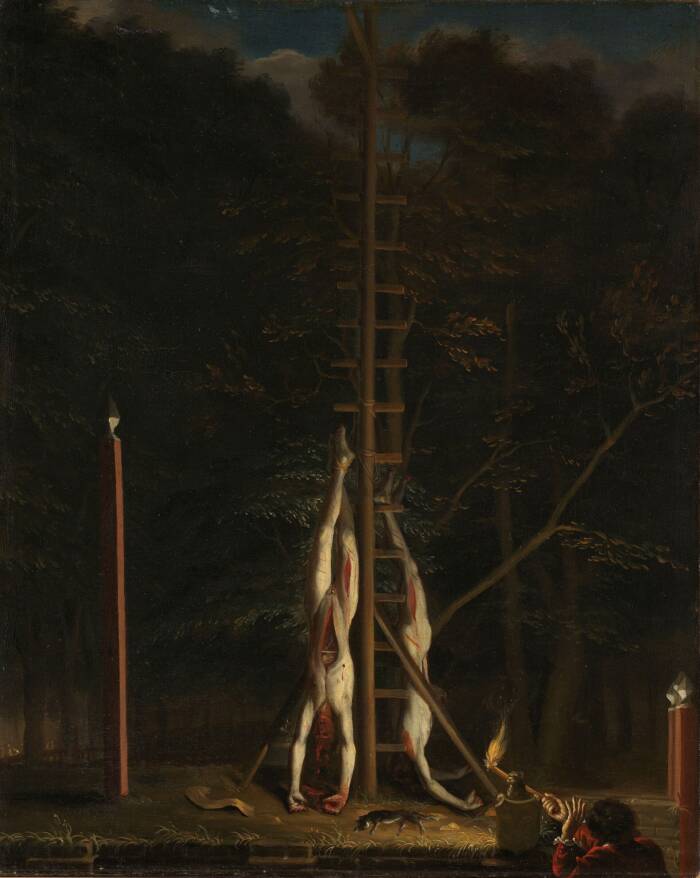
RijksmuseumA painting depicting the dead bodies of Cornelis and Johan de Witt.
Though his book was fiction, Dumas offered a vivid — and largely historically accurate — portrayal of what happened to Cornelis and Johan de Witt. They were set upon by the mob, which tore off their clothing, shot them, and hung them upside down. The mob then purportedly cut out the brothers’ livers, which they ate, and cut off their fingers, toes, ears, and eyeballs. In fact, the Prison Gate Museum in The Hague, Netherlands, reports that these body parts were then sold to the crowd: “A finger raised fifteen to twenty pennies, an ear twenty-five to thirty, and a toe raised ten pennies.”
The museum even holds a tongue and a finger in its private collection, kept in a box which also contains a short description of its contents: “This box contains / the wondrous part / of Jan de Witt.”
In the aftermath, William III was able to consolidate his power in the Netherlands. He subsequently married the daughter of the English king, Mary, which made him William III of England. He and his wife jointly ruled England as William and Mary until Mary’s death in 1694.
Johan de Witt, meanwhile, has faded into the background. Though a remarkable statesman in his time, and one of the few non-royals leaders in Europe in the 17th century, his life and accomplishments have been overshadowed by his death. In 1672, the “Disaster Year,” he became a victim to changing political tides, shifting geopolitics, and a violent smear campaign.
He’s far from the only European leader to meet a grisly end, but Johan de Witt’s death stands as one of the most gruesome in modern history.
After learning about Johan de Witt and his gruesome death in 1672, next read about Big Nose George, the Wild West outlaw who was killed and turned into shoes. Then discover the story of Hypatia of Alexandria, the Ancient Greek intellectual killed for her beliefs.