The stele dates to between the first and third centuries C.E. and depicts a man and a woman alongside an inscription in Greek.
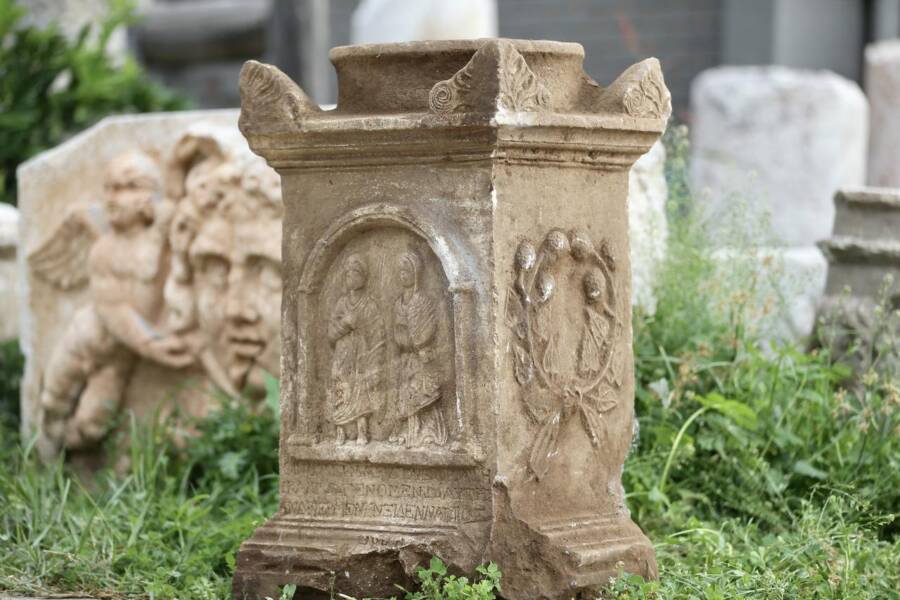
AA PhotoArchaeologists suspect that the stele was erected to commemorate a respected person in Roman society.
While tending to his flock near Kayacik, Turkey, a goat herder stumbled across something in the ground. By chance, the man had discovered a 600-pound, 2,000-year-old Roman funerary stele with ornate carvings and an inscription in Greek.
The stele — which is both especially ornate and extremely heavy — was recovered by a team of archaeologists who responded to the scene. While such objects have been found in Anatolia before, this one stands out because of its detailed carvings and Greek epitaph.
The Discovery Of The Roman Funerary Stele Found In Turkey
According to Türkiye Today, the goat herder and his animals were making their way through the woods in the rugged highlands of the Seydikemer district in Muğla Province, Turkey, when something wedged in the soil caught the man’s eye. It was a 2,000-year-old stone funerary stele in the shape of an altar, which he swiftly reported to the Fethiye Museum Directorate.
But when archaeologists arrived on the scene, they found that recovering the stele would be a challenge: The stone object weighed more than 600 pounds. For that reason, the experts first secured the site by burying the stele and installing motion-detecting cameras, then returned to recover it.
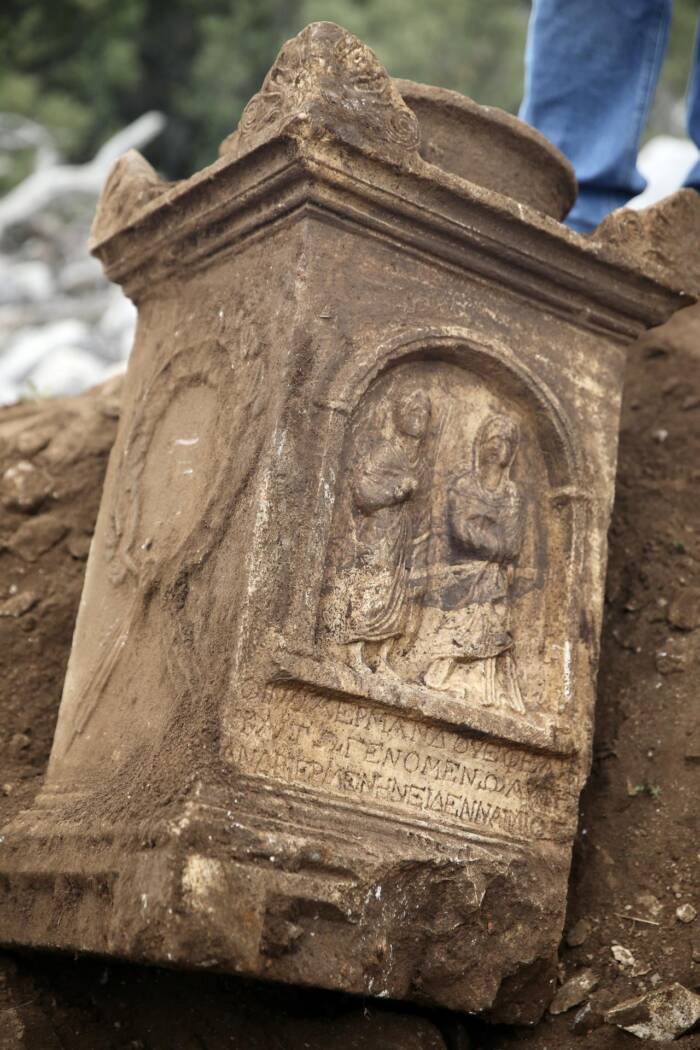
AA PhotoThe Roman funerary stele weighed more than 600 pounds and was found in a remote location, making its recovery challenging.
Even then, however, transporting the stele to the Fethiye Museum was a challenge. It was located in a remote area that could only be reached by a 45-minute hike. Ultimately, the recovery team had to slowly transport the stele by hand, a process that took seven hours and required them to traverse the rugged terrain while carrying the heavy object.
At that point, experts could study the funerary stele more closely. They found that it dated back to between the first and third centuries C.E., the Roman period, and that it likely marked the grave of an important person.
The Ornate Roman Funerary Stele That Once Belonged To A Respected Citizen
Upon studying the object, archaeologists determined that it was roughly 2,000 years old and similar to other altar-shaped Roman funerary steles that have been found in the region. However, this one is especially ornate.
Its carvings include a man and a woman, both of whom are dressed and styled in a Roman fashion, as well as a wreath. The people seem to be part of a family portrait, and the wreath suggests that the stele marked the grave of a respected person in Roman society. According to archaeologist Ahmet Meke, the inscription on the stele, written in Greek, also contains information about the deceased, but it is still being studied.
The stele likely originated in the ancient Lycian city of Kadyanda, where, despite the Roman presence, a strong Greek-speaking Hellenistic culture endured. The Greek epitaph suggests that Greek remained the primary language for commemorating the dead.
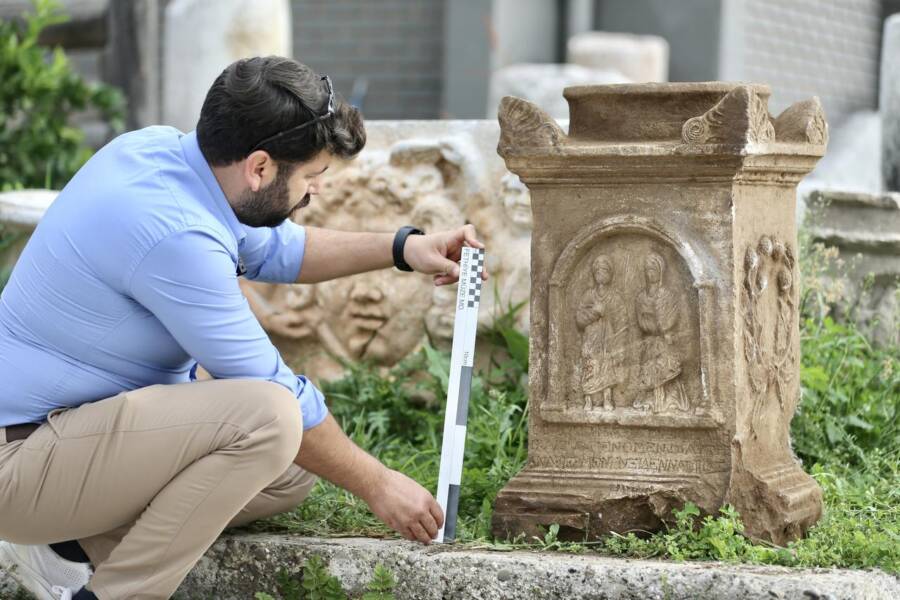
AA PhotoThe Roman funerary stele is similar to other steles found in Anatolia, but it includes more ornate carvings.
Both the stele and the site where it was found are set for further study. In the meantime, the stele stands as just the latest Roman-era discovery from Turkey. In this year alone, archaeologists have also excavated a 1,500-year-old mosaic beneath an abandoned mill, a sprawling 1,700-year-old Roman bathhouse, and a 2,000-year-old Roman villa complete with a fish pond.
Such a wealth of historical artifacts in Turkey is hardly a surprise, given that the Romans began their conquest of the region while still in the period of the Roman Republic. It’s all but guaranteed that more Roman sites and artifacts will come to the surface. And, as in the case of the Roman funerary stele, it won’t always require archaeologists to dig them up.
Given the deep legacy of Roman rule in Turkey, even a goat herder taking his animals on a stroll through the woods has the potential to discover an incredible 2,000-year-old relic.
After reading about the Roman funerary stele that was found by a goat herder in Turkey, discover the story of Derinkuyu, Turkey’s fascinating ancient underground city. Or, go inside the history of some of the world’s lost cities.