The bronze fragments of this medieval weapon appear to date back to 1390, which would make it almost a decade older than the earliest-known handgun up to now.
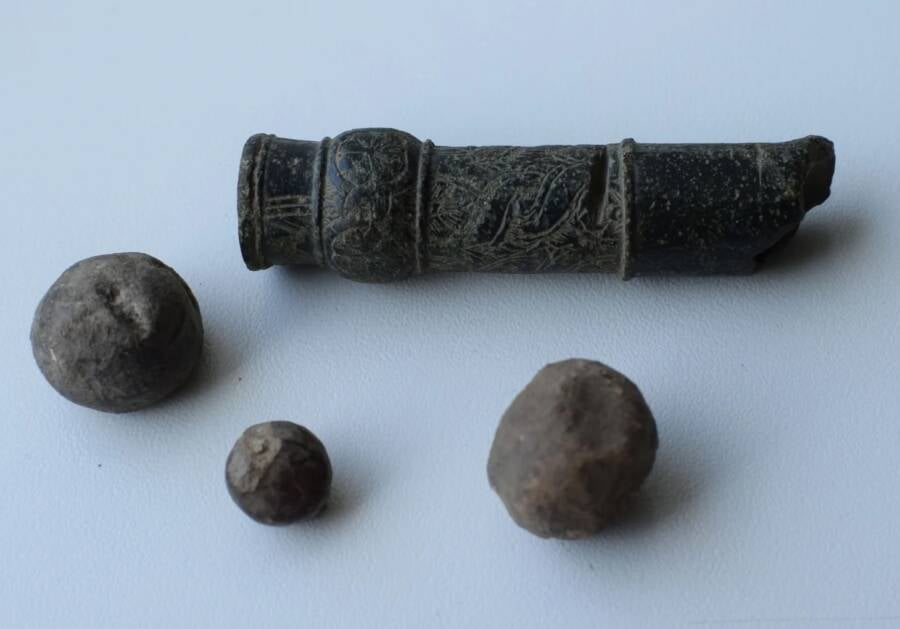
Prignitz DistrictThe bronze fragment of the “hand cannon” found near Germany’s Kletzke Castle.
When a volunteer archaeologist working near Kletzke Castle in Brandenburg, Germany spotted some fragments of bronze, he suspected that they could be important. But these bronze pieces have proven to be even more significant than anyone could have thought. Not only did they belong to a medieval weapon, but they seem to be from the oldest known European handgun ever documented.
What’s more, researchers suspect that this 600-year-old “hand cannon” could have played a role in an especially violent and dramatic moment in Brandenburg’s history.
The Discovery Of What May Be The Oldest Handgun Ever Found In Europe
According to a statement from the Prignitz District, the handgun was found in several pieces at Kletzke Castle by a volunteer named Matthias Dasse during a field survey in 2023. Dasse quickly turned in this “artfully decorated” bronze fragment, which was then identified as the front part of a rudimentary firearm.
While the find itself is undoubtedly exciting, it’s the age of this handgun that has proven to be the most significant aspect of this discovery. Archaeologists believe that it dates back to 1390, which would make it nine years older than the “Tannenberg rifle,” currently considered the oldest firmly-dated handheld firearm ever found in Europe. If the Kletzke Castle gun is indeed from 1390, however, that would make it Europe’s “earliest known archaeological evidence of the use of portable black powder weapons.”
Furthermore, archaeologists suspect that this firearm may have been used in a bloody siege of Kletzke Castle that occurred in 1390.
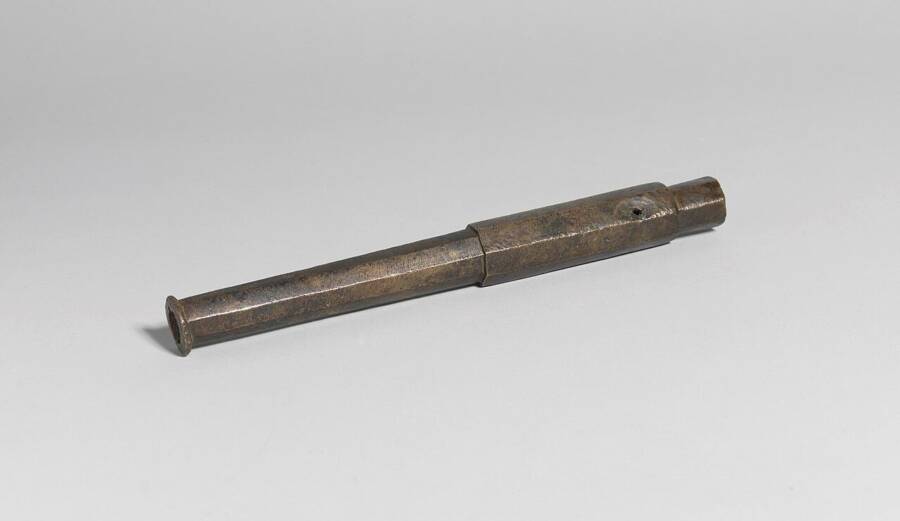
Germanisches NationalmuseumPreviously, the so-called “Tannenberg rifle” (above) has been considered the oldest firmly-dated handheld firearm in Europe, but the Kletzke Castle rifle now appears to be nine years older.
“If this rifle dates back to the siege of 1390, it would be spectacular for Brandenburg,” said Christof Krauskopf of the Brandenburg State Office for Heritage Management and Archaeological State Museum. “We have no written or archaeological evidence of firearm use from that period; until now, we could only assume it in general terms.”
The Handgun’s Likely Role In The 1390 Siege Of Kletzke Castle
At the end of the 14th century, Germany was a scattered collection of disparate states, a far cry from the unified country it is today. The siege of Kletzke Castle came out of this chaos, when the stronghold became the nexus of a violent regional conflict that broke out in 1390.
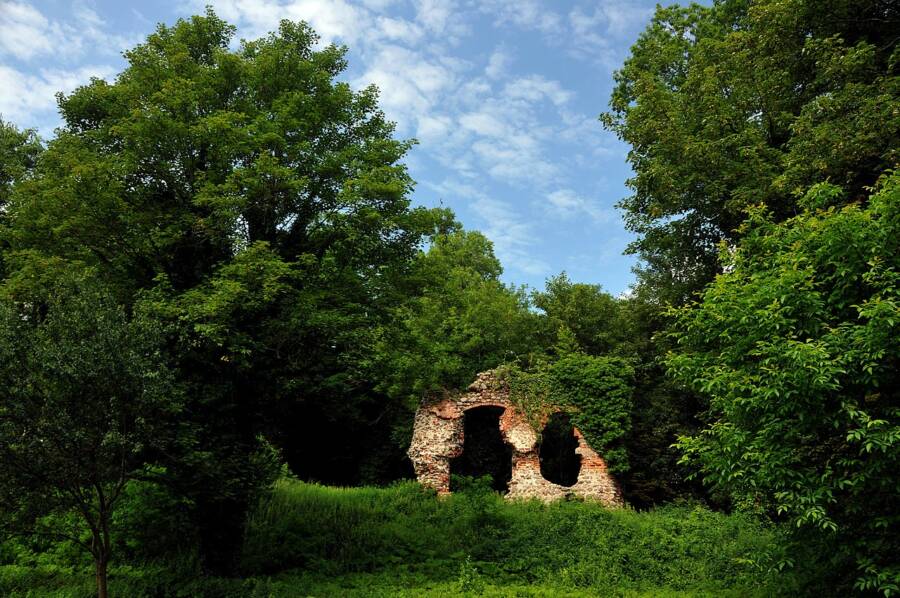
Axel Bublitz/Wikimedia CommonsThe ruins of Kletzke Castle in Brandenburg, where the handgun fragments were found by a volunteer.
As recorded by a Franciscan monk named Detmar of Lübeck, the siege began when two dukes, Henry I of Brunswick-Lüneburg and Eric IV of Saxe-Lauenburg, joined forces and marched to the castle with 1,100 men. The castle was held by the von Quitzow family, who had been gifted the stronghold by Emperor Charles IV in 1375.
The von Quitzow family — which would grow so powerful in the 14th and 15th centuries that this period became known in Brandenburg as the “Age of the von Quitzows” — defended their castle and repelled the attacking dukes. This victory helped cement their power in the region.
They would go on to acquire other castles, though the original Kletzke Castle from the 1390 siege no longer exists. A new castle was built at the site of the old one in 1520, and this castle was replaced by another one in the 19th century. However, it was demolished in 1931, and only ruins now remain.
And what about the handgun found at the site?
Because analysis shows that it was not made locally, archaeologists suspect that the bronze handgun was brought to Kletzke Castle by the attackers. Given its decorative elements, and the relative novelty of handguns in Europe at the time, it was undoubtedly a flashy weapon in its day.
While the exact fate of the gun’s owner is unknown, it seems that something ultimately went very wrong for them. During the failed siege of Kletzke Castle, the bronze handgun was left behind, perhaps when its owner was killed.
In the end, the von Quitzow family triumphed, and the bronze fragments of what may be Europe’s oldest handgun would be swallowed by the surrounding woods for the next 633 years.
After reading about the medieval handgun that was found by a volunteer at a ruined castle in Germany, discover the story of the Schwerer Gustav gun, the fearsome Nazi cannon that was the biggest in the world. Then, learn about the Paris Gun, the largest weapon to be used during World War I.