The Motherboard Earth Theory posits that our planet is, in a sense, a giant computer.

@filspixel TikTok/vipman4 Adobe StockTikToker @filspixel details the “Motherboard Earth” theory, which posits that our planet is a giant computer.
As artificial intelligence creeps into more and more aspects of our lives, some are looking at ancient structures and wondering if we’ve done all this before. There’s a new theory that has the internet talking, and it involves rethinking the purpose of both ancient structures and the Earth itself. It’s called the “Motherboard Earth” theory.
A common question when looking at ancient structures is, simply put, why? Why were they made to look that way — and why were they made in the first place?
While it’s easy to figure out the purpose behind some ancient buildings, others continue to baffle archaeologists. For example, was this Roman structure from the 2nd century C.E. a religious site or simply the beachside villa of an aristocrat? And what was the true purpose of Stonehenge?
Some say the Motherboard Earth theory could offer some answers.
The Motherboard Earth Theory: Are We Living On A Big Computer?
Naturally, questions like those above can easily attract conspiracy theorists.
TikTok user Filip Zieba, for instance, recently explained the “Motherboard Earth” theory in a video with more than 899,000 views. The theory posits that our planet is, in a sense, a giant computer.
“We are living on a giant motherboard, and ancient structures were built as circuit boards to harness the Earth’s natural energy to power civilization,” Zieba summarizes.
Evidence for this claim, Zieba says, includes the large variety of ways in which human creations resemble electrical components, or the ways in which our technology interacts with the natural forces and characteristics of our planet itself.
For his first example, Zieba shows a picture of a Schumann resonator. This is a device that generates or interacts with low-frequency electromagnetic waves around 7.83 Hz, often called the “heartbeat of the Earth.”
Although this was first measured in the early 1960s, Zieba notes that a resonator used to produce or interact with this signal shares the exact same shape as the floor of the Chartres Cathedral in France, which was completed in the 13th century.
Further evidence for this theory, he says, comes from ancient structures, which often resemble modern components on printed circuit boards (PCBs).
Some adherents to this belief, Zieba continues, say that these structures could be signs of ancient development of superhuman or alien technology. Alternatively, it could be evidence of a past version of humanity that mastered artificial intelligence, became enslaved to it and then was wiped out alongside the AI in some catastrophic event. The structures themselves would have served as components for this AI.
To conclude, Zieba states that this is mostly just an interesting “internet rabbit hole,” even if some individual details are compelling.
How The Chartres Cathedral Factors Into The Motherboard Earth Theory
As with any theory involving aliens or super-intelligence, there are a few key points that make the whole theory suspect.
For example, in his video, Zieba shows a Schumann resonator circuit board and claims that it identically — and mysteriously — matches the floor pattern at the Chartres Cathedral.

Mick Haupt/UnsplashThe Chartres Cathedral was designed to represent a pilgrimage.
However, this is actually an intentional Easter egg. If one looks closely at the circuit boards that he features in his video, they are all labeled as having a “Chartres” pattern, referencing the cathedral.
It’s not a requirement that the resonator bear this shape, only a choice of the creator. There are plenty of other Schumann resonance emitters on the market that instead use a simple spiral.
But why does the Chartres Cathedral floor look like that in the first place? According to the cathedral’s website, it is intended to represent a pilgrimage. While walking the path, guests can meditate on their own existence and, for Christians, how the trials and tribulations of their lives led them to Christ. This is a pretty far cry from being a component in a battery or circuit board.
Are Ancient Buildings Similar To PCBs?
When looking at ancient structures, it’s easy to see the similarities to PCBs, as the TikToker points out in his video.
This is simply a coincidence. One way to disprove this theory is by noting the selection bias. For example, there are countless ancient cities that look nothing like circuit boards — and plenty of modern cities that do appear circuit-like, despite not being built with any influence from aliens or artificial intelligence.
The city of Erbil in Iraqi Kurdistan, for example, has been continuously populated for more than 7,000 years. From above, the city looks nothing like a circuit board, with an oblong circular shape divided into uneven fractions.
In contrast, China’s Xiong’an New Area, which only broke ground in 2017, has many of the hard angles and straight lines associated with PCBs.
To be clear, architects for the latter project have not claimed that they are attempting to build an alien battery. Instead, this and the other PCB-like cities are simply examples of pareidolia, which is when our pattern-loving brains find familiar shapes in unfamiliar objects — for example, seeing a face in the clouds or seeing a circuit board in a city built generations before humans harnessed electricity.
Further complicating matters is that the PCB wasn’t even invented until the early 1900s. Many early PCBs looked nothing like ancient cities, with significantly more curved lines and rough edges than the angular structures of ancient temples and fortresses.
The Meaning Behind Shapes And Numbers Used In Ancient Architecture
This isn’t to say that there were no ancient structures with deeper meanings or purposes.
For example, the Maya city of Chichén Itzá is thought to have been founded as early as 400 C.E. While none of its structures were designed to act as a circuit board or battery, there was certainly careful thought put into their construction.
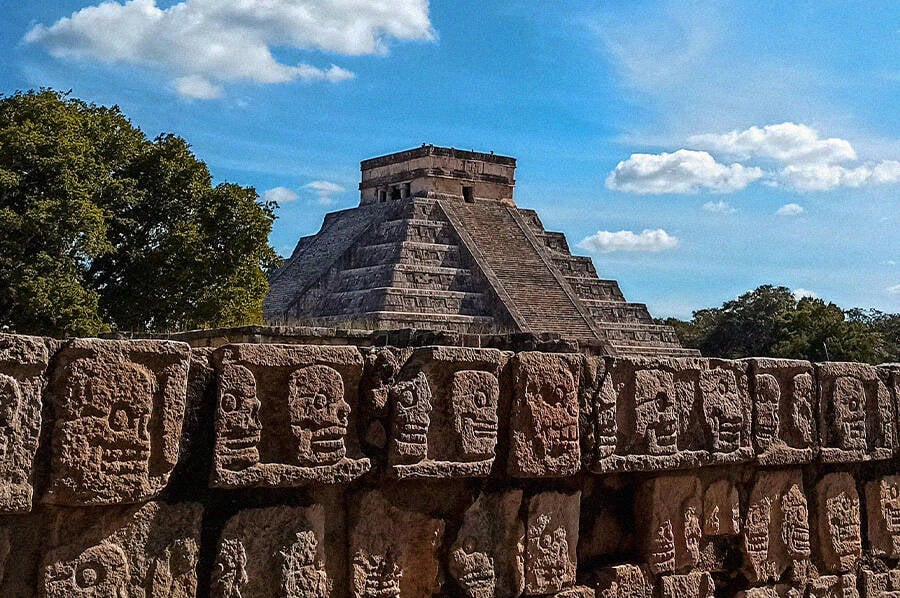
Alexiz Mora/UnsplashThe Maya likely intentionally incorporated calendar and seasonal knowledge into the architecture of Chichén Itzá.
For example, the number of stairs on the Temple of Kukulcan added up to 365 — the number of days in the Maya calendar. Not only that, but the design of the temple gave the illusion that, over the course of the day, the shadow of the serpent deity Kukulcan was slithering down the stairs.
@filspixel Day 743 of “Ok I usually like your theories but you lost me with this one” coded (this one might be real though idk) #interesting #theory #motherboard #pyramids #mindblown Disclaimer: Just a speculative theory, entertainment purposes only, satire, fictional story, etc.
All That’s Interesting reached out to Zieba via email.
There have also been countless religious monuments built throughout history with specific shapes signifying a connection to a higher power: not electrical, but spiritual. In other words, the mystery may not actually be whether ancient people were secretly building computers — but instead, how and why they were building things that are so impressive without them.