This rare bronze relic is just one of only three ever found in England and is the most complete artifact of its kind unearthed anywhere in Europe.
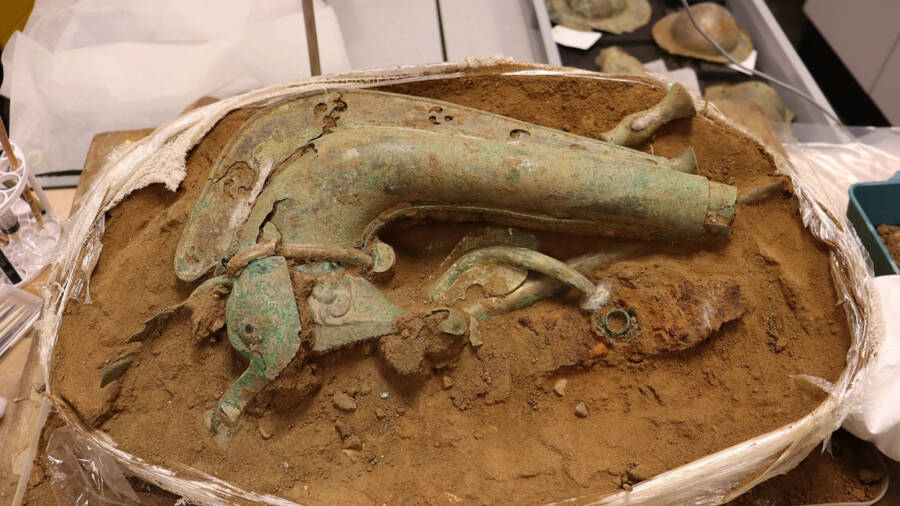
Norfolk Museum ServiceThe Iron Age battle trumpet, or carnyx, found in West Norfolk.
A routine archaeological excavation in West Norfolk has yielded the “extraordinary” discovery of an Iron Age war trumpet with possible links to the Celtic tribe led by Boudica.
The instrument, known as a carnyx, is just the third one found in Britain and the most complete example found anywhere in Europe. These bronze instruments were used by Celtic tribes to intimidate their enemies – namely, the Romans – during battle.
It was found alongside a collection of other Iron Age artifacts, including pieces of another carnyx, five shield bosses, and a bronze boar’s head battle standard.
The “Once-In-A-Career” Discovery Of A Celtic Carnyx In West Norfolk
The collection was uncovered last summer during archaeological excavations ahead of a new housing development.
This discovery was made in a region that was once within the territory of the Iceni, the Celtic tribe led by Queen Boudica that fought a fateful rebellion against the Roman army in 60 C.E.
While conservation work is still being conducted, researchers said they believe the hoard was buried in the first century C.E. – meaning it could have connections to Boudica’s tribe. That potential link is certainly exciting for historians and underlines just how significant this discovery might prove to be.
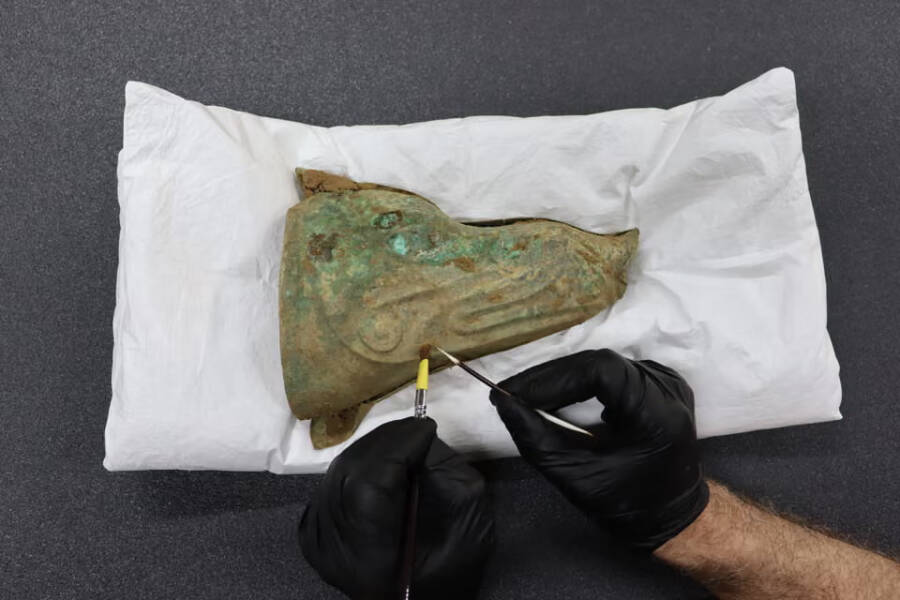
Norfolk Museum ServiceThe boar’s head battle standard found alongside the trumpet.
Mark Hinman, chief executive of Pre-Construct Archaeology, which made the discovery, told The Guardian that this was “a once-in-a-lifetime, once-in-a-career find.”
“I’ve been doing archaeology for over 40 years,” he added, “and I’ve never seen anything like this.”
Experts noted that the objects are incredibly fragile, and as such the conservation effort is a slow-moving, delicate process. Once it is done, though, they will be able to conduct a more thorough, full analysis of these ancient artifacts.
“The full research and conservation of these incredibly fragile remains will reshape our view of sound and music in the Iron Age,” Dr. Fraser Hunter, Iron Age and Roman curator at National Museums Scotland, told Euronews.
“The carnyces and the boar-headed standard are styles well known on the continent and remind us that communities in Britain were well-connected to a wider European world at this time.”
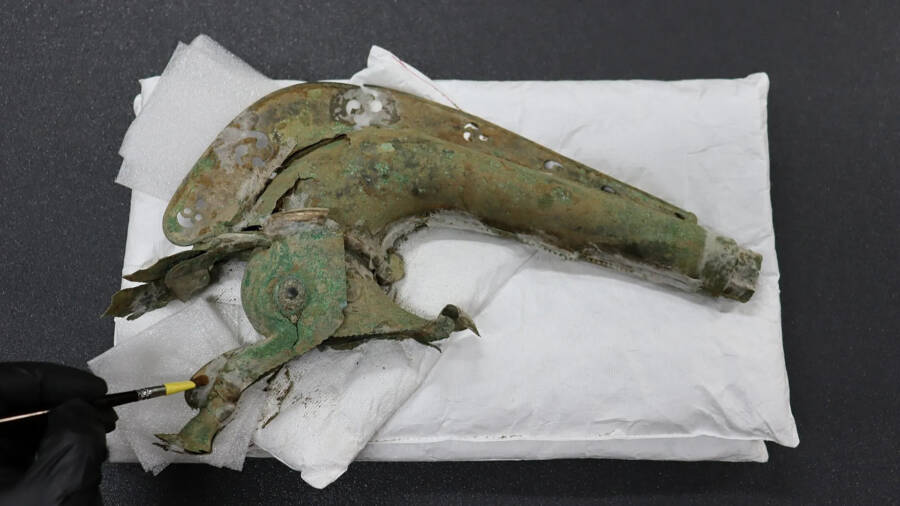
Norfolk Museum ServiceIt is the most complete example of an Iron Age carnyx ever found.
Hinman also noted that the newly discovered carnyx exhibited signs of repair, suggesting that it had been used over a long period of time. Its burial was also quite deliberate, as it was partially dismantled and covered by the shield bosses. Still, it is far more complete than any other known example and offers unique insight into Britain’s Iron Age past.
“Objects like this remind us how little we know about so many different aspects of our past,” Hinman said. “These objects had names, people thought they were imbued by power. They may even have thought that they were alive at certain times in their existence – and all of the stories that go with them are lost.”
Once conservation work is complete, Hinman said that exploring the potential links to the Iceni “is an obvious question and one that we will definitely be focusing on once we’re able to get closer to the objects.”
Potential Links To The Celtic Queen Boudica
The Iceni were a powerful Celtic tribe (or civitas) inhabiting the region of modern-day Norfolk and parts of Suffolk in East Anglia during the Late Iron Age.They were known to be a wealthy people, largely due to their control of fertile agricultural land and extensive trade networks across the North Sea.
They initially allied with Rome during Claudius’ invasion of Britain in 43 C.E., but the relationship remained tense and dependent on the whims of the Roman administration.
In the wake of the Roman conquest, the Iceni were ruled by King Prasutagus, Boudica’s husband. In an attempt to secure the future of his family and kingdom, Prasutagus made a will naming the Roman Emperor Nero as co-heir to his estate, alongside his two daughters. He likely believed this would preserve the dynasty and appease Rome.
However, upon Prasutagus’ death around 60 C.E., the will was blatantly ignored. Roman financial officials treated the kingdom as a conquered territory rather than a client state. Roman law did not recognize the right of a daughter to inherit royalty, allowing the annexation of the entire Iceni kingdom. It is reported that Boudica was flogged, and her two young daughters were raped by Roman slaves.
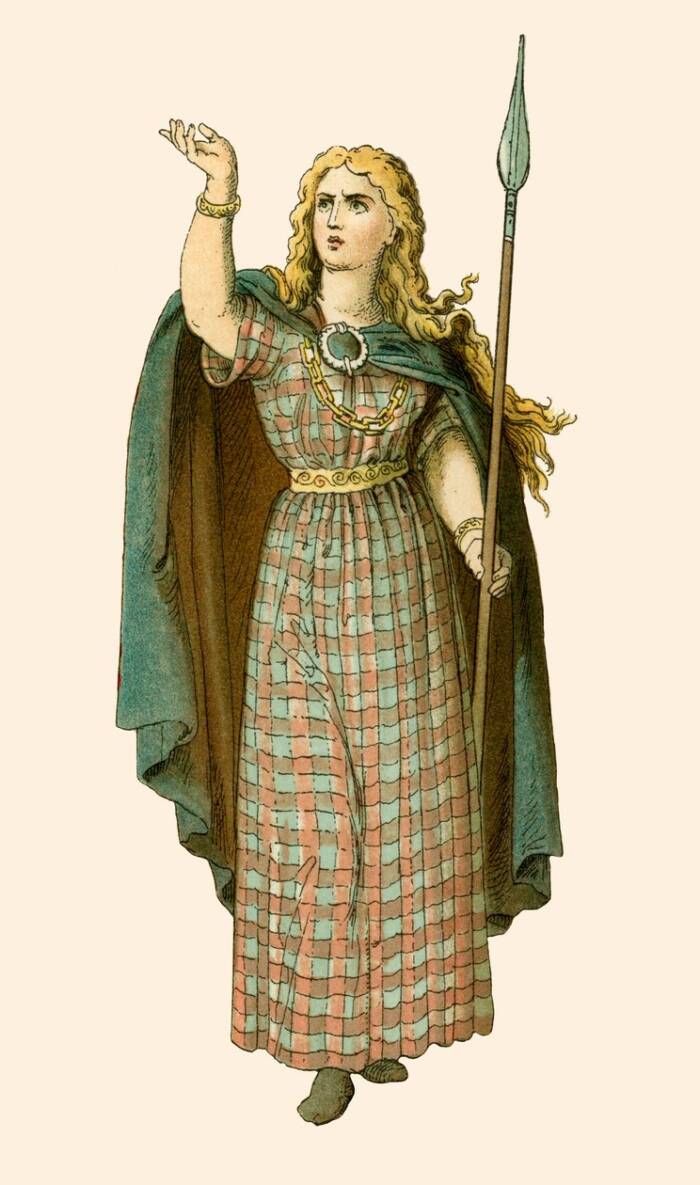
Wikimedia CommonsAlbert Kretschmer’s 1864 illustration of Queen Boudica.
These atrocities were the breaking point.
Boudica, described by the Greek historian Cassius Dio as possessing “greater intelligence than often belongs to a woman,” rallied not only the Iceni but also the neighboring Trinovantes tribe. The Trinovantes had their own grievances, particularly regarding the Roman seizure of lands to build the temple of Claudius at Camulodunum, which served as a center for the Imperial cult and a symbol of their oppression.
Though their rebellion ultimately failed and Boudica likely took her own life, her place in history as both a fierce warrior and a tragic leader remains to this day – and this is why the trumpet’s potential link to her tribe has fascinated historians so greatly.
“It’s hard to describe,” Hinman said of the carnyx, “but you kind of feel like it’s looking back at you. It’s quite a thing.”
After reading about this new discovery from West Norfolk, learn about 11 of the most terrifying creatures from Celtic folklore. Then, learn about the Celtic tradition of Samhain, the precursor to Halloween.