Dating back to sometime between 20 and 50 C.E., the cargo found at the bottom of Lake Neuchâtel includes everything from amphorae to chariot pieces to ceramic plates and bowls.
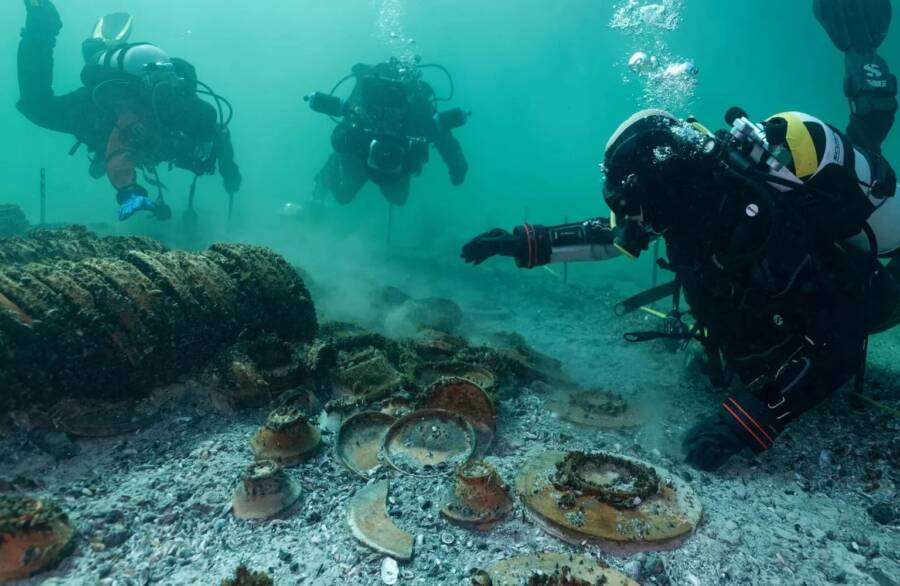
Octopus FoundationDivers investigating some of the Roman cargo discovered at the bottom of Lake Neuchâtel.
While checking up on the ecological health of lakes and certain submerged areas in Switzerland, officials noticed a strange shadow on the bottom of Lake Neuchâtel. Upon further examination, they found a wealth of Roman artifacts that were seemingly lost in a shipwreck roughly 2,000 years ago.
These artifacts include amphorae for transporting olive oil and wine, pieces of chariots, and two short swords known as gladii. This suggests that either the ship had an armed escort, or that it was part of a legion en route to protect the frontiers of the Roman Empire.
Though divers have now recovered hundreds of artifacts from this ancient vessel, much about its story — and its likely tragic end — remain shrouded in mystery.
The “Exceptional” Roman Cargo Discovered At The Bottom Of Switzerland’s Lake Neuchâtel
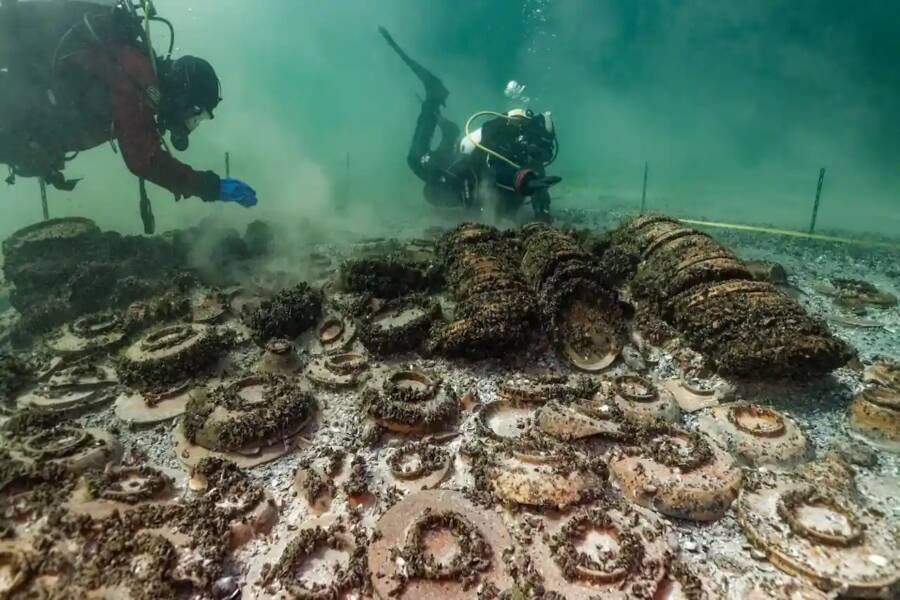
Octopus FoundationDivers found a wealth of artifacts, including a number of ceramic items like plates, platters, and goblets.
The documentation and recovery of the Roman cargo found in Lake Neuchâtel was part of a joint effort between the Cantonal Office of Archaeology of Neuchâtel (OARC), the Octopus Foundation, and the Archaeological Service of the State of Fribourg (SAEF). After the cargo was detected via drone in 2024, they organized exploratory dives in the spring of 2025 to see what they could find in the wreckage.
Though the ship carrying the cargo has not been found, divers uncovered a wealth of Roman artifacts strewn across the lakebed. These include ceramics — platters, plates, bowls, and goblets — which seem to have been produced locally in the Swiss Plateau, amphorae for transporting olive oil or wine, utensils, various tools, and parts for harnesses and chariots, including a set of wheels “in a remarkable state of preservation.”
But perhaps the most fascinating artifacts found in Lake Neuchâtel were military objects. In addition to the ceramics and chariot parts, divers also found two short swords known as gladii, one still tucked in its wood-and-metal scabbard, as well as items used by Roman legionnaires, including a pickaxe, a belt buckle, and a fibula, a kind of brooch used to secure a garment in place.
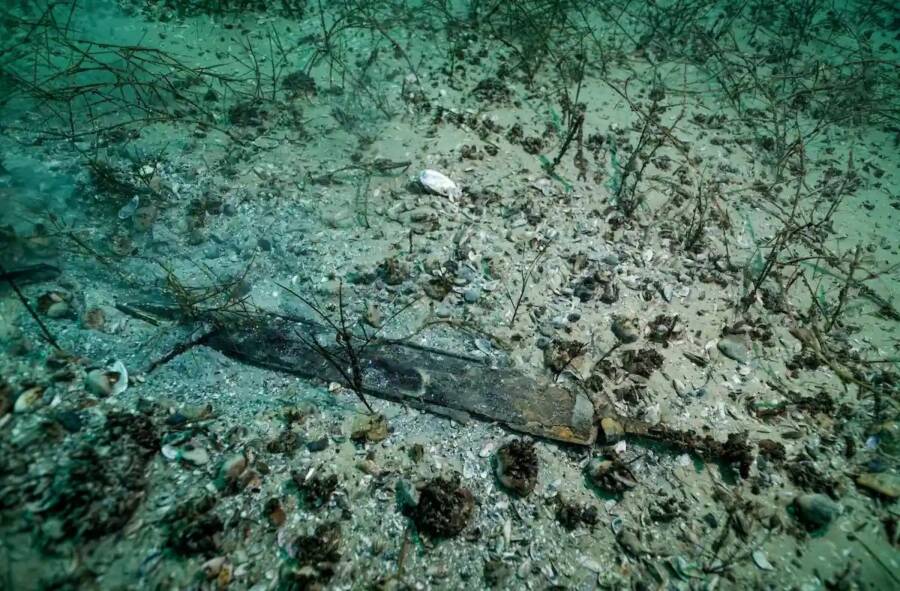
Octopus FoundationOne of the swords, known as a gladius, that was found amid the underwater wreckage.
Researchers were able to roughly date the wreck based on two items: the fibula and a plank of wood. Fibulas were not used in ancient Rome until the reign of Tiberius (14 C.E. to 37 C.E.) and a dendrochronological analysis of the rings in the plank suggest that the cargo dates back to at least 17 C.E. The ship itself may have sank anywhere between 20 and 50 C.E.
And while the Roman ship that was carrying the cargo has been lost to the ages, researchers have speculated about what it was doing when it set out to cross Lake Neuchâtel some 2,000 years ago.
The Possible Purpose Of This Lost Roman Ship
There are several possibilities that would explain the ship’s mix of civilian and military cargo. One is that the ship was a civilian merchant vessel with a military escort. The other is that the ship was carrying equipment for Roman legions posted along the Roman frontier.
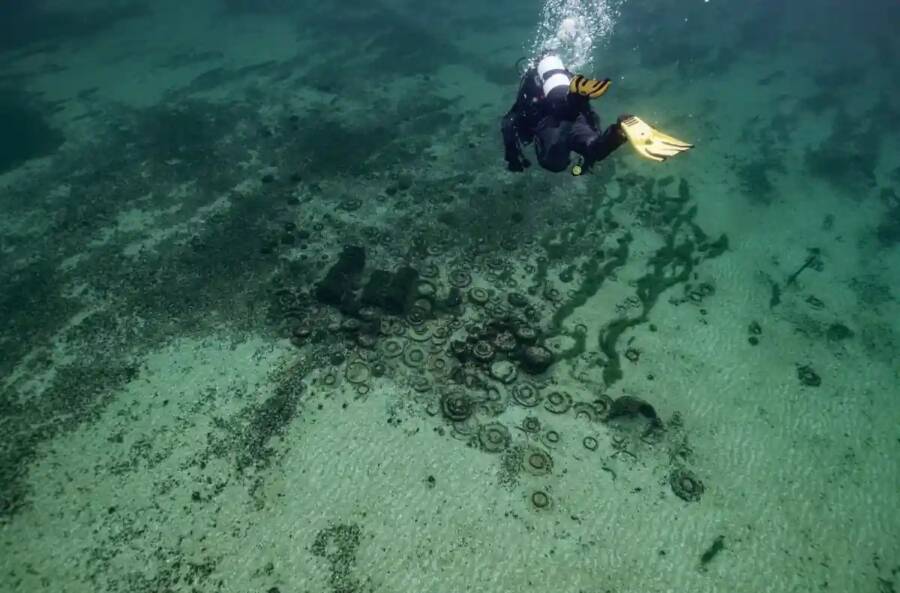
Octopus FoundationA diver swimming toward the Roman cargo found in Switzerland’s Lake Neuchâtel.
Indeed, the Roman cargo may date back to the time of the XIIIth Legion (Gemina), which was stationed along the banks of the Aare River in 16 C.E. Their mission was to prevent the southern incursion of Germanic tribes and to protect Alpine passes. They remained in their camp until 45 C.E.
Roman legions usually consisted of 5,000 to 6,000 men, so Rome would have needed to send huge amounts of supplies to support them. After gathering goods from Italy, Gaul, and Helvetia (modern-day Switzerland), the Romans would have likely consolidated it at Eburodunum, an ancient port on the southernmost tip of Lake Neuchâtel. From there, it would have been loaded into boats and sent north to Roman military camps.
Clearly something went wrong with the ship carrying the Roman cargo that was recently recovered from the bottom of Lake Neuchâtel, but researchers aren’t exactly sure if it sank. Because no trace of the boat itself has been found, it’s possible that the ship somehow managed to make it to shore — or that it simply sank somewhere else nearby.
Whatever happened to the ship may remain a mystery, but the cargo it left on the lakebed has offered a wealth of information about the Romans, their empire, and how they moved goods some two millennia ago.
After reading about the Roman artifacts from a shipwreck that were found on the bottom of a Swiss lake, learn about the factors that ultimately led to the collapse of the Roman Empire. Then, discover the chilling story of decimation, the brutal Roman military punishment that targeted an entire unit for one soldier’s cowardice or insubordination.