Tami Oldham Ashcraft was stranded in the middle of the Pacific Ocean in 1983 after a hurricane damaged her ship and killed her fiancé — but she was able to navigate to safety after 41 days.
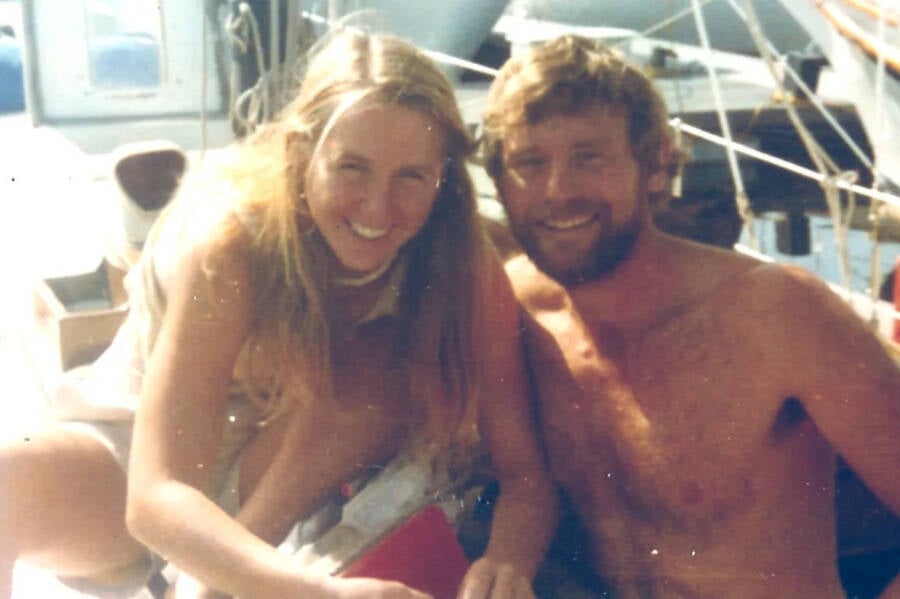
Tami Oldham AshcraftTami Oldham Ashcraft and Richard Sharp, just before setting out on their doomed journey.
The last thing Tami Oldham Ashcraft remembered before being knocked unconscious was hearing her fiancé scream. When she awoke 27 hours later, she was in the partially flooded cabin of their 44-foot yacht, surrounded by debris.
In the aftermath of an unexpected hurricane, her fiancé was gone. Their boat was badly damaged. And Ashcraft was stranded in the middle of the Pacific Ocean with no way to call for help.
Over the next 41 days, Ashcraft struggled to survive as she navigated back toward land, using nothing more than a makeshift sail, the stars, and a sextant. And survive she did.
Her experience is a masterclass in overcoming the physical and psychological toll of being lost at sea – one that has inspired people across the globe. This is the harrowing story of Tami Oldham Ashcraft, the true story behind the 2018 film Adrift.
Tami Oldham Ashcraft Prepares To Sail 4,000 Miles

Tami Oldham AshcraftTami Oldham Ashcraft and her fiancé Richard Sharp.
By the summer of 1983, everything in Tami Oldham Ashcraft’s life seemed to be falling into place. She’d gotten engaged to her fiancé, Richard Sharp, and the boat-loving couple spent their days days cruising around the South Pacific Islands on Sharp’s 36-foot sailboat.
Then, in September, a friend approached the couple and asked if they would deliver a 44-foot yacht, Hazana, from Tahiti to San Diego. Though the trip was over 4,000 miles, longer than they had ever gone at one time, the couple felt confident in their ability to do it.
At another time, perhaps they could have.
Tami Oldham Ashcraft and Richard Sharp set off from Papeete Harbor on September 22. But tragedy would sadly strike just a couple of weeks into their journey.
How Hurricane Raymond Killed Richard Sharp
By early October, Ashcraft and Sharp became aware of a powerful storm forming nearby. Though they tried to outrun the bad weather — which developed into a category-four hurricane, Hurricane Raymond — they couldn’t escape.
“We ran from it for three days trying to figure it out, because it kept changing direction,” Ashcraft told PEOPLE in 2018. “The storms are going twice your speed. We couldn’t make that kind of time with the boat to get out of the way.”
By October 12, they were right in the path of the storm. The couple attempted to weather it, donning raincoats and boarding up the yacht. As they did so, 40-foot waves and 140-mile-per-hour winds pounded against their vessel.
Their final moments together were a frantic scramble. As the wind howled and tossed the yacht about like a toy, Sharp told Ashcraft to seek shelter below deck, while he secured himself into a safety harness. As she closed the door, she heard Sharp shout “oh my god!” — and then the boat capsized. The force threw Ashcraft against the wall, knocking her unconscious.
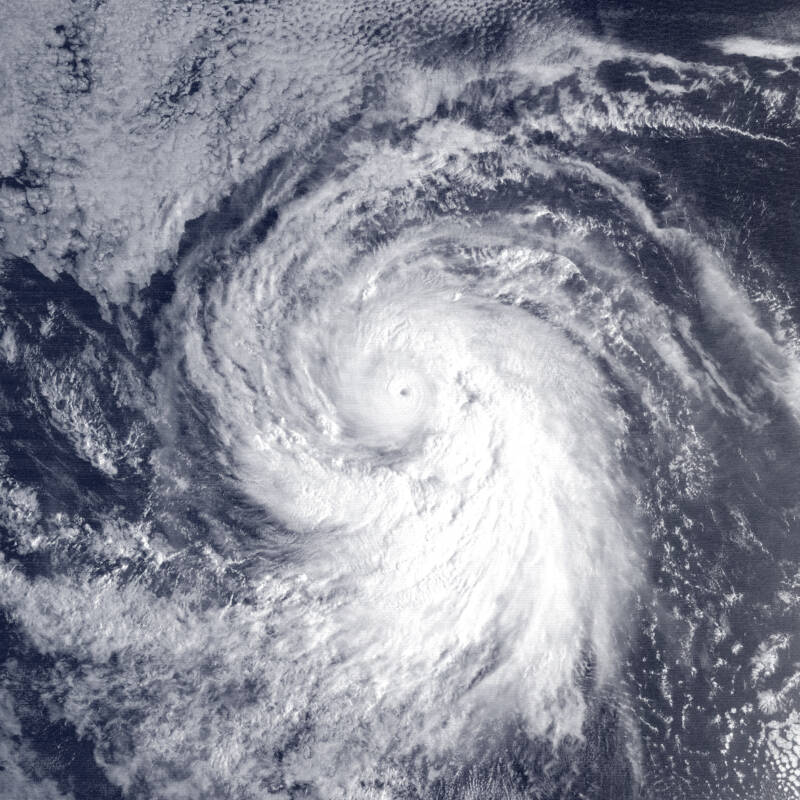
NASAAn aerial view of Hurricane Raymond.
Tami Oldham Ashcraft was out for 27 hours. When she woke up, she was surrounded by destruction.
The main cabin was filling with water, the ship’s masts were broken clean off, and the ship’s sails were dragging in the sea. Ashcraft also had a deep gash on her forehead. But the worst part was the silence, broken only by the lapping of water inside the boat.
Sharp was gone. Ashcraft later stated that she believes that the force of the wind was just too strong; he must have been thrown into the sea and pulled beneath the massive swells.
Yet despite the devastation, the ship was still afloat. Tami Oldham Ashcraft still had a chance to survive.
Tami Oldham Ashcraft’s Battle For Survival
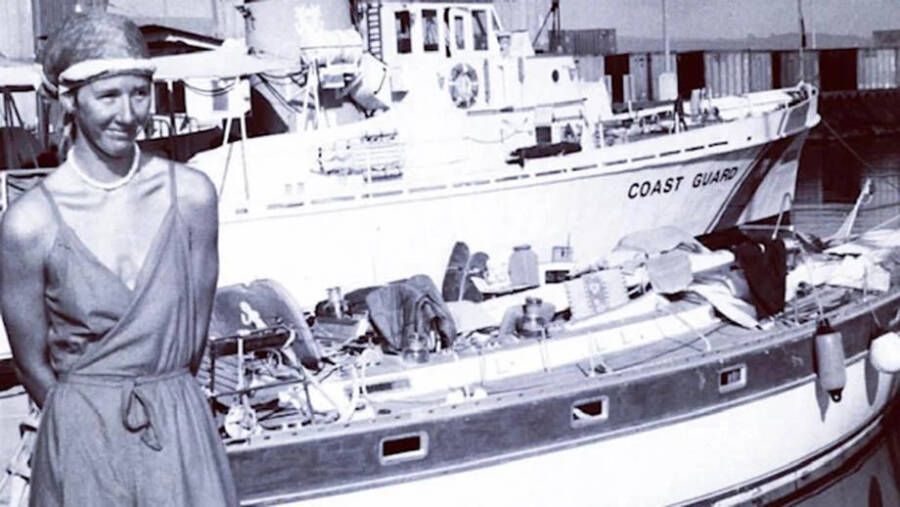
Tami Oldham AshcraftTami Oldham Ashcraft in Hawaii after the hurricane.
Tami Oldham Ashcraft didn’t have time to feel grief, or fear, or anything. Her yacht was sinking, the sails were all but gone, and the gash on her forehead was increasingly painful. Upon further investigation, Ashcraft also realized that the ship’s engine, navigation system, and emergency positioning devices were also badly damaged.
Grief had to be suppressed. The immediate threat was the sinking boat.
So Ashcraft leapt into action. She pumped water out of the hull by hand, a physically exhausting and seemingly endless task. And she fashioned a makeshift sail out of a broken pole and a storm jib.
Her next challenge was navigation. Ashcraft knew that the closest land was Hilo, Hawaii (1,500 miles away) but her only tools were a sextant and a watch. With no other choice, Ashcraft used these and celestial navigation to plot her course, painfully aware that if she missed Hilo, she would sail into open ocean — and perish.
41 Days Alone In The Pacific Ocean — And Then Rescue
Though the odds were against her, Tami Oldham Ashcraft survived.
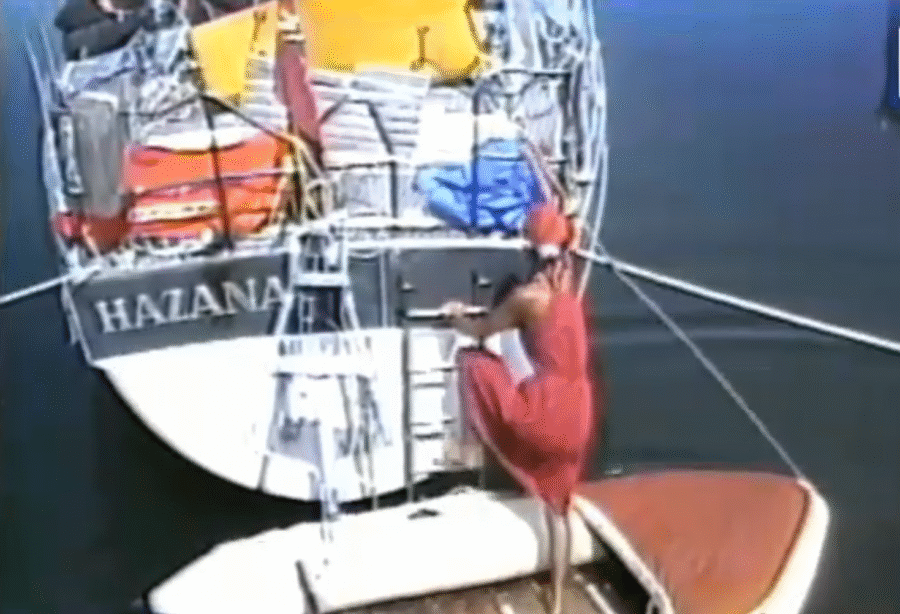
Hawaii News NowThe Hazana at port in Hilo, Hawaii.
Relying on her sextant, eating canned fruit salad and sardines, and hoping that she was navigating correctly toward Hawaii, Ashcraft spent 41 days at sea.
The loneliness was the worst part. For 41 days, she spoke to no one – no one who could speak back, at least. Her grief for Richard, which she had kept at bay through sheer necessity, began to surface in the quiet moments. She would talk to him, to the boat, to the sea — anything to break the silence. Her survival instinct, however, focused her mind, forcing her to concentrate on the next task, the next calculation, the next sunrise.
“I had to tell myself onboard that I couldn’t cry anymore, because I was losing way too much water,” Ashcraft told PEOPLE. “My water supply was very limited. I just had a big talk with myself. That inner strength to survive is so strong. You just don’t realize it, until you’re put in a really crucial time that you have to survive. It’s amazing what you can do. That just comes from within really. Then keeping your mind active.”
Then, on Ashcraft’s 41st day at sea, a Japanese research vessel spotted the Hazana drifting erratically just outside the harbor at Hilo. As they approached to bring the vessel in, they were astonished to find a living soul aboard.
Tami Oldham Ashcraft was safe, but she was emaciated, dehydrated, and traumatized by her experience.
Finding A New Purpose After The Storm
Though her experience was harrowing, Tami Oldham Ashcraft eventually found solace by writing her story down.
She couldn’t read for six years due to her head injury, but in the end she managed to put her entire story down on paper for her book Red Sky in Mourning: A True Story of Love, Loss, and Survival at Sea. It was ultimately translated into eight languages, published in fifteen countries, and made into a movie appropriately titled Adrift.
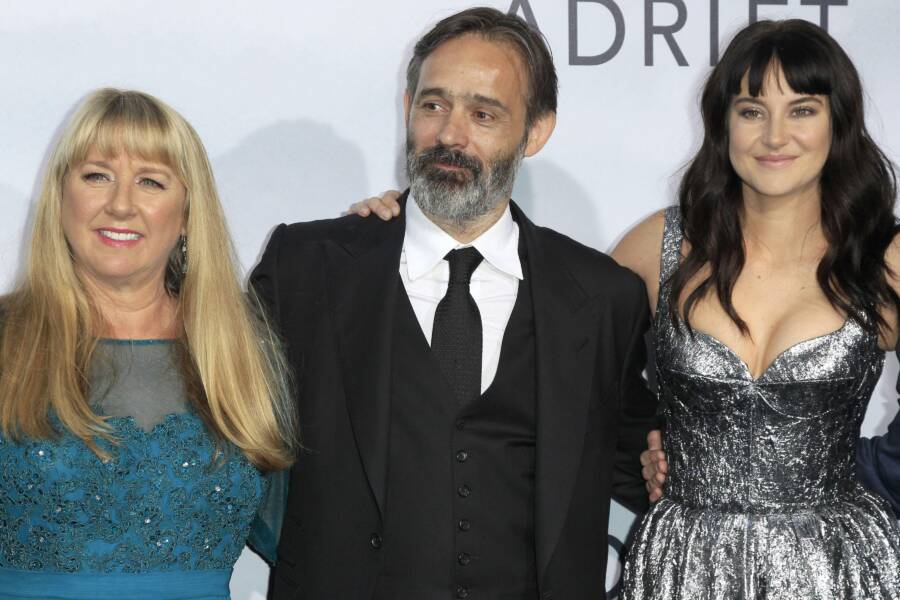
ZUMA Press, Inc./Alamy Stock PhotoTami Oldham Ashcraft at the premiere of Adrift alongside director Baltasar Kormakur and actress Shailene Woodley.
“Definitely the hardest part was dealing with Richard being gone,” Ashcraft later told the Chicago Tribune, in her first interview about her experience after her book was published. “There were times I didn’t even want to live anymore because I didn’t know how I was going to go on. I was never going to fall in love again.”
She continued: “Actually, while I was in the survival mode, the grief was fairly low. It wasn’t as intense as when I got to shore and the survival was over, and I could see people together and everything kept reminding me of him. I just really had a hard time. But that survival instinct [while at sea] just kicked in. It helped me to focus, to keep myself on track.”
Today, Ashcraft lives in the San Juan Islands, in Washington state, where she still sails regularly. Though she carries the trauma of her experience and the loss of Sharp with her, she’s also found peace. Ashcraft has gotten married, has two children, and is the picture of happiness.
The only sign of her survival at sea is a tiny sextant pendant, encrusted with a diamond, which she wears every day.
“It reminds me of how I got home,” she said.
After reading about Tami Oldham Ashcraft and the true story of “Adrift,” learn about the worst natural disasters in history. Then, check out these unbelievable survival stories.