Clips about a lost empire called Tartaria are racking up millions of views — but how much of the theory is true?
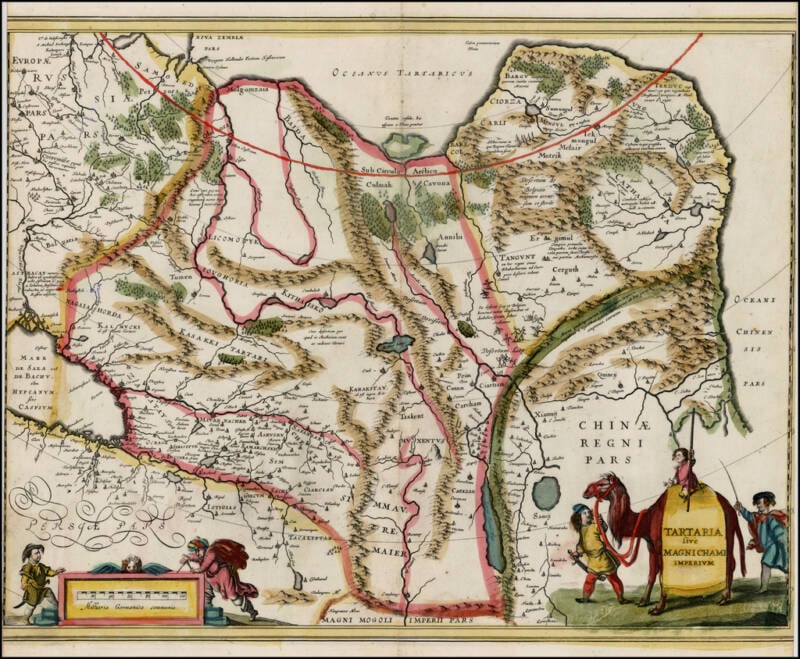
Public DomainA 17th-century map of Tartaria.
You know how some people can’t stop thinking about the Roman Empire? Well, for a growing corner of the internet, the Romans are yesterday’s news. The civilization that captures their imagination is one you’ve probably never heard of — and according to one theory, that’s exactly what makes it interesting.
The Tartarian Empire, as it’s known online, was allegedly a technologically advanced ancient civilization that once ruled the entire globe, built the world’s most iconic landmarks, and was then wiped out by a catastrophic mud flood and deliberately erased from history by the men who rewrote the timeline.
Recently, two TikTok videos about Tartaria have racked up a combined 2.5 million views.
One is a reposted clip from the Joe Rogan Experience podcast shared by @mindknowledgepower; another is a deep dive from @nomadsanimalencounter. Both creators urge viewers to question everything they learned in school.
“This video might completely shake everything you ever thought you believed in,” @nomadsanimalencounter warned at the top of his video. “Buckle in and get ready for it.”
Here’s what’s actually true and what isn’t.
Tartary Was Real — The Conspiracy Theory Is Not
Tartary, or Tartaria, is a real geographical region. It was a term historically used by Europeans to refer to central Asia and Siberia and encompassed what is today Kazakhstan, parts of Mongolia and China, and the far eastern stretches of Russia. Old maps from the Russian Empire frequently label the Siberian region as Tartary.
So, yes, the region was real and appeared on old maps — but that’s about it.
The modern conspiracy theory holds that Tartaria was not just an area of the world but a technologically advanced global empire that built architectural masterpieces across the globe, from the Pyramids of Giza, the Great Wall of China, and the Taj Mahal to the United States Capitol, among other landmarks.
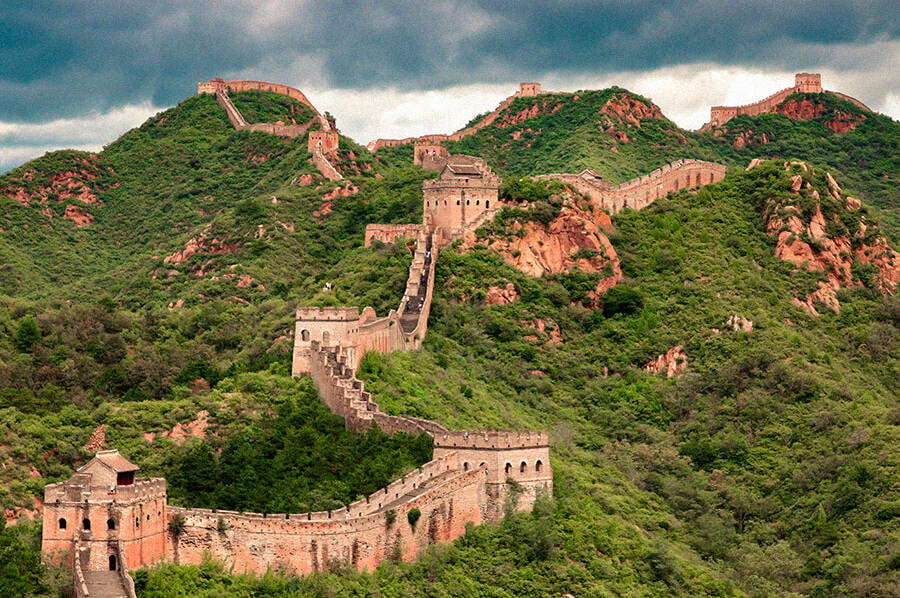
William Olivieri/UnsplashConspiracy theorists believe the Tartarian Empire built grand architecture, like the Great Wall of China.
Then, according to theorists, a series of catastrophic mud floods wiped the empire out, and the governments of the world orchestrated a massive cover-up, allegedly rewriting history, falsifying timelines, and destroying surviving Tartarian architecture to hide what had really happened.
The theory has even been dubbed the “QAnon of architecture.” But where did it start?
The origins of the Tartaria conspiracy theory can be traced back to Russian nationalist pseudohistory. Russian mathematician Anatoly Fomenko developed what he called a “New Chronology” in the 1970s, arguing that historical events believed to be thousands of years old actually occurred during the Middle Ages.
Roger Avary parroted this theory to Joe Rogan, saying, “Everything has been falsified before the year 1600… about a thousand years have been added to the timeline in order to justify land claims.”

@@mindknowledgepower/TikTokRoger Avary discusses the Tartaria conspiracy theory on the Joe Rogan Experience.
Nikolai Levashov, a Russian occultist, popularized the idea that Tartaria was the true name of Russia and that a great Tartarian Empire once existed in Central Asia. The Russian Geographical Society debunked both men’s theories and called Levashov’s ideas an “extremist fantasy.”
The modern internet version of the theory took shape around 2016, when YouTubers began combining Fomenko and Levashov’s ideas with other alternative history threads, including claims about basement windows in old buildings, photographs of muddy 19th-century streets, and the ornate architecture of Gilded Age buildings.
Why The Tartaria Claims Don’t Hold Up
The Tartaria theory rests on a few recurring pieces of “evidence.” Buildings from the 19th century are too grand and technically complex to have been built by the people of that era, theorists argue, so they must be remnants of an older, more advanced civilization. Basement windows in old buildings are actually first-floor windows buried by mud flood sediment. The ornate classical architecture of Beaux-Arts and Second Empire buildings is “Tartarian” in origin, not modern.
Architectural historians have offered more straightforward explanations.
As architectural historian Robin Aitken told The Spinoff in 2022, “I think horses can answer for a lot of this,” he said. “Horse sh—t, horse hooves pounding the horse sh—t.”
Horses were the primary mode of transportation for most of the 19th century, and Aitken said they can likely account for most of what theorists interpret as flood sediment.
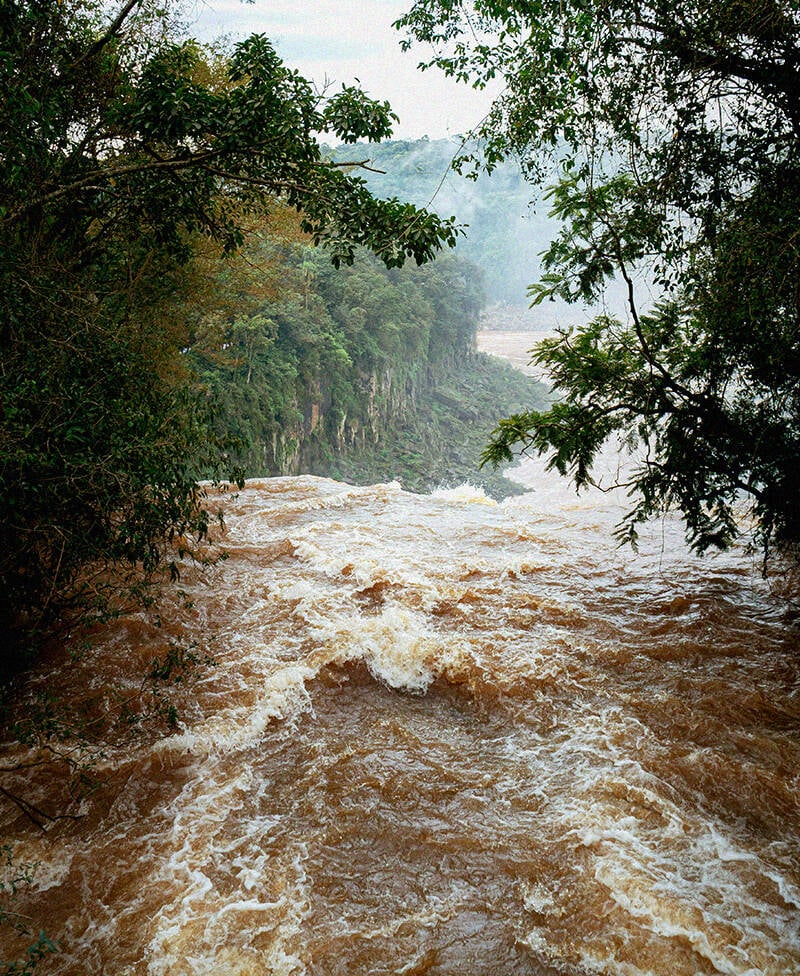
Rafael Hoyos Weht/UnsplashAccording to conspiracy theorists, mud floods wiped out the Tartarian Empire around the 19th century.
Basement windows in buildings constructed on sloped terrain reflect the land shape, not a buried civilization.
As for the broader claim that a thousand years have been added to the historical timeline and that Rome, Greece, and Egypt were all active until around 1600 — well, there are thousands of pieces of independent archaeological evidence, from radiocarbon dating to stratigraphic analysis to contemporaneous written records in dozens of languages, that firmly establish the conventional chronology.
Theorists have no coherent answer for any of these discrepancies beyond the assertion that all such evidence was planted as part of the cover-up. The Tartaria conspiracy theory holds a flimsy argument because there is no central timeline or authority figure; believers dismiss any contradicting evidence as part of the conspiracy.
But the theory taps into genuine feelings of institutional distrust, wonder at grand architecture, and the suspicion that history is written by the powerful to serve the powerful.
“The winners write the history books,” @nomadsanimalencounter noted in his video. “They can write anything they want in there.”
Those feelings are not unreasonable. The conclusions drawn from them here, however, are.
Tartaria was a real place, but it was not a global empire that traversed the planet while building grand architecture.
@mindknowledgepower The Lost Country of Tartaria erased from History #ancienthistory #podcast #jre #knowledge #mystery
After reading about the Tartarian Empire conspiracy theory, discover the stories behind nine lost cities around the world. Then, go inside the legend of Atlantis.