The Titanic Conspiracy Theory That A Mummy Cursed The Ship
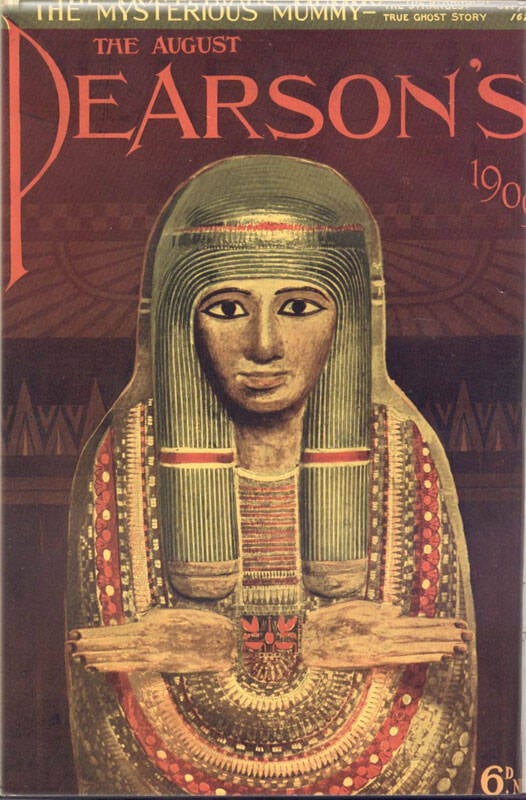
Wikimedia CommonsA 1909 Pearson’s Magazine cover featuring an “unlucky mummy” — that was later accused of cursing the Titanic.
One Titanic conspiracy theory alleges that the ship sank due to a mummy’s curse — and this idea emerged shortly after the liner sank. On May 12, 1912, The Washington Post ran a story with this headline: “Ghost of the Titanic: Vengeance of Hoodoo Mummy Followed Man Who Wrote Its History.”
William T. Stead, a British editor who was a passenger on the Titanic, shared with his fellow passengers the tale of a cursed mummy, an ancient “Egyptian priestess” who brought misfortune, destruction, and even death to those who disturbed her — or even dared to share her story with the world.
“[Stead] told of one person after another who had come to disaster after writing its sinister history,” the Post article stated, as noted by Slate. “‘I know the story, but I shall never write it,’ added the veteran publicist.”
Within hours of Stead sharing this information with his fellow passengers, the Titanic crashed into an iceberg, and Stead sank to the bottom of the ocean along with it. This led some to believe that Stead talking about the mummy on the voyage doomed not only Stead, but hundreds of others.
This theory has expanded over the years to claim that the unlucky mummy was actually on board the Titanic, as some alleged the British Museum sold the mummy to an American who was traveling home on the Titanic.
But in reality, the so-called “cursed mummy” in question never left the British Museum — and it was actually just the coffin lid of the Priestess of Amun in the museum, not a full mummy. And cargo records for the Titanic don’t show any mummy ever being loaded on the ship.
As a Snopes article put it:
“A few days after the Titanic’s sinking, one of the survivors recounted Stead’s ‘cursed mummy’ tale in an interview with the New York World, and eventually the ghost story Stead and Murray invented, Stead’s presence aboard the Titanic, and reports of Stead’s having related the mummy tale to Titanic passengers became jumbled together, producing a new legend about an actual mummy aboard the Titanic.”
The Coal Fire Theory

News Direct/YouTubeA coal fire burned in the Titanic’s bunkers for up to three weeks before the ship set sail, allegedly weakening the hull.
Another theory claims that a raging fire in the Titanic’s coal bunkers weakened the ship’s hull in the exact place where the iceberg struck, allowing it to do much more damage than it would have otherwise.
“Just after survivors made landfall, several people who worked on the ship’s engines cited a coal fire as the cause of the shipwreck,” the Smithsonian Magazine explained. Irish journalist Senan Molony believes that the coal fire started as early as three weeks before the Titanic set sail, but it was covered up or downplayed to prevent any delays of the voyage.
The Titanic’s coal bunkers were right inside the hull of the ship, so excessive heat from a spontaneous fire would have directly damaged the hull itself. In recently discovered photos of the ship before it set sail, Molony found his “smoking gun” — a 30-foot-long black streak on the outside of the Titanic’s hull, in the same area where it would fatefully hit the iceberg.
“We asked some naval architects what this could be, and nobody knew and everybody was intrigued,” Molony said. “The best suggestion at the time was that this was a reflection.” But engineers from Imperial College London believe that the streak came from the coal fire right inside the hull.
An article from the New York Tribune published shortly after survivors made it back to land details an early version of this theory, as reported by Snopes.
“The fire must have been raging long before she pulled out of her pier in Southampton, for the bunker was a raging hell when, one hour out past the Needles, the fire was discovered,” said an officer of the ship who requested to remain anonymous due to warnings to not talk about the fire. He added, “In my opinion, this fire played no small part in the disaster.”
The structural damage caused by the coal fire is not the only way the fire could have played a role in the Titanic’s sinking. Proponents of the coal fire theory believe that the ship’s crew members attempted to contain and control the fire by burning coal at a faster rate, increasing the ship’s speed.
The Titanic was traveling at 22 knots the night of the collision, which was close to its maximum speed, despite receiving multiple warnings of icebergs in the area. At first, it was believed the captain wanted the ship at top speed, either to break a speed record or to make sure the ship wouldn’t arrive late to New York. But the coal fire theory asserts that the reason the ship was traveling so fast was because it was burning up the smoldering coal.
Whether or not the fire happened is not in question; the coal fire theory asserts that the deadly crash was a direct result of the damage from the fire. And not everyone agrees with that idea.
“A fire may have accelerated this. But in my view, the Titanic would have sunk anyways,” said David Hill, a former honorary secretary of the British Titanic Society, in an interview with The New York Times.