From the caves of India to the deserts of Australia, these amazing and bewildering underground cities once housed thousands of people below the surface of the Earth.
Cities are widely associated with their skylines, and it’s likely that the word “city” would invoke in your mind an image of a densely crowded urban center like New York, Chicago, London, Paris, Tokyo, Shanghai, or Dubai. However, not all cities around the world have iconic skylines — and some, such as the underground cities on this list, lack a skyline entirely.
Some underground cities, such as the Beijing Underground City and Britain’s Burlington Bunker, have more recent histories, dating back to the 20th century’s wars. They served as contingency plans, should danger fall from the sky. But there are others with histories that date back further — ancient underground cities with rich backgrounds that paint a picture of the past.
In nearly every case, though, these underground cities are sure to astonish with their complex constructions and fascinating histories.
Derinkuyu Underground City: The Subterranean Metropolis Of Ancient Turkey
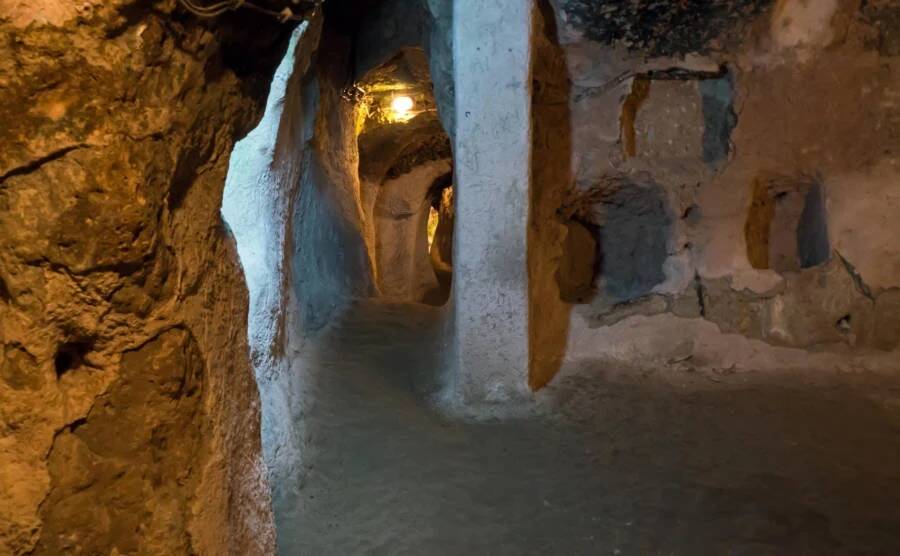
Dan Merino/CC BY-ND 2.0 No one knows Derinkuyu’s true origins, but there are several theories as to who built it and why.
Hundreds of feet below the surface of the Earth, in the country of Turkey, sits a vast, labyrinthine network of tunnels that once housed 20,000 people.
Known as Derinkuyu, this underground city extends just under 300 feet down into the ground, encompassing as many as 18 floors. While its exact origin and purpose are unknown, the Turkish Department of Culture estimated that the construction of the city started around 2,800 years ago by a group of people known as the Phrygians, an Indo-European people from the Iron Age, notable for their architectural prowess.
But the Phrygians were not the only people to inhabit Derinkuyu. During the Byzantine era, researchers believe Christians lived in the caverns of Derinkuyu to avoid religious persecution. It’s also possible that its halls were used as recently as the 20th century, when others avoiding persecution from the Ottoman Empire may have once again hidden in Derinkuyu.
There are other theories about Derinkuyu’s origins, though. Some historians have suggested that the city had actually been built in the 15th century B.C.E. by the Anatolian Hittites, so that they could escape their enemies.
Others have theorized that the caves were formed around the same time as Göbekli Tepe, during the Younger Dryas Event roughly 14,500 years ago.
And of course, there are those who have claimed that the original architects of Derinkuyu were ancient aliens who once inhabited, then later abandoned, the underground city. An alternate version of this theory suggests humans did indeed build the city — to hide from invading extraterrestrials. Generally, however, scientists agree that these latter theories don’t hold much weight.
For a time, Derinkuyu was largely forgotten — until it was rediscovered in 1963 when a Turkish man took out a wall amid home renovations, only to discover that there was an entire room behind it. As it turned out, this single room connected to the even larger labyrinth of Derinkuyu.
Dixia Cheng: Beijing’s Underground City And Cold War Shelter
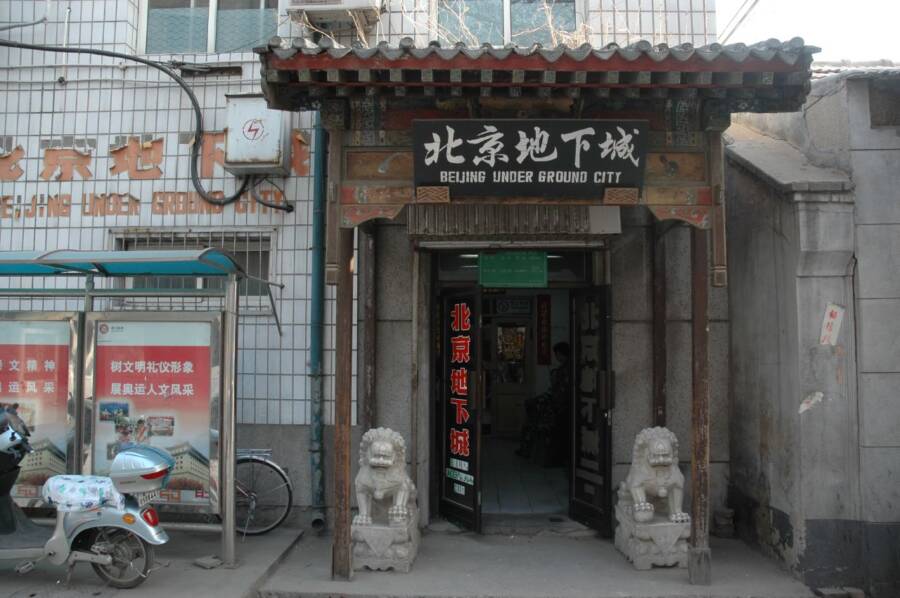
David/FlickrThe entrance to Beijing’s Underground City.
At the height of the Cold War, as much of the world worried about the possibility of sudden nuclear fallout, citizens of Beijing, China could take solace in the fact that they had a bomb-safe refuge right below their feet.
Stretching across 33 square miles of underground catacombs, Beijing Underground City — or the “Underground Great Wall” — is a complex tunnel system hand-dug by citizens in the ’60s and ’70s as a protective measure against invasions, air raids, or even nuclear strikes, Atlas Obscura reports.
According to National Geographic, the order to construct these underground bunkers came straight from Chairman Mao, and by the end of the construction, Beijing alone had roughly 10,000 underground bunkers.
Clearly, the nuclear fallout never came, and Beijing’s underground bunkers were leased to private landlords in the early 1980s. Since then, a significant portion of these bunkers have been rented out to more than a million people, most of whom are migrant workers and students from rural areas.
And while these bunkers were equipped with some basic necessities — electricity, plumbing, and a sewage system — they were hardly made for long-term settlement. They lacked a proper ventilation system, leaving the air moldy, and residents had to share unsanitary kitchens and restrooms.
In 2010, Beijing prohibited the use of nuclear shelters and storage spaces for residential use, putting an official end to its city below the city, though the clean-up effort has continued on with significant difficulty.