Naours, France: The Underground City That Started As A Limestone Quarry
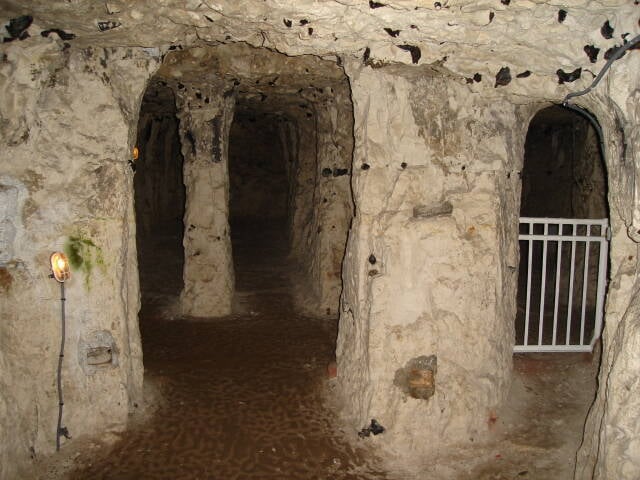
Wikimedia CommonsAn underground chapel in Naours, France.
In the second century C.E., Romans occupying Naours, France constructed a limestone quarry that eventually fell out of use. At first, locals used the abandoned quarry as a place to store goods and hide from invading armies, but as conflicts ramped up during the time of the late Roman Empire and the early Middle Ages, this hiding happened more and more frequently.
According to Ancient Origins, locals hid in the quarry so often, in fact, that they began to construct more permanent structures within it. These structures included things like wells, stables, bakeries, and chapels.
To conceal their underground presence, the locals even routed any fires from bakers’ ovens or other heat sources up through above-ground structures. But they weren’t secretive enough. Around the 9th century C.E., Viking invaders overtook the town and inhabited its subterranean settlement.
It was in the 17th century, however, that the underground city reached its peak population of 3,000 people, as fearful locals sought shelter in the midst of the bloodshed that took place during the Thirty Years’ War.
Like many other underground cities, Naours was eventually abandoned and later rediscovered. In this case, the rediscovery happened in 1887 during a home renovation project. After this, it became a massive attraction for tourists, especially for off-duty soldiers during World War I.
Later analysis of graffiti left on the underground city’s walls revealed that up to 2,000 Australian soldiers left messages on the walls during this time.
Wieliczka Salt Mine In Poland
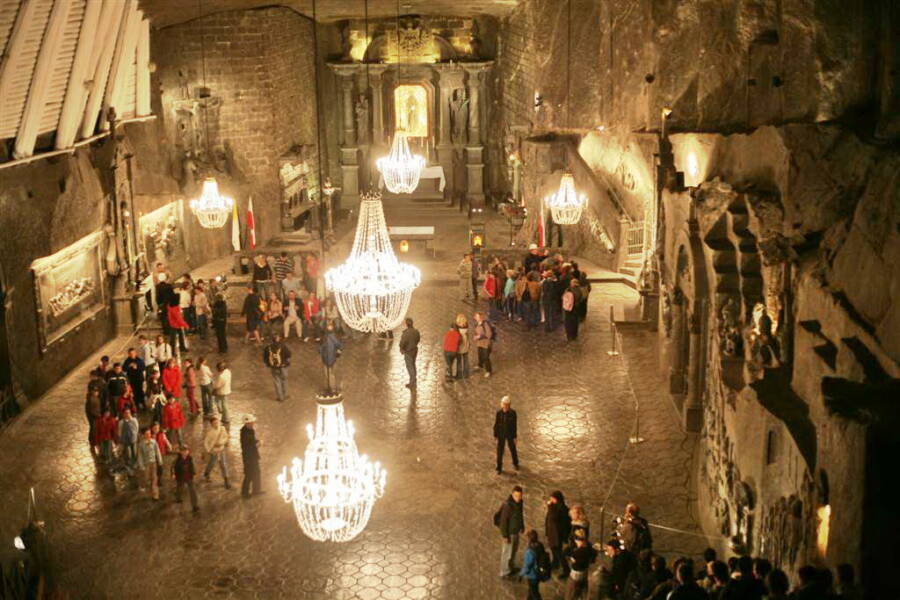
Wikimedia CommonsSt. Kinga’s Chapel deep within the Wieliczka salt mine.
Ever since ancient times, humans have sought to obtain salt. In the Neolithic era, this was done by boiling brine in small clay pots. Ancient humans used salt primarily as a method of preserving meat and fish, making it a valuable resource. As it turns out, the earliest salt-making tools found in Central Europe were discovered in the village of Barycz, near Wieliczka, Poland.
Hundreds of years after these tools were used, around the 12th century C.E., however, the salt springs began to dry up. Locals across the Wieliczka region began to dig deep wells to extract salt water and bring it to the surface for boiling, hoping once again to extract the coveted salt from the brine.
It was around the 13th century when the first chunks of salt rock were discovered — and this discovery would change the region forever.
Over the following centuries, locals continued to dig into the ground, extracting salt rocks. According to the mine’s own website, the salt excavation ended up being so profitable for the Polish crown that it constituted nearly a third of the treasury’s income.
Thankfully, the Polish king Casimir III decided to put that money to good use. He took the profit from the salt mine and put it toward civil projects, including Poland’s first university, Krakow Academy.
By the end of the Middle Ages, about 300-500 people worked in the Wieliczka salt mine, mining nearly 8,000 tons of salt each year.
And though a mine isn’t technically a city, Wieliczka is a notable exception because it remained in production for about 700 years. This extended excavation resulted in more than 2,300 underground chambers spanning over 150 miles, making it bigger than most other underground cities.
Today, the mine no longer produces salt, but it remains a massively popular tourist destination in the country, often included in the official itineraries of politicians, heads of state, and royal families who visit Poland.