Walter Wick spent up to three weeks painstakingly crafting and photographing each scene for the I Spy books, which became a worldwide phenomenon in the 1990s.

Alvintrusty/Wikimedia CommonsArtist and photographer Walter Wick, one of the creators of the I Spy series.
Most people might not immediately recognize the name Walter Wick, but they are most assuredly familiar with his work. In 1991, Wick began collaborating with writer Jean Marzollo to create a series of books that would go on to sell millions of copies worldwide: the I Spy picture riddles.
Wick began as a commercial photographer, but by the 1980s, he’d started creating photo illustrations and puzzles for books and magazines. That hobby expanded into an incredible career, and today, he’s celebrated for his pictures that appear in the I Spy and Can You See What I See? books.
Walter Wick didn’t just photograph the elaborate puzzles, though — he built them. From miniature towns to intricate Rube Goldberg machines, Wick painstakingly designed each page of his books to capture the whimsy of childhood.
Even now, more than 30 years after Wick’s first I Spy book was published, his work continues to enthrall children around the world.
Walter Wick’s Early Life And Career
Walter Wick was born in Connecticut on Feb. 23, 1953, and grew up in East Granby. Living in a small, rural town meant that he had to find ways to entertain himself. So, he began to tinker with things, making his own toys out of various objects he found lying around the house.
When he was eight, his brother introduced him to photography. Wick reflected on the first roll of film he ever used in a blog post on his website, describing the excitement and frustration of learning how to take good photos.
“I distinctly remember the moment for both the failures and success when the prints came back from the drugstore,” he wrote. “The cause-and-effect aftermath lingered in my head years later. But lost pictures are no different than any other undocumented childhood memories: over time, you begin to wonder if certain events of your life actually happened.”
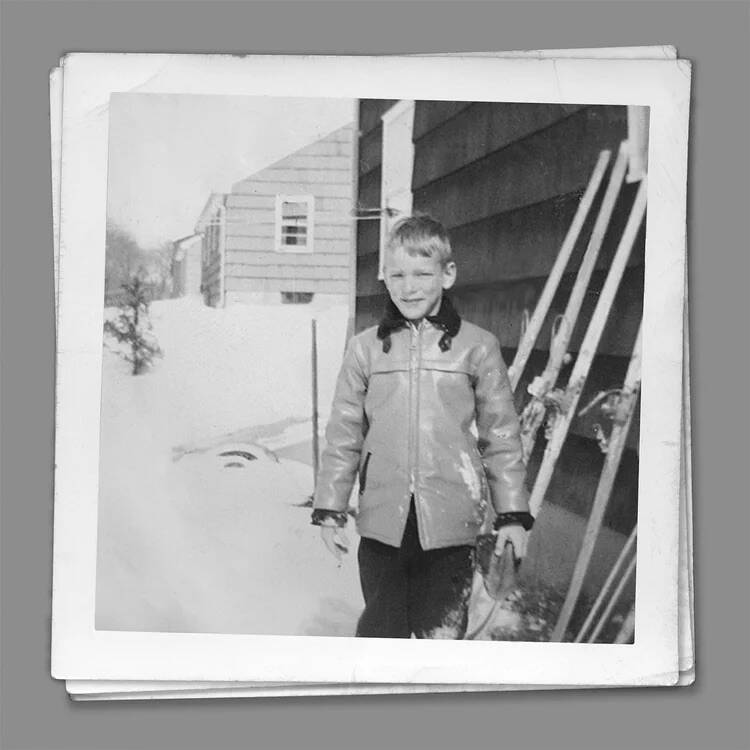
Walter WickWalter Wick at the age of eight.
It wasn’t until later in life, after high school, that Walter Wick decided to seriously pursue photography as a career. He studied photojournalism at Paier College of Art in Connecticut, graduating in 1973. He then spent several years working as a lab technician and photographer’s assistant.
In 1978, Wick moved to New York City and opened a small commercial photography studio. However, finding clients was difficult, so he spent much of his time developing new ideas and techniques.
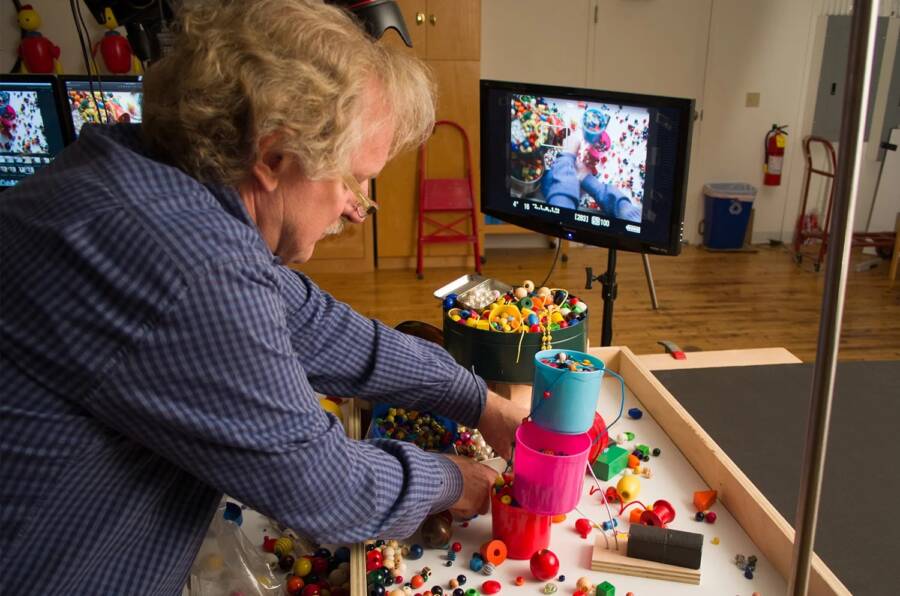
Walter WickWalter Wick working on a scene called “Toppled” from his book Hey Seymour!
Wick married his wife, Linda Cheverton — a photo prop stylist for magazines and cookbooks — in 1980, and as his career continued to grow, he began working with magazines such as Psychology Today and Discover. Then, in 1981, he crafted his first photographic puzzle, “The Amazing Mirror Maze,” for the magazine Games.
He continued to contribute small puzzles to various publications over the next decade, but it wasn’t until 1991 that he and Jean Marzollo came up with the idea for I Spy. At the time, Marzollo was the editor of the Scholastic children’s magazine Let’s Find Out, and she hired Wick to photograph “fasteners” to include as a poster in an upcoming issue.
“I was organizing screws, paper clips and other odds and ends,” Wick recalled to Deseret News in 2009. “As I began sorting, I liked the way the objects looked spread out on my light box. After hours of careful arranging, I took a picture. This photograph of odds and ends was the spark that inspired the first I Spy book.”
Creating The Beloved I Spy Books
The first I Spy book was published in 1992, and it was a breakout success. Wick built the scenes and photographed them for each of the book’s pages, while Marzollo wrote the rhyming riddles that accompanied the images.
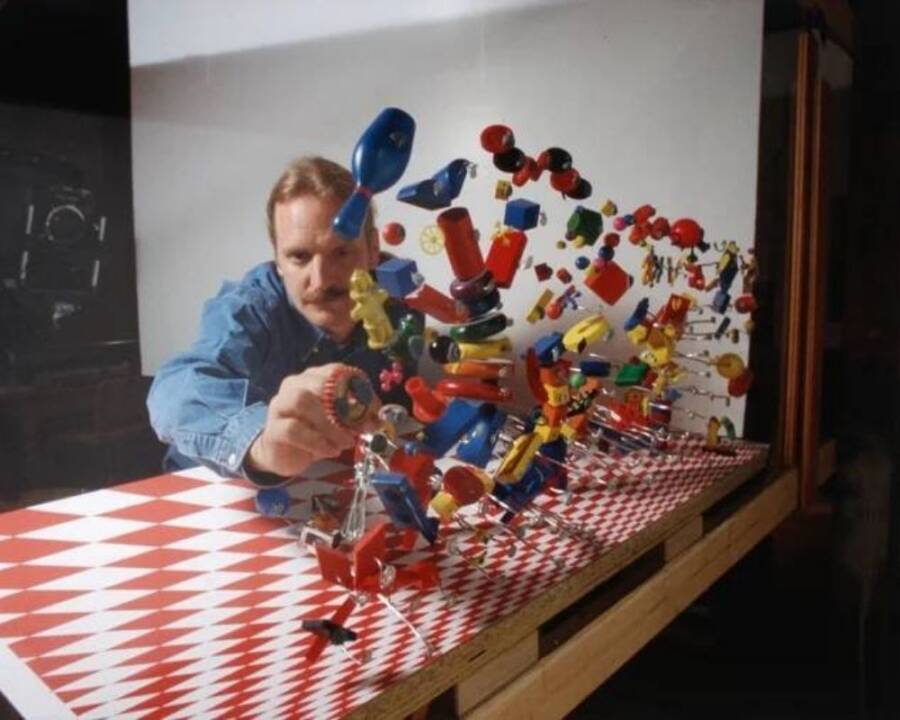
Walter WickWalter Wick designing one of his elaborate photographic illusions in 1993.
The popularity of the first I Spy book spawned seven more in the original series, in addition to compilations and spin-offs, each releasing to critical acclaim. But Walter Wick was no one-trick pony.
In 1997, he published A Drop of Water: A Book of Science and Wonder, which won the Boston Globe-Horn Book prize for nonfiction. The next year, The New York Times named Wick’s Optical Tricks one of the year’s “best illustrated children’s books.” And in 2002, Can You See What I See? remained on the bestseller list for a staggering 22 weeks.
Part of what made Wick’s work so successful was the sheer dedication he had to his craft. Speaking to PEOPLE in 2024, Wick revealed that one of his most popular photographs from I Spy — “Levers, Ramps, and Pulleys” — was actually a functional machine, despite the fact that it would only appear in a still frame.
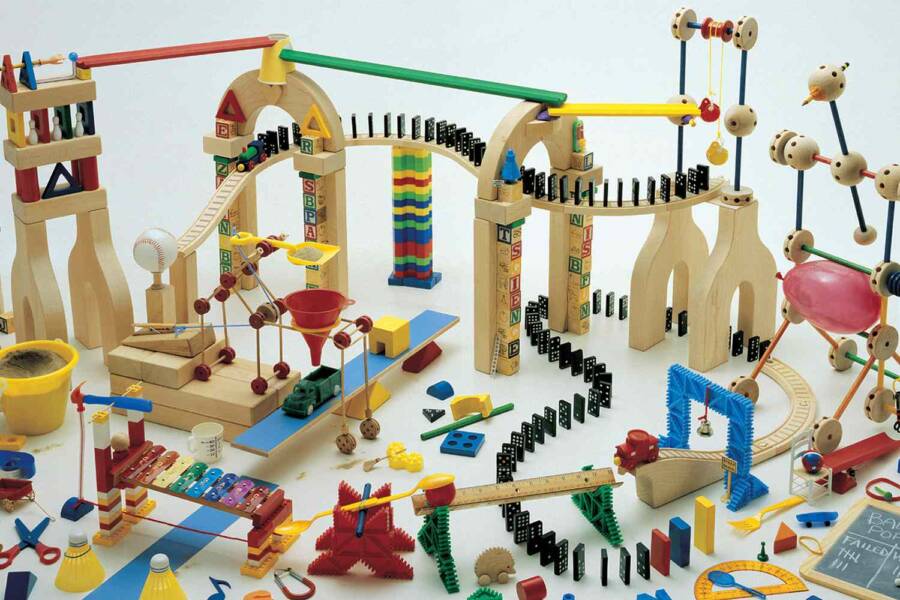
Walter Wick/I Spy“Levers, Ramps, and Pulleys” from I Spy School Days.
“[Jean Marzollo] just thought I was gonna do some levers, ramps, and pulleys in a scene, which would’ve been perfectly sufficient,” he said. “But I decided to make this machine and I said, ‘Well, it’s gotta do something. What’s it gonna do?’ I said, ‘I think it’s gonna pop a balloon.'”
So, Wick spent the next three weeks building what was effectively a Rube Goldberg machine out of tiny objects. “I came up with this Tinkertoy stand that held the balloon and held the thing that popped it at the same time,” he said. He settled on a pencil as the popper, but it had to be sharp, or “it would just bounce off the balloon,” explained Wick. “So I sharpened it and then I accidentally triggered it and almost killed myself with it.”
Wick has called creating these sets and scenes “a joy” — but his greatest pleasure is seeing how children react to his work.
How Walter Wick Continues To Spark Children’s Curiosity And Creativity
Feedback and questions from young readers were some of the motivating factors for Wick to continue making his books over the decades. In 2023, he told CT Insider about an instance in which a four-year-old asked him how he managed to get a doll pictured in one book to balance on one foot as if it was running.
“This is a child who couldn’t read but understood the toy shouldn’t be able to balance as I had it,” Wick said. “That question stuck with me. When you get questions like this, you realize they’re trying to reconcile their understanding of how the world works. I consider these inquiries from kids to be high-value engagement, so I try to always amplify that as much as I can.”
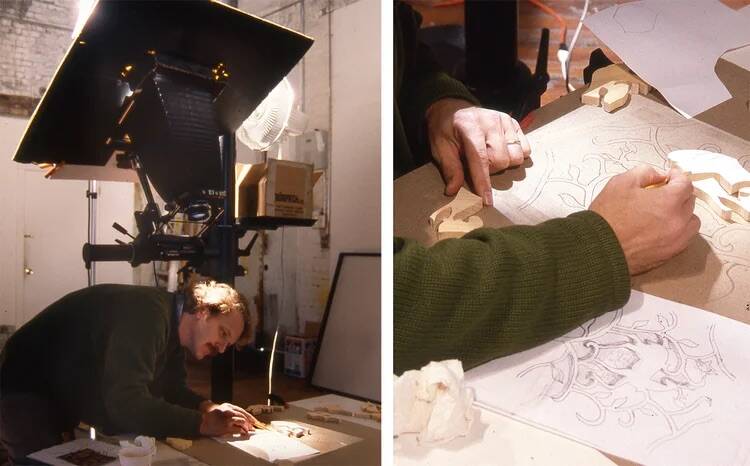
Walter WickWalter Wick working in his studio.
In order to expose his work to even more curious children, Wick has allowed his illustrations and models to appear at exhibitions across the country. An exhibit titled “I Spy! Walter Wick’s Hidden Wonders” also went on display at the Norman Rockwell Museum in 2025, showcasing decades of Wick’s photography.
Through these photos, Wick has provided millions of readers with hours of entertainment. But for the man behind the camera, creating the images brought just as much joy. More than three decades into his career, Walter Wick continues to inspire.
After learning about Walter Wick and his mind-bending photographs, meet Rosalind Walter, the woman behind Rosie the Riveter. Then, read about Stephen Wiltshire, the autistic artist who can draw entire cities from memory.