Coco Palms Resort: The Hotel Where Elvis Presley Filmed Blue Hawaii
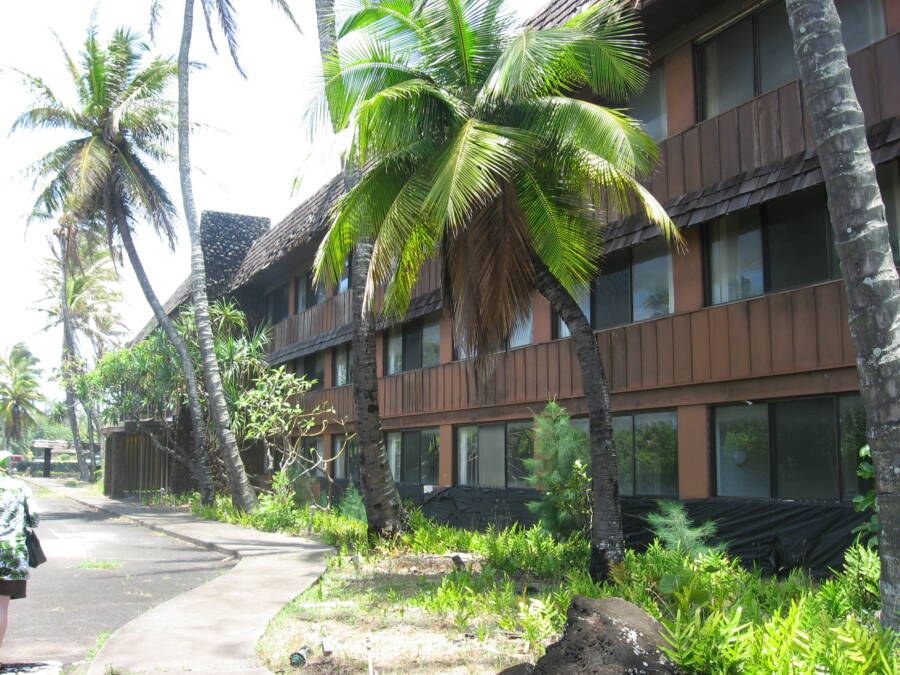
Wikimedia CommonsCoco Palms Resort on the Hawaiian island of Kauai.
Located in Wailua on the Hawaiian island of Kauai, the Coco Palms Resort was at one point one of the most famous hotels in America.
Once ancient Hawaiian royal property, the land where the hotel was built has been the subject of a heated dispute since the 1860s. This dispute began as a conflict between the former Hawaiian leaders and Sanford Ballard Dole, the controversial leading figure in “Westernizing” Hawaii in the 19th century and early 20th century. Later on, in the early 1950s, Lyle Guslander purchased the property to build an “exotic” resort. It’s little wonder why rumors have always circulated about the hotel’s alleged “curse.”
As Hawaii Magazine noted, Guslander’s hotel had a rough start until Grace Buscher arrived to help him manage the hotel in 1953. With Buscher’s help, the resort would transform into a luxurious destination that mixed aspects of traditional Hawaiian culture with a sense of Hollywood fantasy.
Together, Guslander and Buscher incorporated fishponds, coconut tree groves, and historic sites into the resort’s design. Buscher also became somewhat famous for her nightly torch-lighting ceremonies.
Of course, the hotel was most famous for serving as a filming location for Elvis Presley’s 1961 movie Blue Hawaii, which showcased the resort’s lush grounds and romantic atmosphere. Other celebrities like Frank Sinatra and Bing Crosby had also spent a good deal of time at the resort, and Coco Palms Resort became synonymous with the rise of Hawaiian tourism.
For Hollywood elites, these were exciting times, but for the people of Kauai, it was often a different story. Many Native Hawaiians disagreed with ancient Hawaiian royal property being used as a hotel for the rich and famous. Some also disliked the use of traditional customs as entertainment.
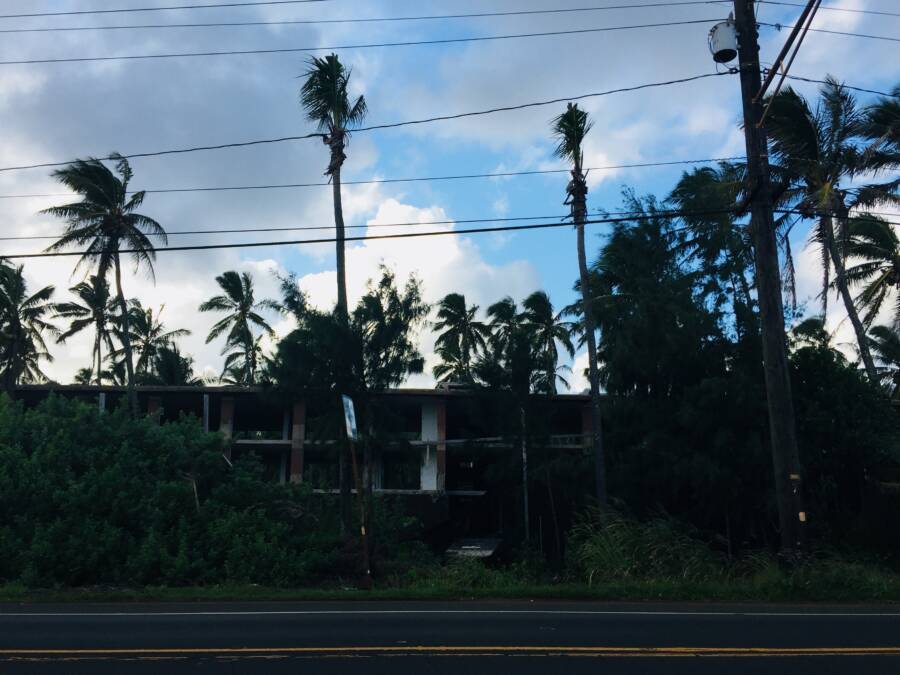
Wikimedia CommonsThe derelict Coco Palms Resort, pictured before new redevelopment began.
Then, on Sept. 11, 1992, Hurricane Iniki — the most destructive hurricane to ever hit Hawaii — made a direct strike on Kauai. The Category 4 storm severely damaged the resort, ripping off roofs, shattering windows, and causing catastrophic water damage. The owners ultimately closed Coco Palms Resort, and the hotel lay abandoned for years, falling into decay.
Over time, though, others floated ideas about rebuilding or redeveloping, but little seemed to gain traction until March 2024, when the Las Vegas-based development company Kimpton began demolishing the structure.
“Kimpton wants to recreate the Coco Palms hotel as it was in its Hollywood heyday — when stars like Elvis Presley and Frank Sinatra gallivanted across the resort erected on sacred Hawaiian land,” wrote Emma Schneck for Anthroposphere. “Back when the hotel made a name for itself by commodifying Native Hawaiian culture and selling a contrived image of ‘paradise’ to an eager tourist market.”
Schneck, who grew up in Wailua, is just one of many critics of the ongoing development project. For Americans in the 20th century, Coco Palms Resort may have been a destination getaway, but for the locals whose ancestors’ land was taken from them, it mostly symbolized colonialism.
“The Coco Palms resort is haunted by a colonial, extractive mindset that has continued to exploit and profit off of Hawai’i since its very first colonial encounter,” Schneck wrote. “The senseless modern rebuilding project not only summons the ghosts of revellers past, but also reproduces the same power struggles that have existed in Hawai’i for centuries, further exploiting a culture and island already stricken by the forces of extractivism and climate change.”