A sketch by German artist Hans Holbein the Younger created sometime in the 1530s and known only as the "Unidentified Woman" may in fact be an extremely rare portrait of Anne Boleyn.

Public DomainA portrait of Anne Boleyn, the doomed second wife of Henry VIII.
Almost 500 years after her tragic death, Anne Boleyn remains one of the most famous women in English history. King Henry VIII tore apart his kingdom to be with her, divorcing his first wife, Catherine of Aragon, and forcing an historic split between England from the Catholic Church.
Then, when she failed to give him a male heir, the king sent Anne Boleyn to her death in 1536. But despite her fame, portraits of Anne Boleyn made during her own lifetime remain exceedingly rare.
But now, a group of researchers have applied A.I. facial recognition technology to a set of drawings by Hans Holbein the Younger, a noted German portraitist in the Tudor court. Their findings suggest that one sketch, long believed to depict Anne Boleyn, actually portrays her mother, Elizabeth Howard. Meanwhile another drawing, known only as “Unidentified Woman,” may actually be a portrait of Anne Boleyn.
The Supposed Anne Boleyn Portrait That May Depict Her Mother, Elizabeth Howard
As a study in npj Heritage Science reports, researchers began with a collection of portraits by Hans Holbein, who sketched the likenesses of many members of King Henry VIII’s court in the 16th century. Though 85 of Holbein’s works survive, only 30 have been confidently identified. Others were only labeled centuries later, raising questions about the accuracy of those labels.
Using facial recognition technology, which looks at bone architecture and geometric features, researchers made surprising conclusions about two of Holbein’s works. The first sketch’s subject, which had been identified as Anne Boleyn, seems to in fact be her mother.
Historians had long speculated about this portrait. Contemporaneous accounts and paintings have depicted Anne Boleyn as slight, with dark hair. However, this newly-analyzed Holbein portrait presents a more heavyset woman with blond hair.

Royal Collection TrustThis portrait’s subject, identified as Anne Boleyn, may actually be her mother, Elizabeth Howard.
What’s more, though historians long assumed that this alleged Anne Boleyn portrait was meant as a token for the king, the woman in the portrait seems to show signs of illness — which an artist would probably not include in a romantic portrayal. However, Boleyn’s mother, Elizabeth Howard, was “diseased with a cough,” near the end of her life, and the study’s authors wrote that the subject’s “full or doubled chin [may be] evidence of illness” — specifically, tuberculosis.
Meanwhile, another one of Holbein’s drawings, given the label of “Unidentified Woman,” may actually depict Anne Boleyn.
Is Holbein’s “Unidentified Woman” Actually A Portrait Of Anne Boleyn?
In other words, though the Holbein sketch labeled as Anne Boleyn may be her mother, Elizabeth Howard, researchers found that another Holbein work, labeled as “Unidentified Woman,” may actually be Anne Boleyn.
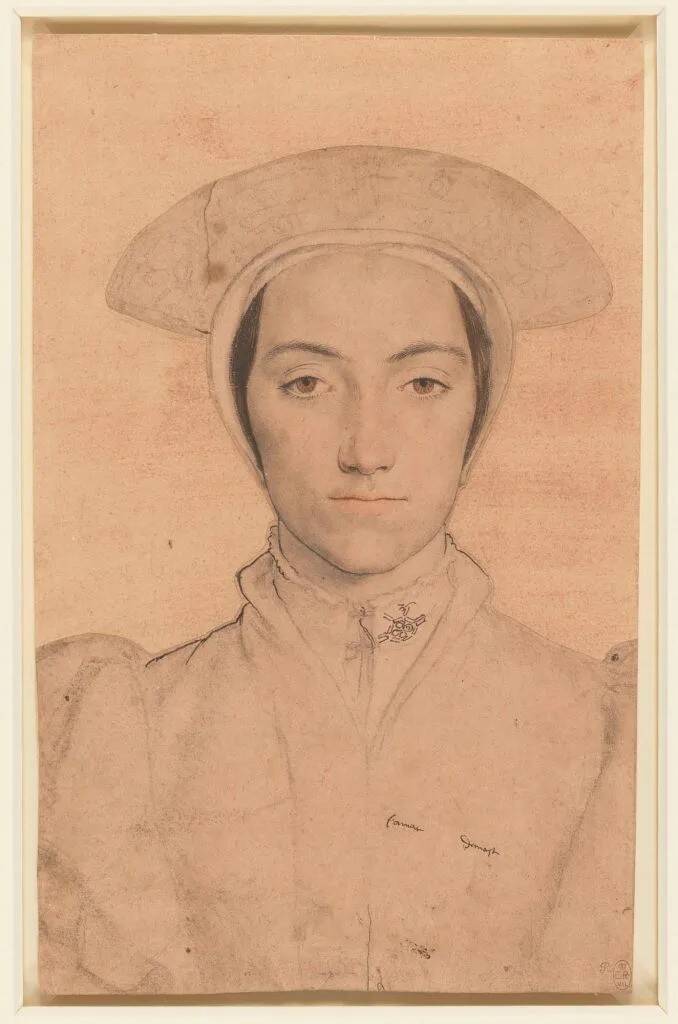
Royal Collection TrustResearchers believe that this portrait, labeled as “Unidentified Woman,” may actually depict Anne Boleyn.
Unlike the drawing that may portray Elizabeth Howard, this other sketch’s subject bears a strong resemblance to Anne Boleyn. Contemporaneous sources described her — like the woman in the drawing — as being dark-haired, slender, and with a “little neck.”
What’s more, Holbein’s notes suggest that the sitter wore luxury fabrics, including samat (velvet) and damask. Furthermore, the pink-preparatory paper matches the material that Holbein was known to use during Anne’s courtship with Henry, and her short time as queen before her husband had her beheaded in 1536.
Researchers also believe that this illustration was created and handled with special care.
“The drawing’s extraordinary preservation treatment — precise silhouetting and professional remounting on prepared paper—is shared with only two other Holbein drawings,” the researchers explained in their study. “This rarity is significant: the careful preparation indicates deliberate valuation, not routine handling… [it suggests] sustained recognition of its importance through mechanisms now lost to the historical record.”
The study’s findings offer a fascinating window into the story of Anne Boleyn, arguably the most famous of King Henry VIII’s six wives. It was in pursuit of Boleyn that Henry broke up both his first marriage and England’s connection to the Catholic Church. Anne Boleyn was thus one of the most important women in English history, and the new study’s findings offer a revealing look at her momentous life.
That said, the study’s authors noted that their results should be seen as a data point — not necessarily a firm conclusion. The data should be taken alongside other information, including historical records, new analyses, and, first and foremost, contemporaneous identification.
“In this sense,” the researchers concluded, “facial recognition serves not as an arbiter of identity, but as a rigorous and transparent tool for reassessing long-standing attribution problems where traditional evidence alone has proved insufficient.”
After reading about these possible portraits of Anne Boleyn, go inside the mystery of sweating sickness, the horrific and mysterious illness that terrorized Tudor England. Then, discover the stories of Henry VIII’s children — and how they each changed English history.