Researchers examined eight 14th-century tombs at Barcelona's Royal Monastery of Santa Maria de Pedralbes, including the graves of monastery founder Queen Elisenda, two medieval abbesses, and a woman whose unborn child was still inside her mummified torso.

Institute of Culture of BarcelonaResearchers study the remains of Queen Elisenda, who was buried in a wooden coffin.
In 1326, Queen Elisenda of Montcada founded the Monastery of Santa Maria de Pedralbes in Barcelona. Now, an archaeological project launched to celebrate the monastery’s 700th anniversary is revealing more than ever before about the people who once lived and died there.
Archaeologists have uncovered eight medieval graves along with the remains of 25 individuals and a trove of burial goods. From a woman who died during pregnancy to the body of Queen Elisenda herself, these discoveries illustrate “the internal dynamics of a center of female power in the 14th century.”
The Story Of Queen Elisenda And The Monastery Of Santa Maria De Pedralbes
Elisenda de Montcada was part of one of medieval Catalonia’s most powerful families, a legacy that was secured when she married King James II of Aragon in 1322. When Elisenda raised the idea of building a monastery in Barcelona, James agreed to fund it, and construction began in 1326.
Because her husband’s health was declining, Elisenda also had a small palace constructed next to the monastery. James died in November 1327, and the queen moved into the new residence, where she lived until her own death in 1364.
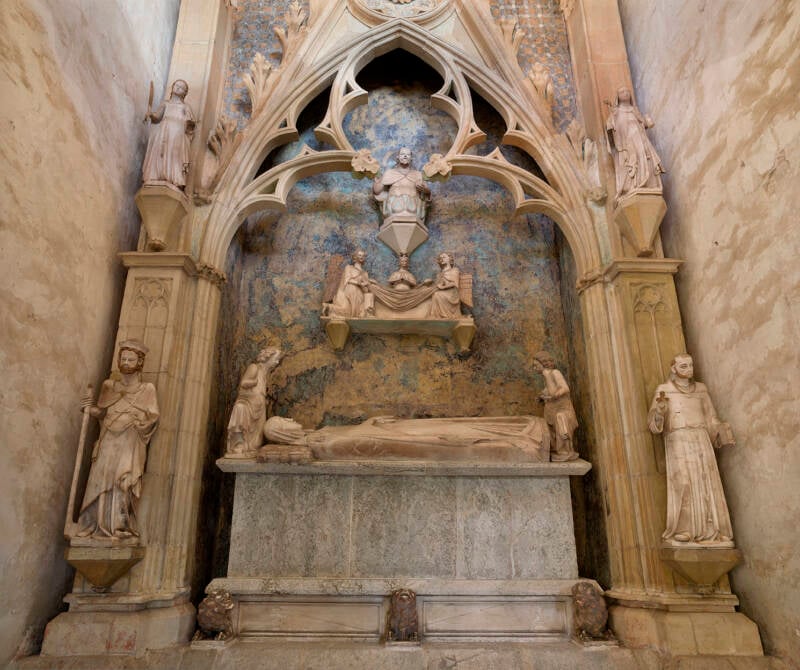
Institute of Culture of BarcelonaThe tomb of Queen Elisenda, the 14th-century founder of the Monastery of Santa Maria de Pedralbes.
She was buried within the monastery, and archaeologists examined her tomb as part of this 700th anniversary project. According to a statement released by Barcelona’s Institute of Culture, they discovered that the tomb was divided into two sections by a low wall, indicating “a double representation of the queen’s figure: as a sovereign, next to the church, and as a penitent, next to the cloister, a duality that reinforces her political and spiritual role.”
Elisenda was seemingly buried in a traditional monastic habit, but her grave also contained bits of silk with metallic thread. What’s more, archaeologists found pieces of rosemary and myrtle that were seemingly part of the queen’s burial rites.
While Elisenda’s grave revealed a wealth of information about medieval funerary rituals in Catalonia, the other tombs in the monastery held even more fascinating discoveries.
Uncovering 25 Medieval Burials In This Barcelona Monastery
Elisenda’s remains matched historical records about the queen, but not all of the tombs at the Monastery of Santa Maria de Pedralbes contained what archaeologists expected to find within them. For instance, a grave that has long been linked to a knight named Artau de Foces held no male remains at all. Instead, researchers found the skeletons of three children and two women — one of whom still had a long ponytail attached to her skull, eerily intact after 700 years.

Institute of Culture of BarcelonaOne of the most unusual discoveries was a skull with a centuries-old ponytail still attached.
The monastery’s first abbess, Sobirana d’Olzet, was discovered with a facial injury. It was seemingly inflicted with a sharp object like a knife shortly before her death, and archaeologists are still trying to determine what happened and whether it contributed to her demise. Her grave also contained the remains of candles and cords that were “initially interpreted as possible disciplines,” according to archaeologists.
But perhaps the most fascinating burial was that of Francesca Saportella, Elisenda’s niece and the second abbess of the monastery. The remains of at least nine individuals from various time periods were found in her tomb, suggesting that it was repeatedly reused over the course of many years.
These remains included four male skulls with stab wounds, as well as the mummified torso of a woman who was pregnant when she died. The fetus, estimated to be between 20 and 23 weeks of gestation, was lodged in her birth canal.
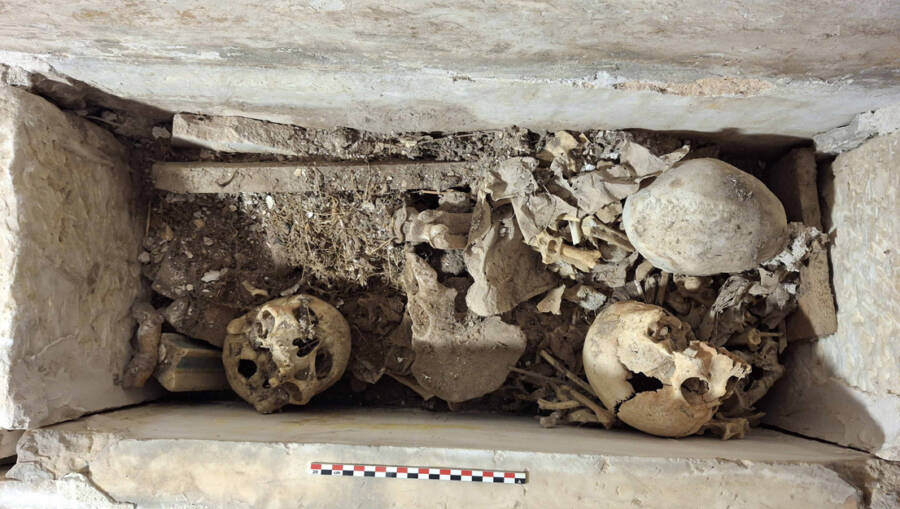
Institute of Culture of BarcelonaThe tomb of Francesca Saportella contained the skulls of four unidentified men with stab wounds.
Saportella’s tomb also contained various documents and pieces of parchment with handwritten musical notations. Experts hope that these will reveal new information about daily life inside the monastery.
In all, archaeologists identified the remains of 11 women, seven children, four men, as well as three bodies that are still awaiting analysis. Some were wrapped in textiles, others were deposited directly into the tombs, while Queen Elisenda herself was buried in a wooden coffin — all “various forms of burial… that had not been studied with this level of detail until now.”

Institute of Culture of BarcelonaScientists used radiography, 3D scanning, radiocarbon dating, and textile analysis to study the graves and their contents.
The archaeological project is expected to continue until 2027. Archaeologists write that “the challenge for the coming year will be to transform these first findings into a complete historical reading that allows us to better understand not only who these people were, but also how they lived, how they died, and how they were remembered.”
So far, they’ve found more than they ever could have expected: “The first results of the research: a new look at life, death, and rituals in the monastery.”
After reading about the graves found in a medieval monastery in Barcelona, take a walk through the Meteora Monasteries of Greece. Then, look through 33 stunning photos of Barcelona’s Sagrada Familia cathedral.