This small fort was part of the Antonine Wall, built in 142 C.E. to separate the northernmost reaches of the Roman Empire from lands controlled by local tribes.
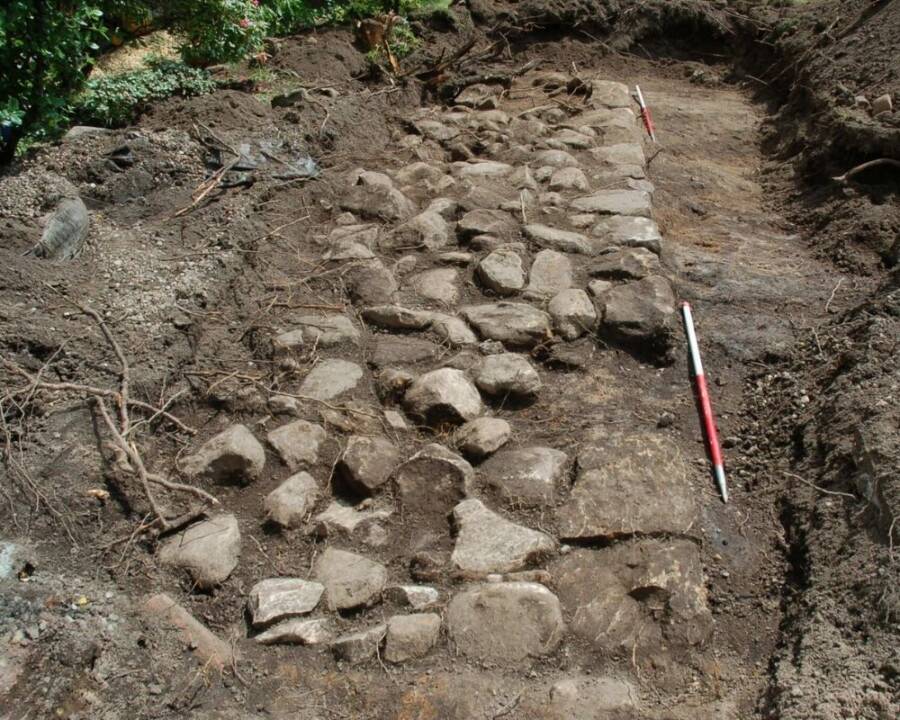
GUARD Archaeology LtdThe ancient stone foundation uncovered in the back garden of a suburban home in Bearsden, Scotland.
In 2017, an archaeological dig ahead of a construction project in Bearsden, Scotland revealed a stone foundation. After Historic Environment Scotland commissioned further excavations, researchers have identified this discovery as an ancient Roman fortlet that was part of the Antonine Wall.
This structure was one in a series of defensive forts that studded the barrier, which separated northern Britain from the area under Roman control. The Antonine Wall was only used for about 20 years in the second century C.E., however, as soldiers then withdrew south to the previous frontier boundary at Hadrian’s Wall. Now, this newly discovered fortlet is revealing valuable information about this short-lived period in the history of Roman Britain.
The Discovery Of An Ancient Roman Fortlet In Scotland
Before construction could commence in Bearsden, the East Dunbartonshire Council required a preventive excavation to ensure the protection of any ancient remains that may be hiding beneath the ground. When archaeologists struck a stone foundation, they investigated further, ultimately digging up the gardens of three adjacent residences along Boclair Road.
In addition to the foundation, researchers uncovered a manmade ditch running parallel to the stones that contained deposits of peat, wood, and vegetation. They also found more stone structures that are likely fragments of the Antonine Wall as well as two shards of Roman pottery.
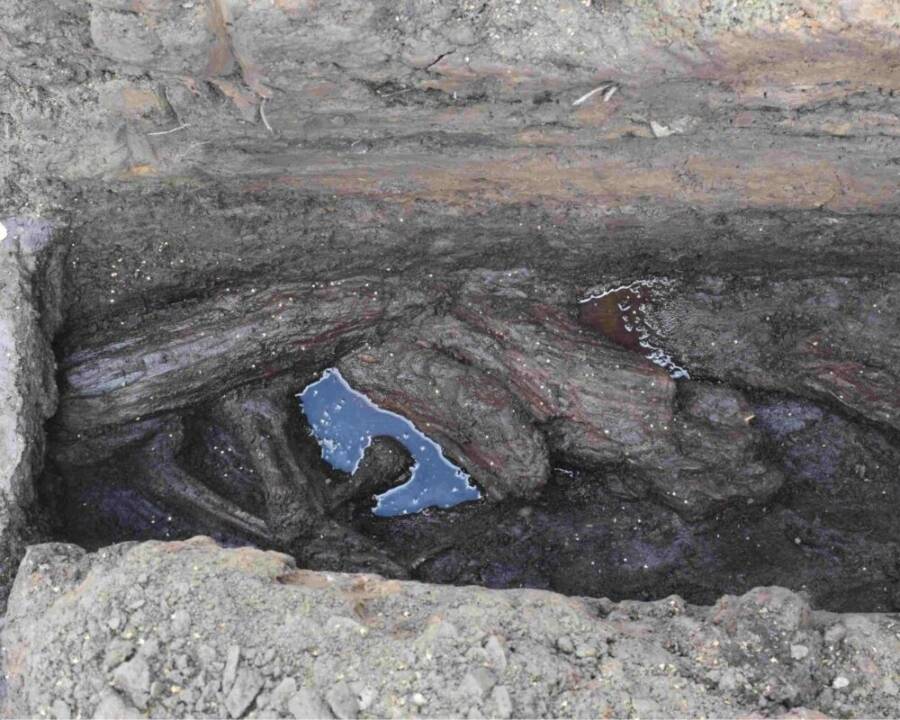
GUARD Archaeology LtdPieces of wood found in a ditch at the excavation site dated back more than 1,800 years.
The wood discovered in the ditch was radiocarbon dated to between 127 and 247 C.E. Given that construction on the Antonine Wall began in 142 C.E., experts are confident that these remains were part of this ancient barrier.
As lead archaeologist Maureen Kilpatrick noted in a study published in Archaeology Reports Online, “Given their location and date, the archaeological remains discovered in the back gardens of Boclair Road are related to the Antonine Wall, and it would therefore seem that the stone base supported a turf wall and the ditch was a section of the perimeter ditch around a hitherto unknown Roman fortlet.”
Very little remains of the Antonine Wall today, so this unexpected discovery is a rare addition to what historians know about the expansion — and ultimately, the fall — of the Roman Empire in Britain.
The History Of The Roman Empire’s Antonine Wall
Unlike Hadrian’s Wall, which was made primarily of stone, the Antonine Wall consisted of stone foundations with turf piled on top along with a timber palisade. It was studded with defensive forts and smaller fortlets, like the one that would have stood at the newly uncovered site.
In 142 C.E., near the end of the Pax Romana, Emperor Antoninus Pius ordered the Roman Army to construct the barrier from the mouth of the River Clyde, just north of Glasgow, to the Firth of Forth, north of Edinburgh. The wall spanned the width of the island, stretching nearly 40 miles, and it marked the northernmost reaches of the Roman Empire.
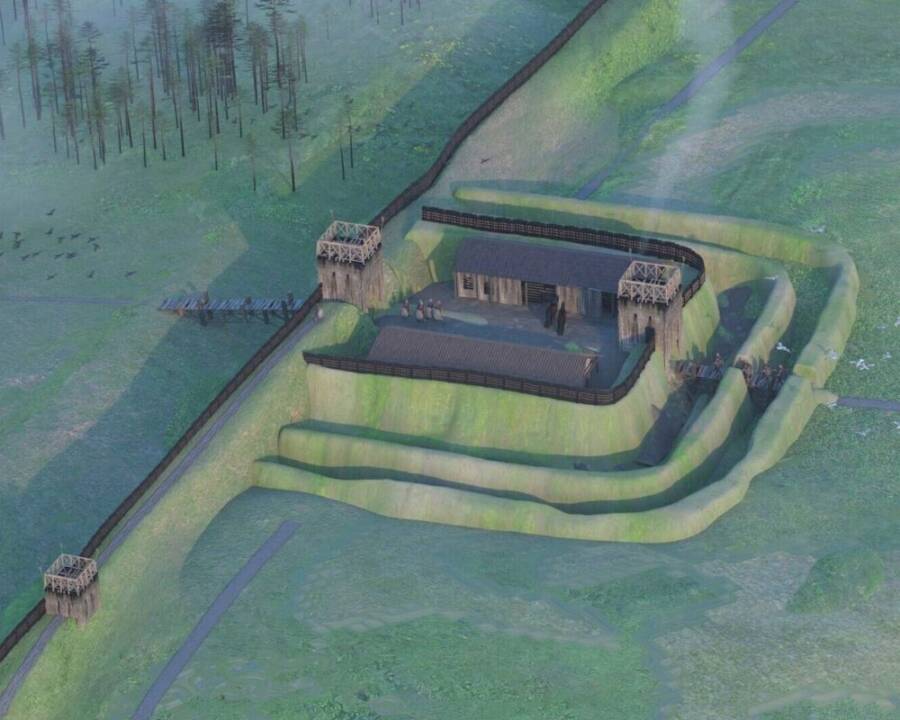
Eduardo Pérez-Fernández/GUARD Archaeology LtdAn artist’s rendering of what the Roman fortlet may have looked like.
So far, 17 forts and approximately 17 additional fortlets have been identified along the Antonine Wall. Soldiers would have been stationed in these structures to defend Roman territory from raids by northern tribes. A road called the Military Way ran near the wall so that troops and goods could be transported easily between forts.
Kilpatrick noted that the fortlet found in the gardens of Boclair Road “lay on an area of high ground right next to the Antonine Wall. It had commanding views over the landscape, particularly to the north, which was beyond Roman control, and was also intervisible with the larger Roman fort at Bearsden, which lay close by to the west on lower-lying ground. This suggests that the fortlet was an integral part of the Roman Wall defenses.”
But the Romans may have been too ambitious with the expansion of their empire. The Scottish tribes regularly attacked the Antonine Wall, and its turf and timber were more difficult to maintain than the stone of Hadrian’s Wall. In the 160s C.E., just 20 years after the barrier was built, it was abandoned, and troops fell back to Hadrian’s Wall.
The Antonine Wall eroded over the centuries, and only a few signs of its existence — mostly ditches through the Scottish countryside — are visible today. As such, every small remnant of the ancient structure that’s revealed adds to the rich history of the region.
As Kilpatrick put it, “The work within the three gardens in Bearsden has revealed how important the planning process is to archaeological investigation and the discovery of new sites.”
After reading about the Roman fortlet uncovered in Scotland, learn about the Picts, the mysterious residents of ancient Scotland. Then, go inside the story of Queen Boudica, the Celtic ruler who sought revenge against the Romans.