In 1859, a massive geomagnetic storm disrupted electrical signals, illuminated nighttime skies, and even sparked fires. If it were to happen today, the effects could be even more devastating.
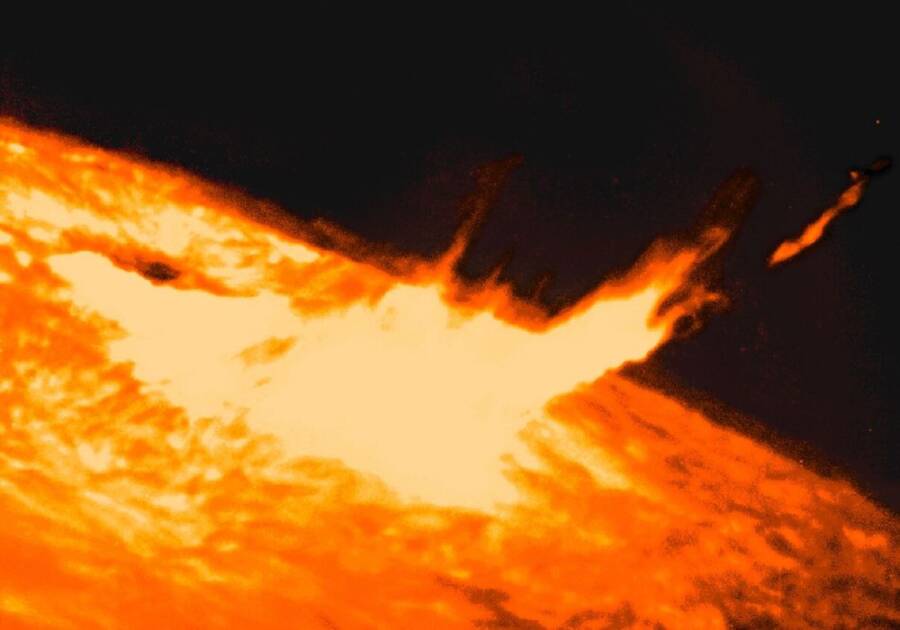
NSO/AURA/NSF/Wikimedia CommonsThe Carrington Event of September 1859 was seemingly caused by a massive solar flare, like the one seen here.
The Earth isn’t the only planet with weather. In fact, space itself can have massive weather events — and, in some cases, the impacts of these events on our lives can be devastating. There’s no greater example of this in recent history than the Carrington Event.
According to the National Environmental Satellite, Data, and Information Service (NESDIS), English astronomer Richard Carrington was studying sunspots when he noticed a sudden and intense flash of white light. That night, skies around the world lit up so brightly with auroras that people from the Rocky Mountains to Panama reported that they could read newspapers from its light alone.
While the presence of the auroras was visually stunning, the consequences of this coronal mass ejection (CME) were relatively severe. And if it happened today, it could be significantly worse.
What Was The 1859 Carrington Event?
In a video with over 213,000 views, space physics Ph.D. student and TikTok user Vincent Ledvina (@vincentledvina) says the “one thing” that keeps him up at night about his studies is the possibility of the Earth getting hit by an extreme solar storm — or, as he puts it, another “Carrington Event.”

Public DomainRichard Carrington, the English astronomer who recorded the Carrington Event.
“The Carrington Event was one of the largest geomagnetic storms ever recorded,” he says. “It occurred all the way back in 1859. And despite us not having much technology at the time, it was pretty devastating.”
As Ledvina explains, space has weather. In 1859, a “giant explosion from the Sun” — the aforementioned CME — sent a solar storm headed toward Earth. While solar storms generally move over the course of days, this one took less than 18 hours to reach our planet.
“Coronal mass ejections or solar storms happen almost daily — even multiple times per day at solar maximum,” Ledvina explains. “Right now, we are near solar maximum. We are headed down towards solar minimum. This solar cycle happens roughly every 11 years. But occasionally, one of these coronal mass ejections can be super fast, super powerful, and directed at Earth.”
The Carrington Event announced its presence on Earth by causing massive auroras in areas that would not otherwise see them. While the Northern Lights are typically only spotted in places like Alaska, Canada, northern Russia, and Nordic countries, this event caused auroras to appear in regions all around the world, even near the equator.
This wasn’t the only impact, however. Soon, technology began to glitch and fail.
“The solar storm can compress our magnetic shield, pushing it inwards,” Ledvina says. “That rapid change in magnetic field causes a rapid change in the current in Earth’s surface called a ‘geomagnetically induced current.’ Also, if there’s really powerful auroras happening overhead directly beneath those auroras, you can also have these geomagnetically induced currents.”
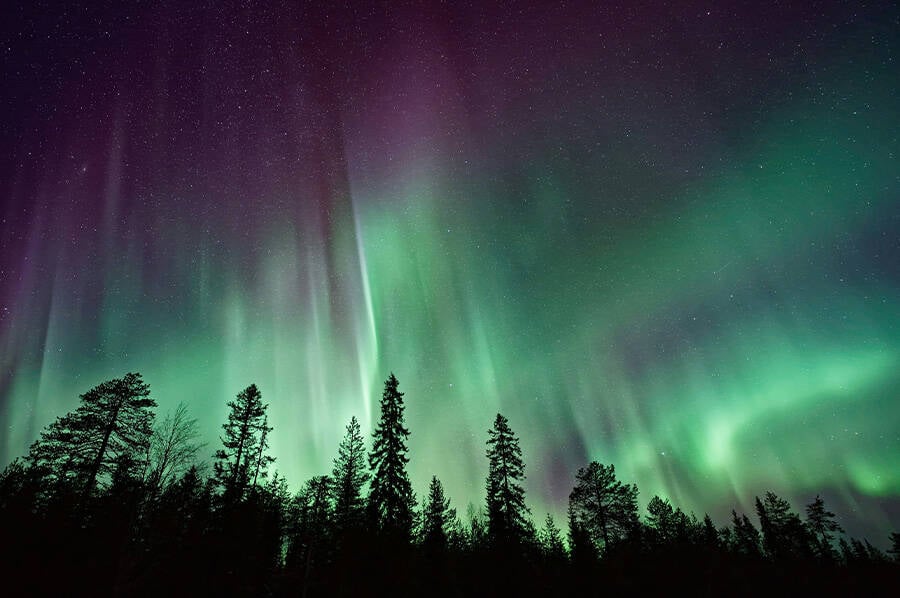
Vincent Guth/UnsplashThe Carrington Event of 1859 caused massive auroras all around the world — even in places they aren’t typically visible.
In 1859, this meant that telegraph operators began to notice all sorts of strange behavior from their machines.
As reported by the Science History Institute, some machines sparked and caused fires. Others began clacking out long, garbled messages all by themselves, while some machines were able to operate entirely without power. In fact, a pair of telegraph operators between Maine and Boston even reported that they were able to have a two-hour conversation while completely disconnected from power.
Of course, technology has advanced over the past 150 years — and so have opportunities for disaster.
What If The Carrington Event Happened Today?
At the time, the Carrington Event was seen mostly as an oddity. Now, however, its implications for our technology could be disastrous.
“Solar storms can have other effects that weren’t so obvious in 1859 because we didn’t have things like satellites,” Ledvina shares. “All the energy coursing through the atmosphere and through Earth’s magnetic field lines can cause issues for communications between the ground and satellites — notably GPS, which is used in a lot of things; high frequency radio communications, which are used by emergency responders, ham radio operators, the military.”
Not only that, but the radiation from these solar storms can disrupt sensitive electronics on satellites.
So, what would happen if a solar storm of this strength hit Earth today? The short answer is, we don’t really know. However, the impact would likely be severe.
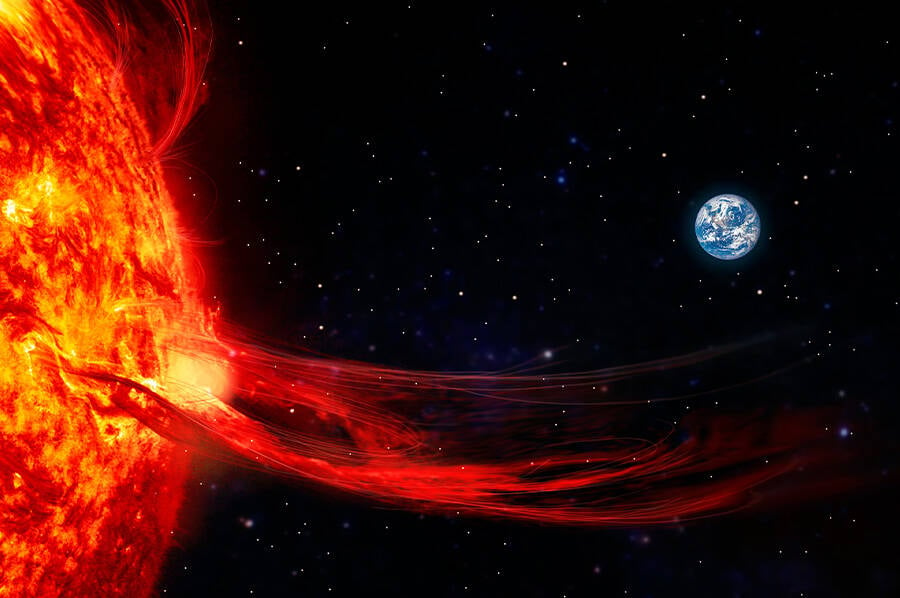
Ulia Koltyrina/Adobe StockAn artist’s interpretation of a solar flare hitting the Earth.
“A Carrington-class event would be one of the most economically devastating natural disasters to affect planet Earth,” Ledvina states. “We’re talking potentially on the order of $1 trillion. That is many orders of magnitude above even a landfalling hurricane in the U.S… The entire Earth is affected, so it really is one of these scenarios where it’s hard to predict.”
The $1 trillion number may even be an underestimate. Some scientists predict the economic implications in the U.S. alone could reach $2 trillion or more. So, how are governments around the world preparing for this possibility?
Are We Ready For Something Like This?
Thankfully, the NESDIS estimates that a storm like this happens only once every 500 years. This means that not only is another event of this nature (likely) still far away but that we have plenty of time to prepare our technology for whatever it may bring.
Some of these preparations are already underway.
In 2014, regulators in the United States passed rules that required power producers to improve their readiness for geomagnetic storms. Furthermore, the Space Weather Prediction Center at NOAA constantly monitors potential incidents and provides data about the possible consequences of any event.
There is already some evidence that these precautions have proved effective.
As Ledvina explains, Earth experienced a G5 “extreme” geomagnetic storm in May 2024. This had some similar effects to the Carrington Event. For example, auroras were seen in places where they would not usually be visible. That said, only minor disruptions to satellite positioning systems and power grids were reported.

@vincentledvina/TikTok Space physics Ph.D. student Vincent Ledvina discusses the possibility of another Carrington Event.
“It reached a Kp 9 out of 9, which is maxing out on the scale,” Ledvina says of the event. “We didn’t see huge power grid blackouts. We didn’t see huge disruptions to airlines or airspace. As far as I know, we didn’t see major cascading failures of GPS or any of those systems. So, we were able to weather that storm pretty well. But it was still an order of magnitude lower than what the Carrington Event maybe was.”
If anyone is reading this thinking they need to build a bunker and stock up on canned food, they should probably take a few deep breaths. As Ledvina himself states, it’s his job to worry about this sort of thing. And even then, he only loses around “one or two hours a month” of sleep thinking about it.
“Thankfully, we have over 150 years of scientific progress and understanding of how our Sun works and what it’s capable of doing,” he says. “So, even though, yes, it could cause some damaging effects, it’s not something to be extremely fearful of.”
“There are people in the background at agencies and industries that are affected by space weather that are mitigating effects in real time,” the TikToker adds. “So, just like during the May 2024 extreme geomagnetic storm, that was a big event. But there are people whose jobs it is to be monitoring the Sun, making adjustments, and making sure everybody is safe and not noticing anything happening.”
@vincentledvina What would happen if the Carrington Event of 1859 hit the Earth today? It’s one of the scenarios that “keeps me up at night” as someone who looks at space weather a lot and is going to school to study it. Would it be a world-ending situation? Probably not, and it’s important we know what could happen and how we would prepared for it. #geomagneticstorm #spaceweather #sciencetok
After reading about the possibility of another Carrington Event, go inside history’s most devastating natural disasters. And for more space oddities, look back at the time the U.S. government exploded a nuclear bomb in the cosmos.