The Danish warship Dannebroge was sunk by British Vice Admiral Horatio Nelson during the 1801 Battle of Copenhagen.
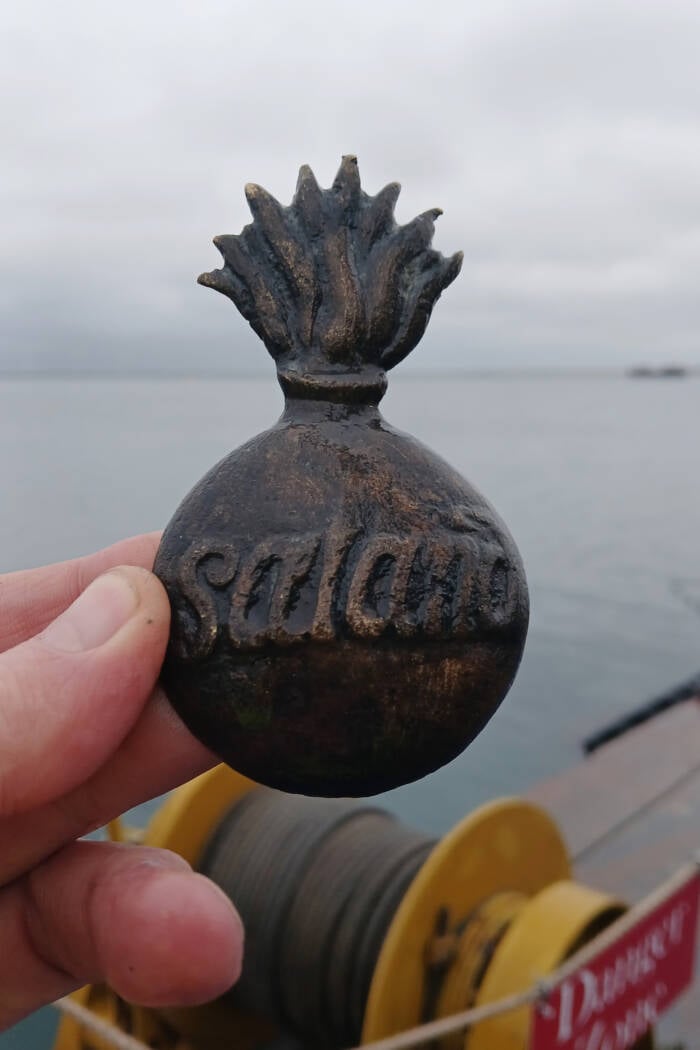
The Viking Ship Museum in RoskildeA metal insignia that was recovered from the wreck of the Dannebroge.
In preparation for the construction of an artificial island in Copenhagen, Denmark, archaeologists have been surveying the harbor’s seabed. They’ve found a number of fascinating underwater artifacts so far, including several unknown shipwrecks and the sunken remains of the world’s largest 15th‑century cog.
But they just made their most exciting discovery yet: the Dannebroge, a famous warship that was sunk in 1801.
The Dannebroge was destroyed by a British fleet led by Vice Admiral Horatio Nelson during the fierce Battle of Copenhagen. Of its crew of 357, 53 died onboard and 19 were never found. But the discovery of human remains amid the shipwreck suggests that some of these fallen sailors may finally be recovered at long last.
Discovering The Danish Warship Dannebroge In Copenhagen Harbor
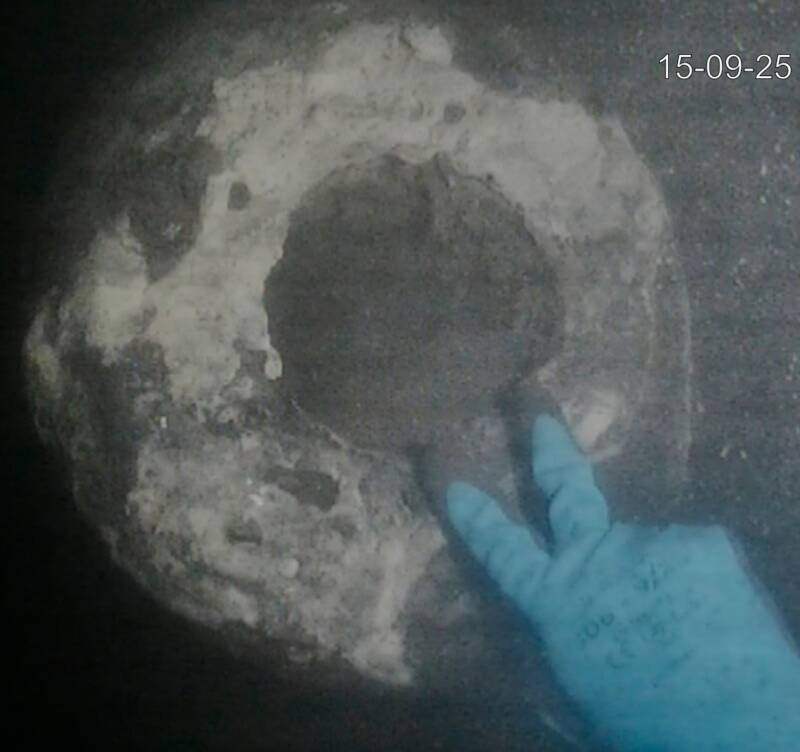
The Viking Ship Museum in RoskildeOne of the cannons from the Dannebroge, which was recently found by underwater archaeologists off the coast of Copenhagen.
According to a statement from the The Viking Ship Museum in Roskilde, the Dannebroge was discovered during an ongoing archaeological project to inspect the waters of Copenhagen Harbor ahead of the construction of an artificial island. At the end of 2025, they detected a “large shipwreck” roughly 50 feet beneath the surface that appears to be the Dannebroge.
“The dimensions of the timbers correspond exactly to the drawings of [Dannebroge] that survive, and the dendrochronological dating matches the vessel’s year of construction in 1772,” said Otto Uldum, a maritime archaeologist with the museum and the leader of the excavation. “So we are stating this with a degree of certainty that borders on absolute.”
He added that the area near the ship is also “littered with cannonballs and bar shot” and that marine archaeologists have also found two cannons.
What’s more, archaeologists uncovered human remains amid the shipwreck — rib bones and jaw bones — as well as objects like shoes and metal insignias that once belonged to the ship’s crew.
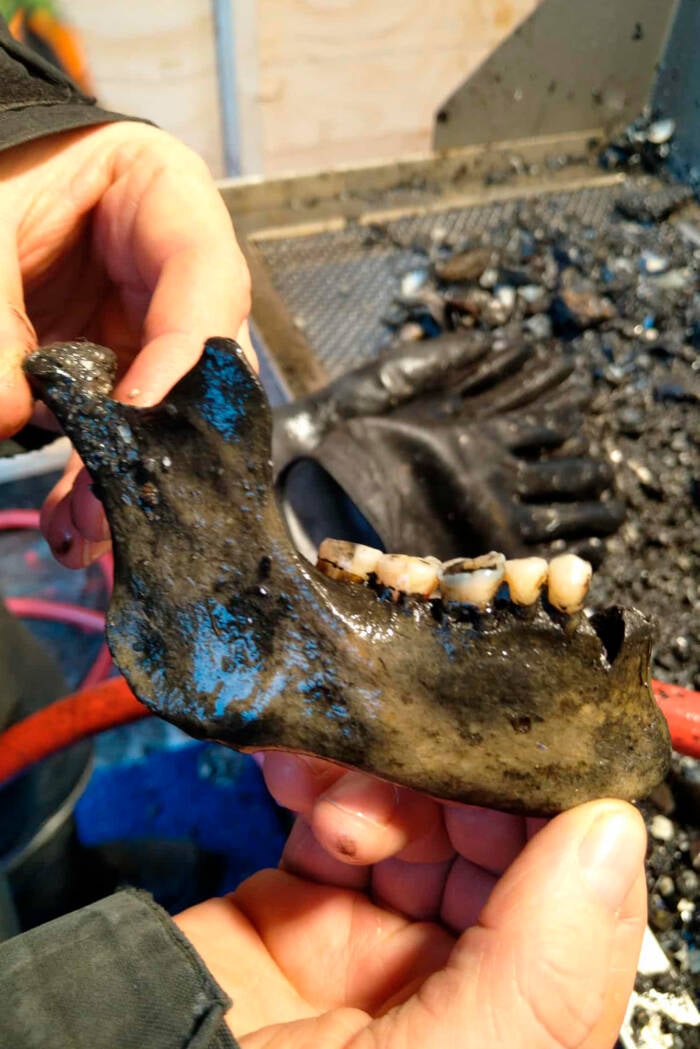
The Viking Ship Museum in RoskildeA lower jawbone recovered from the wreck of the Dannebroge that likely belonged to one of its lost crew members.
“We have found a number of personal belongings,” Uldum explained. “Shoes and fragments of clothing, and various small items the sailors would have carried with them — clay pipes, uniform insignia, and weapons. And we have also found remains of one of the 19 people who are listed as missing.”
Indeed, the newly discovered wreck of the Dannebroge has offered fresh insights into the dramatic clash in which it met its end.
How The Dannebroge Sank During The Battle Of Copenhagen In 1801

The Viking Ship Museum in RoskildeGrape shot found near the wreck of the Dannebroge.
The Battle of Copenhagen took place almost exactly 225 years ago, on April 2, 1801. The British, fearful that Denmark would align with France in the Napoleonic Wars, sent a fleet of almost 40 ships commanded by Vice Admiral Horatio Nelson. The Danes, outnumbered and outgunned, set up a blockade of ships in Copenhagen Harbor, hoping to repel the British. At 10:15 a.m., the battle began.
Nelson immediately targeted Dannebroge, the center of Denmark’s defensive line. Though the ship was armed with dozens of guns, it was unable to defend itself against the British onslaught. Not only did persistent attacks from the British fleet clear the ship’s deck of both its guns and its crew, but incendiary shells caused a fire to break out onboard.
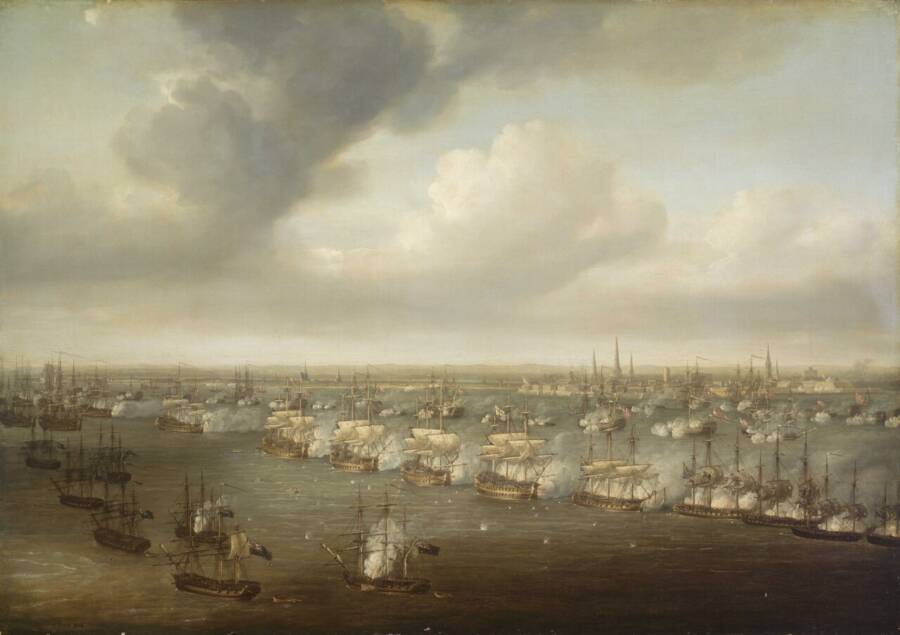
Royal Museums GreenwichA depiction of the Battle of Copenhagen, which pitted a powerful British fleet against a much smaller Danish one.
During the battle, Nelson famously ignored a signal from a superior to cease firing and withdraw. Blind in one eye, Nelson stated: “I have only one eye — I have the right to be blind sometimes.” He then lifted his telescope to his blind eye and declared, “I see no signal,” and continued to fire upon the Danish fleet. Thus we have the phrase “turn a blind eye.”
At 4 p.m., Denmark agreed to a ceasefire. Just 30 minutes later, the Dannebroge, which had drifted toward the north, exploded with what was remembered as “a deafening roar that can be heard across the entire city.”
For the next 225 years, the ship was lost beneath the murky waters of Copenhagen Harbor. But now, its wreck has been found, and every object that’s recovered will surely add to the story about its final chapter.
“We are now gaining an archaeological body of sources on the Battle of Copenhagen, and that is something entirely new. It is not something that has previously been excavated or studied archaeologically,” Uldum remarked. He added: “Every time we say even a little something about a shoe or a bone, it matters just a bit more, because this is actually the Battle of Copenhagen.”
After reading about the Danish warship that was discovered off the coast of Copenhagen, discover the stories behind some of history’s most famous shipwrecks. Then, read about the 1708 sinking of the San Jose — and why it’s considered the “holy grail” of shipwrecks.