You've heard about Sasquatch and the Loch Ness Monster, but they're far from the only cryptids with bone-chilling backstories.
Cryptids are legendary creatures rumored to exist around the world — without any verifiable proof. Though some people dismiss cryptids as mere folktales, others are convinced they truly live among us.
Perhaps the most well-known examples of cryptids are Bigfoot and the Loch Ness Monster. For decades, believers have tried to prove the existence of these creatures. One of the most controversial examples of Bigfoot “evidence” was the Patterson-Gimlin film, which allegedly recorded the legendary animal in 1967. Then, there was a photo that supposedly captured the Loch Ness Monster in 1934 and published by the Daily Mail.
As it turned out, the picture of “Nessie” was later proven to be a hoax, and the footage of “Sasquatch” remains heavily scrutinized to this day (though never fully debunked). Still, these images became international sensations and sparked countless hunts for the creatures — which continue today.
But even though the Loch Ness Monster and Bigfoot are two of the most famous cryptids in the world, they are far from the only ones. Below, you’ll find a list of 11 other fascinating — and creepy — cryptids from history.
The Wolpertinger: One Of The Most Famous Cryptids Of Germany
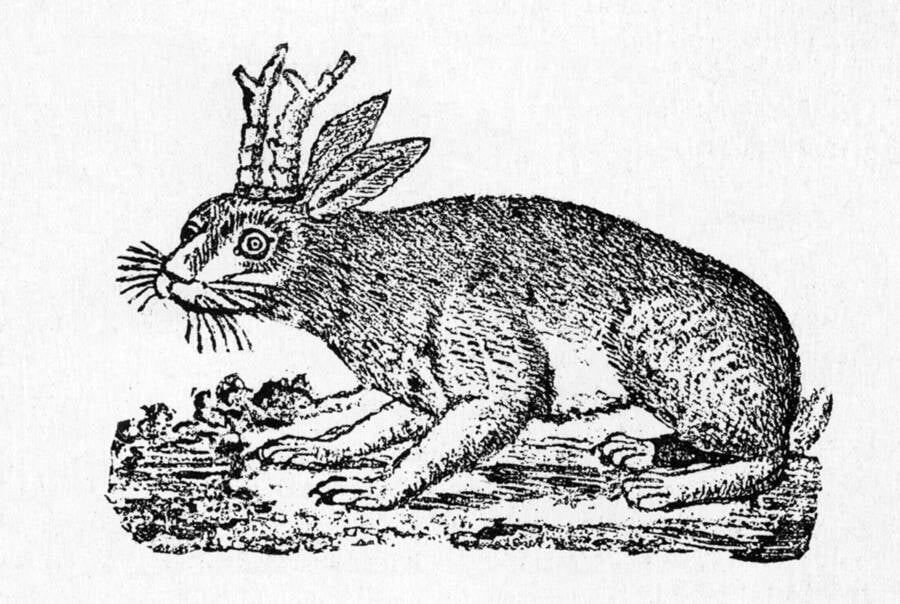
Wikimedia CommonsThe wolpertinger is a German cryptid said to reside in the alpine forests of Bavaria and Baden-Württemberg.
Whether you know it as the wolpertinger, the wolperdinger, the woipertinger, or the volpertinger — yes, there are quite a few variations of its name — this cryptid is unquestionably bizarre. Originating in German folklore, the wolpertinger supposedly has the body of a hare, the antlers of a deer, and the wings, feet, or beak of a bird, depending on the story.
Locals in the alpine regions of Bavaria used to spin tales of the wolpertinger to travelers passing through the region in the early 19th century. According to these legends, the first wolpertinger was born as the result of a hare and a roebuck mating, but as more and more wolpertingers were born, they began to mate among themselves. Over time, these creatures came to take on the characteristics of several different woodland animals.
While wolpertingers are said to only feast on herbs, roots, and insects, travelers were warned to avoid them as they exuded a foul, skunk-like odor that could linger on people for seven years after exposure. Anyone unfortunate enough to come into contact with the wolpertinger’s saliva would also soon begin to grow patches of thick hair all over their body.
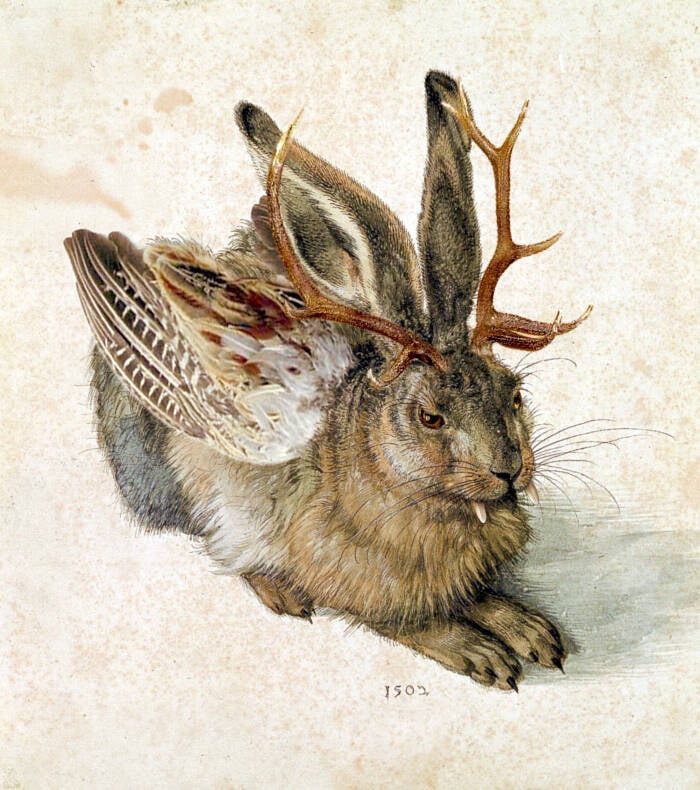
Wikimedia CommonsMany taverns and inns in Bavaria and Baden-Württemberg display stuffed “wolpertingers” for guests to marvel at.
Unlike some of the other cryptids on this list, however, it’s been essentially confirmed that the wolpertinger is a hoax. The alpine forests of southern Germany provided the perfect backdrop for fanciful stories, and local taxidermists capitalized on this by stitching together pieces of different forest animals and putting them on display, weaving tales for visitors and telling them to be on the lookout for the wolpertinger as they traveled.
Of course, this type of trickery is not limited to Germany.
In the United States, entrepreneurs realized the value in displaying odd taxidermied animal combinations when there was a good tale to accompany it. Thus, the jackalope was created in Wyoming — another mythical rabbit with antlers put on display to lure travelers into stopping by for a drink and a story.
Funnily enough, there are so-called “horned rabbits” in the wild, but they are far from mystical. Rather, these rabbits are simply suffering from Shope papilloma virus, also known as cottontail rabbit papillomavirus, which causes large horn-like growths to appear on or near rabbits’ heads.
The Ya-Te-Veo
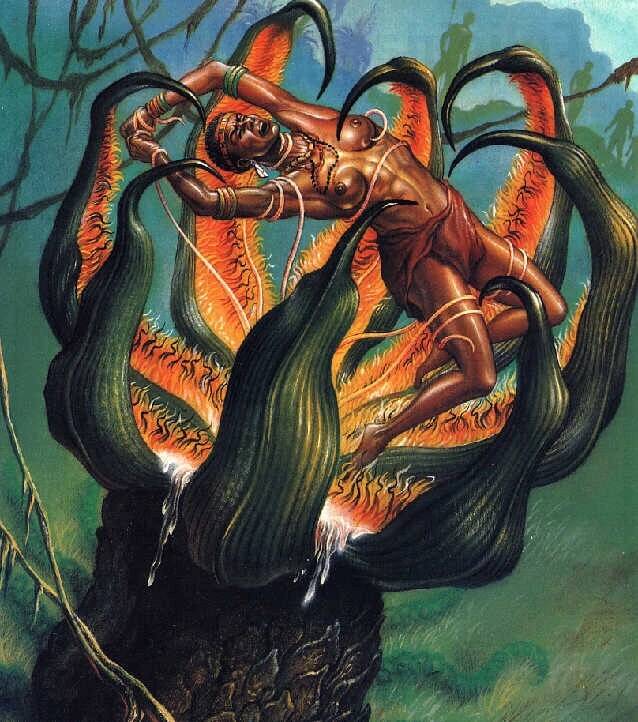
Cryptid WikiAn artist’s depiction of ya-te-veo, a man-eating plant said to grow in South America and Africa.
The idea of man-eating plants has been utilized in plenty of modern media, like the 1986 movie Little Shop of Horrors. It isn’t a completely far-fetched idea — after all, species like the Venus flytrap show that carnivorous plants exist. Taking that idea to the extreme is simply good entertainment.
However, an 1874 New York World article written by a purported German explorer named Karl Leche claimed that man-eating plants were real.
According to Leche — who was actually the author Edmund Spencer writing under a pseudonym — he met a tribe known as the Mkodo when he was exploring Madagascar. While he was with the tribe, Leche claimed to have witnessed a bizarre ritual sacrifice in which the tribe offered up a human to a carnivorous tree. The bloodthirsty plant then devoured the sacrifice.
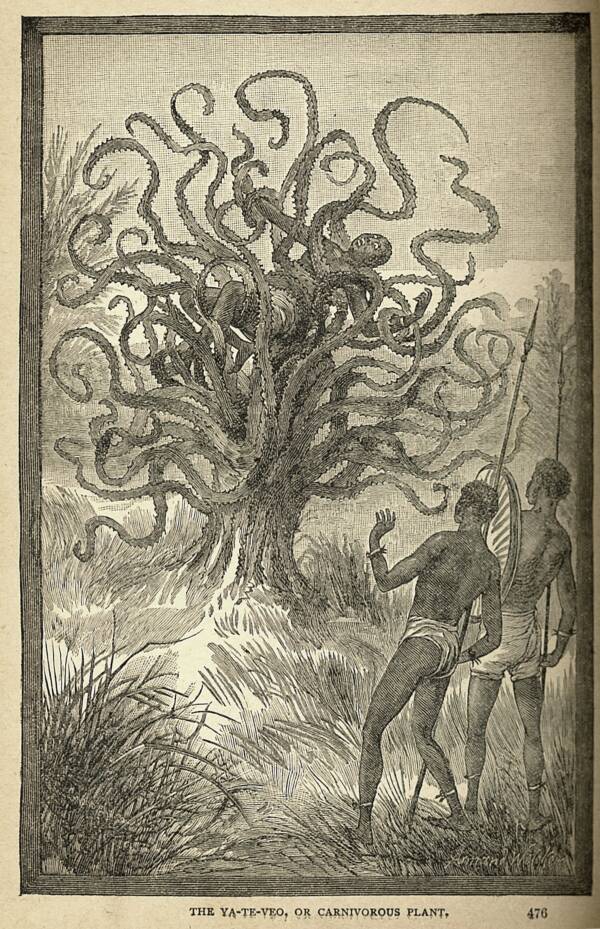
Wikimedia CommonsThe story of ya-te-veo — one of the scariest cryptids on this list — was spread by numerous national newspapers.
Leche’s account reads in part:
The slender delicate palpi, with the fury of starved serpents, quivered a moment over her head, then as if instinct with demoniac intelligence fastened upon her in sudden coils round and round her neck and arms; then while her awful screams and yet more awful laughter rose wildly to be instantly strangled down again into a gurgling moan, the tendrils one after another, like great green serpents, with brutal energy and infernal rapidity, rose, retracted themselves, and wrapped her about in fold after fold, ever tightening with cruel swiftness and savage tenacity of anacondas fastening upon their prey.
Former Governor of Michigan Chase Osborn further spread the story in his 1924 book, Madagascar: Land of the Man-Eating Tree, in which he claimed that missionaries in Madagascar had heard of the bloodthirsty tree. However, he also admitted that he did not know if the story was true.
Though the Madagascar tale was eventually confirmed to be a hoax, a different book by author James W. Buel, Sea and Land, had already introduced the public to another story of the man-eating tree in 1889. This one was given the name ya-te-veo, and this legendary plant not only appeared in Africa but also Central and South America.
The ya-te-veo name endured, and terrified those who believed in it, as it supposedly used its long branches to catch unsuspecting prey, including insects, bigger animals like horses, and humans who got too close to it.