Nearly 160 years ago, one of Victorian England's most storied archaeological digs turned up a prehistoric pendant inside a cave along the English Channel — and researchers have just now determined how magnificent a find this truly was.
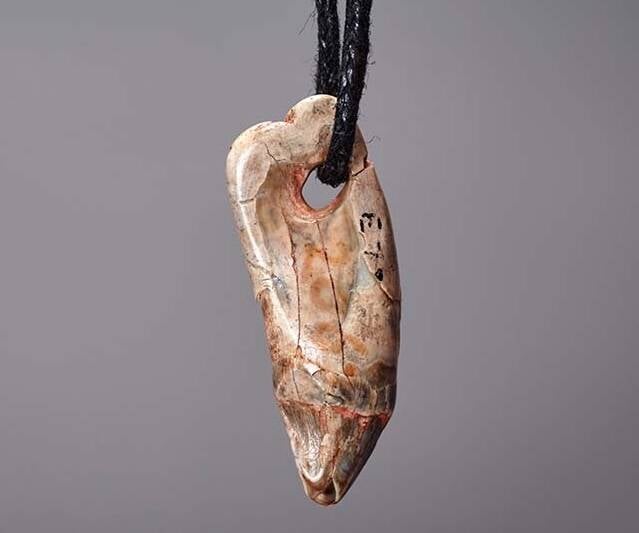
The Trustees of the Natural History MuseumThe seal tooth pendant was expertly made, suggesting that it was highly prized by its owner.
In 1867, archaeologists in Devon, England unearthed a pendant inside a cave used by both Homo sapiens and Neanderthals thousands of years before. The pendant then went overlooked for almost two centuries after its discovery, but researchers have recently taken another look. They discovered that the pendant was made not from the tooth of a badger, wolf, or beaver, as previously thought, but instead from the tooth of a gray seal — a whopping 15,000 years ago.
During the Late Upper Paleolithic period, someone collected this tooth and expertly carved it so that it could be worn as a pendant. Then they — or someone else — wore it long enough for the tooth to become smooth over time before it was finally left behind inside the cave where it was finally found.
The Prehistoric Seal Tooth Pendant Found In England
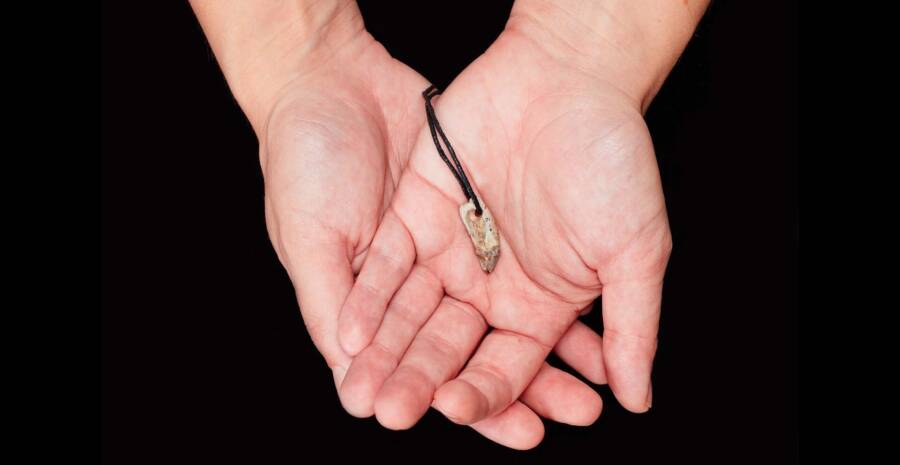
The Trustees of the Natural History MuseumThe seal tooth pendant was made some 15,000 years ago.
According to a new study on the seal tooth pendant published in Quaternary Science Reviews, this fascinating relic was discovered in 1867 during excavations at Kents Cavern, a site in southwestern England where Homo sapiens and Neanderthals lived for tens of thousands of years.
Though the pendant then went overlooked for some 160 years, researchers recently discovered that it was made roughly 15,000 years ago. They also found that it came from the jaw of a gray seal, not a land animal, as previously assumed.
It’s unknown if the seal was killed or if it died of natural causes and washed ashore, but researchers do know what came next. A prehistoric human — possibly using a heavy object as a tool — extracted one of the seal’s teeth. Then, someone delicately scraped off the root, drilled the tooth with a piece of flint, and pushed a piece of cord through the hole.
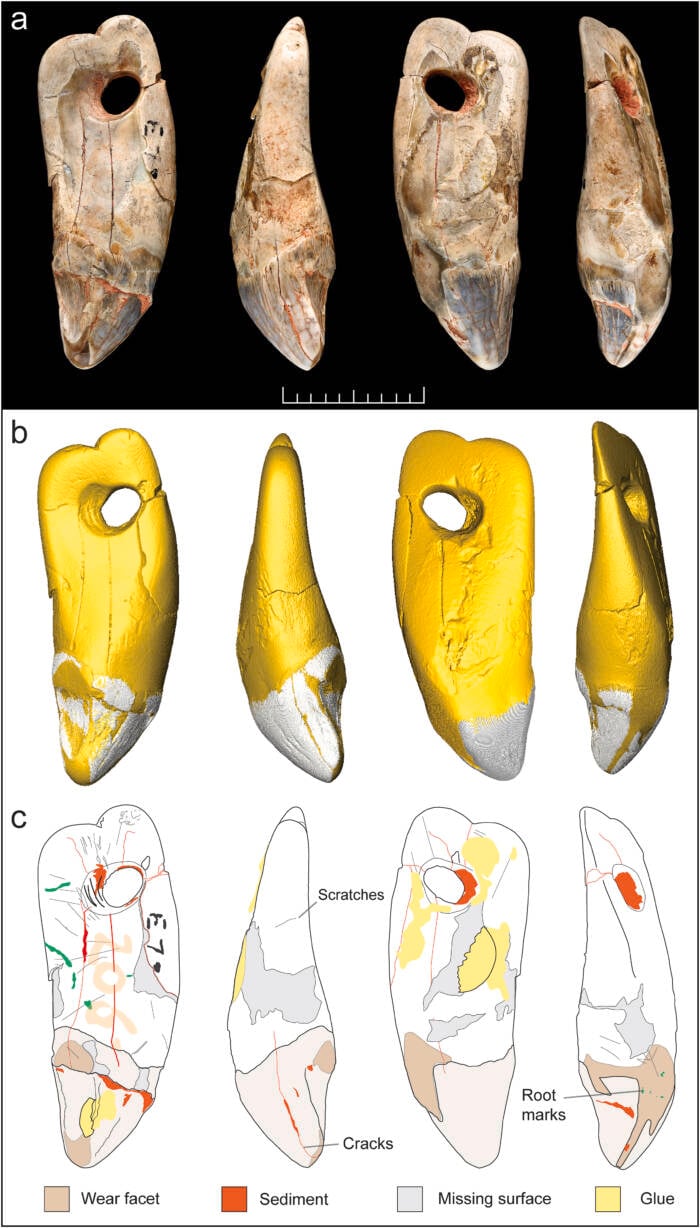
The Trustees of the Natural History MuseumNew analysis of the pendant, which was made from the tooth of a 12-year-old gray seal.
At that point, someone wore the seal tooth as a pendant or bracelet. According to the researchers, its owner likely wore it for a long time.
“The pendant was probably worn for many years, because it’s become smooth through wear and repeated polishing,” Silvia Bello, a co-author of the study and a human evolution expert at the Natural Museum London remarked in a museum statement. “A long period of use would also explain why the neat circular hole became more oval shaped, as the cord gradually wore away at the tooth’s interior.”
Bello added: “While it’s well-loved, the pendant is still in pretty good shape. This means it might have been accidentally lost by its owner when they came to the cave, rather than intentionally discarded.”
But while it’s impossible to know who owned this seal tooth pendant, or why they left or lost it in Kents Cavern, the object offers fascinating insights into the lives of prehistoric humans living in the British Isles.
The Significance Of The Paleolithic Pendant Discovered Inside Kents Cavern
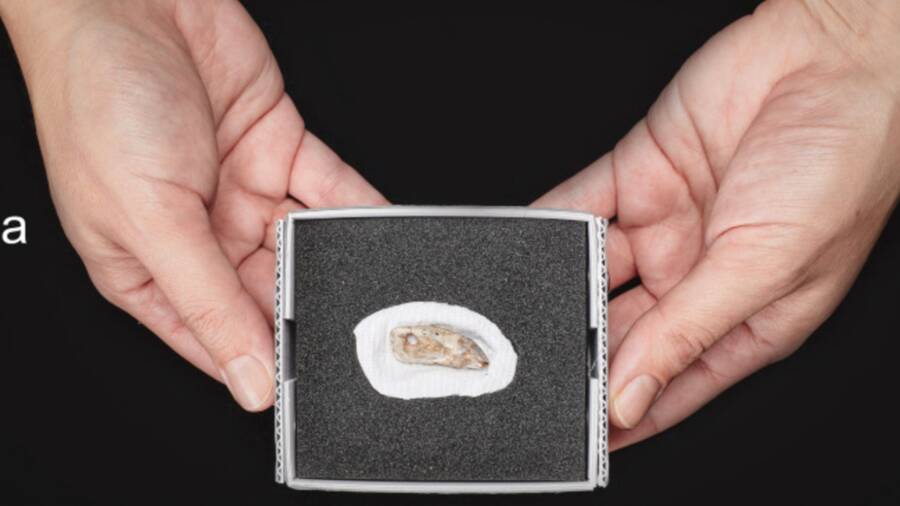
The Trustees of the Natural History MuseumThe seal tooth pendant is still in good shape, suggesting it was lost, rather than intentionally discarded, by its owner.
Today, the area where the seal tooth pendant was found is a tourist destination overlooking the English Channel. But 15,000 years ago, sea levels were different, and Kents Cavern was located roughly 80 miles from the shoreline.
This suggests that the seal tooth pendant and its wearer had traveled a great distance long ago. It could have been traded from someone who lived near the sea to someone who lived further inland. But it’s also possible that prehistoric peoples in this area traveled long distances, perhaps to follow migrating animals that served as a food source.
What’s more, the composition of the pendant suggests that it was made by someone with a high level of skill. It would have taken great dexterity and experience to drill the hole into the tooth without breaking it.
Given that only four such seal tooth pendants have ever been found before (none of them in the British Isles), researchers believe that this rare pendant would have been highly valued by its owner. It may have even symbolized something to them, though the pendant’s possible significance has since been lost to the ages.
“It’s just speculation, but I think this seal tooth pendant might have had some formal purpose – perhaps to show the social identity of the pendant’s owner,” Bello remarked in the museum statement. “It could be an indication that the person, or group they were part of, was familiar with the sea and maybe used to live near the coast. We’ll never know for sure, but it provides a fascinating glimpse into the past.”
After reading about the 15,000-year-old seal tooth pendant found in England, look through this collection of stunning reconstructed faces of ancient people. Then, see some of the most incredible ancient ruins around the world.