On October 29, 1929, investors lost more than $25 billion during the Black Tuesday stock market crash that brought the Roaring Twenties to a screeching halt.
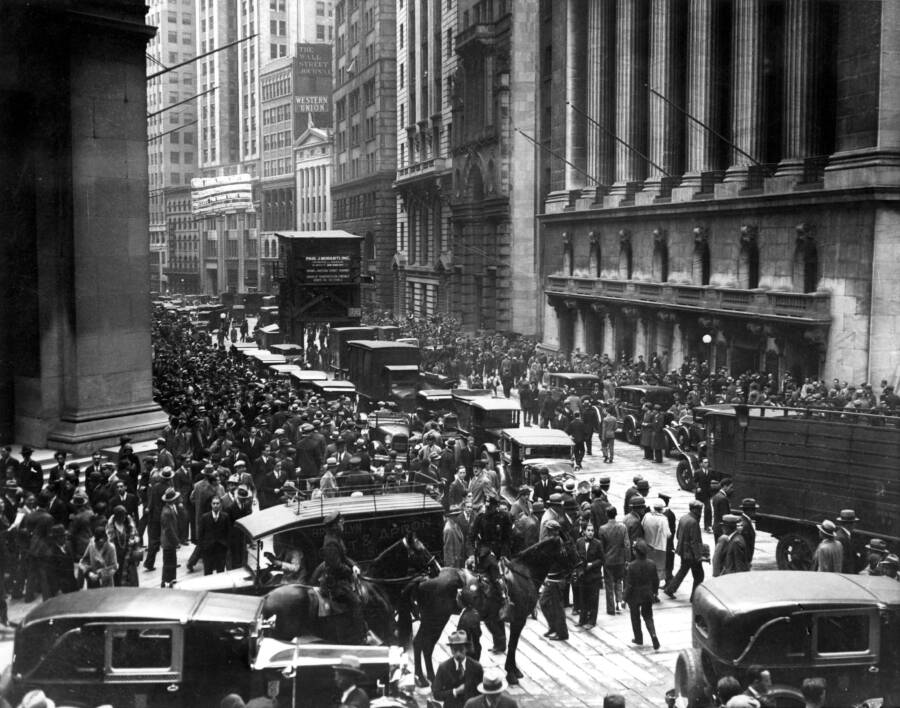
Public DomainPanicked investors gathered on Wall Street on Black Tuesday.
On Oct. 29, 1929, the stock market dropped by nearly 12 percent. Panicked investors sold off more than 16 million shares, and countless Americans lost their life savings. The day infamously became known as Black Tuesday.
The Wall Street crash followed several days of uncertainty in the market. The free fall had begun on Oct. 18, but major banks and big businesses were initially able to stave off the disaster by purchasing large amounts of stock. By Oct. 29, however, it was clear that a stock market collapse was inevitable.
In the weeks that followed, rumors circulated that ruined investors were jumping from skyscrapers in Manhattan. While these stories were mostly exaggerated, the crash did wipe out $25 billion — the equivalent of $500 billion today.
Black Tuesday brought an abrupt end to the Roaring Twenties and ushered in the Great Depression, impacting the lives of millions of Americans for years to come.
The Events Leading Up To The Economic Disaster
Before the Wall Street crash of 1929, it seemed as if the prosperity of the Roaring Twenties might last forever. America’s wealth more than doubled throughout the decade, fueled by industrial growth and the rise of a credit system that was accessible to the average person.
Between 1921 and 1929, the stock market had grown by 600 percent, with the Dow Jones Industrial Average rising from 63 points to 381 points. This economic boom meant soaring automobile sales, affordable appliances, and a growing interest in purchasing stocks and bonds.
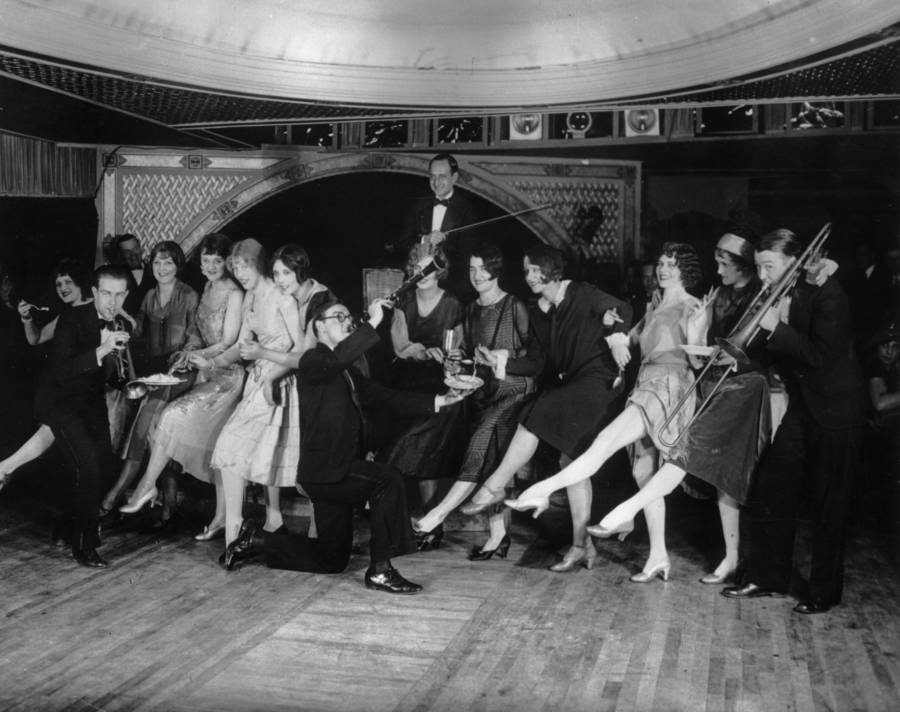
Hulton Archive/Getty ImagesThe Roaring Twenties were marked by rapid economic growth, unprecedented consumer demand, and the rise of the Jazz Age and the flapper.
Just two weeks before the crash, Yale economist Irving Fisher told members of the Purchasing Agents Association that stock prices had hit “what looks like a permanently high plateau,” as The New York Times reported on Oct. 16, 1929. He also predicted that the stock market would be “a good deal higher than it is today, within a few months.”
But not all was well in the economy. Many people who were flush with cash were putting it into the market, and this exponential growth inspired others to take out loans or even mortgage their homes to get in on the payday. They purchased stocks on credit, intending to sell them for a higher price and still make a tidy profit after paying back their lenders. This further inflated the stock market — but it also made the impending crash even more devastating.
The Wall Street Crash Of 1929
Not all experts agreed with Irving Fisher’s optimistic assessment of the market. In September 1929, according to The New York Times, statistician Roger Babson had spoken at the National Business Conference and warned attendees, “More people are borrowing and speculating today than ever in our history. Sooner or later a crash is coming and it may be terrific.”
And come it did. The first signs of trouble appeared on Oct. 18, when the market began a free fall. Investors initially snatched up shares for low prices, intending to sit on them until they rebounded, but they never imagined what would happen next.
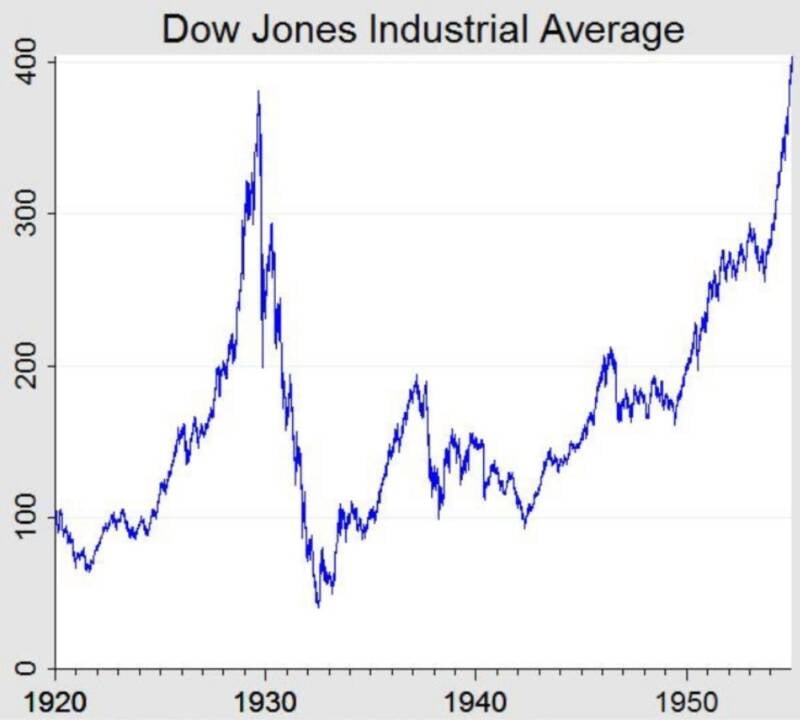
U.S. Federal ReserveA graph of the Dow Jones Industrial Average from 1920 to 1955 clearly shows the moment when the stock market crashed in 1929.
By Oct. 24, which became known as Black Thursday, people had started to panic. The market had continued to decline, and a record 12.9 million shares were traded that day as investors tried to recoup at least some of their money. Companies and banks attempted to prop up the market by buying large numbers of stocks, so the Dow closed just six points down, but these efforts soon proved futile.
When the press questioned President Herbert Hoover about the issue on Oct. 25, he tried to calm the nation’s nerves, stating, “The fundamental business of the country, that is the production and distribution of commodities, is on a sound and prosperous basis.”
But the president’s words and the banks’ attempts to hold off disaster couldn’t staunch the bleeding. On Monday, Oct. 28, the stock market dropped 12.8 percent. And the following day, Black Tuesday, it plummeted a further 11.7 percent. Investors traded a record-breaking 16.4 million shares, going through 15,000 miles of ticker tape. Children in nearby slums later rolled the discarded strips of paper into balls that they played with in the streets.
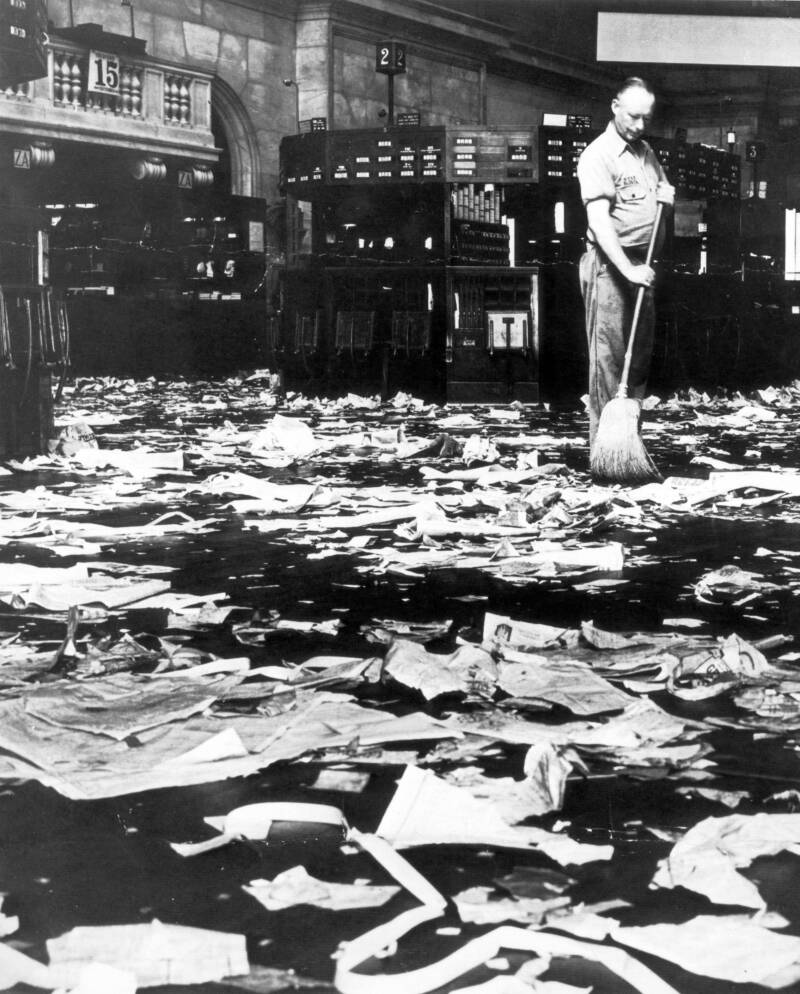
Public DomainA janitor sweeps crumpled paper and ticker tape from the floor of the New York Stock Exchange following the Wall Street crash.
It’s said that the opening bell wasn’t heard on the morning of Oct. 29 because it was drowned out by shouts of “Sell! Sell! Sell!” Three million shares were sold within 30 minutes, and by the end of the day, the Dow Jones Industrial Average sat at 198, well below its high of 381. $25 billion had been lost, and many stockholders were left penniless and in debt, as they’d purchased their stock on credit.
The Roaring Twenties had come to a screeching halt, and the next decade would be a far cry from the previous era of prosperity.
The Devastating Impacts Of Black Tuesday
As the true extent of the Wall Street crash became obvious, rumors quickly spread that ruined investors and overburdened stockbrokers were flinging themselves from the upper floors of their office buildings. Following the events of Black Thursday, humorist Will Rogers wrote to the editor of The New York Times, “When Wall Street took that tail spin, you had to stand in line to get a window to jump out of, and speculators were selling space for bodies in the East River.”
In reality, there were fewer suicides between mid-October and mid-November 1929 than during the same period the year prior, but several cases were verified. Hulda Borowski, a clerk at a brokerage firm on Wall Street, jumped from the roof of her office building and fell 40 stories to her death in early November. Her fellow employees told the police that she was exhausted from overwork. Ten days later, George Cutler, the head of a wholesale produce firm, leaped from a seven-story window after suffering heavy losses in the market.
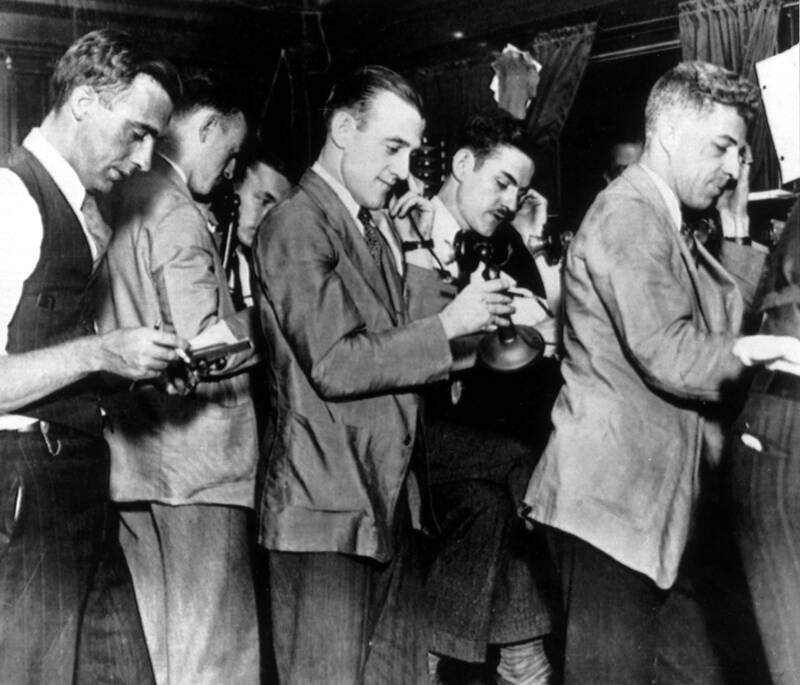
Public DomainStockbrokers working at the New York Stock Exchange on Oct. 25, 1929.
And on Dec. 7, 1929, a man named Wellington Lytle died by suicide in a hotel room in Milwaukee. According to a TIME article published later that month, his final note read, “[M]y body should go to science, my soul to Andrew W. Mellon [the Secretary of the Treasury at the time], and sympathy to my creditors.”
Even as the immediate aftermath of Black Tuesday waned, it became clear that its impacts would last far beyond the autumn of 1929. While the market briefly rebounded, the Dow had plunged to just 41.22 points by the summer of 1932, the lowest value of the 20th century. The Great Depression had officially begun.
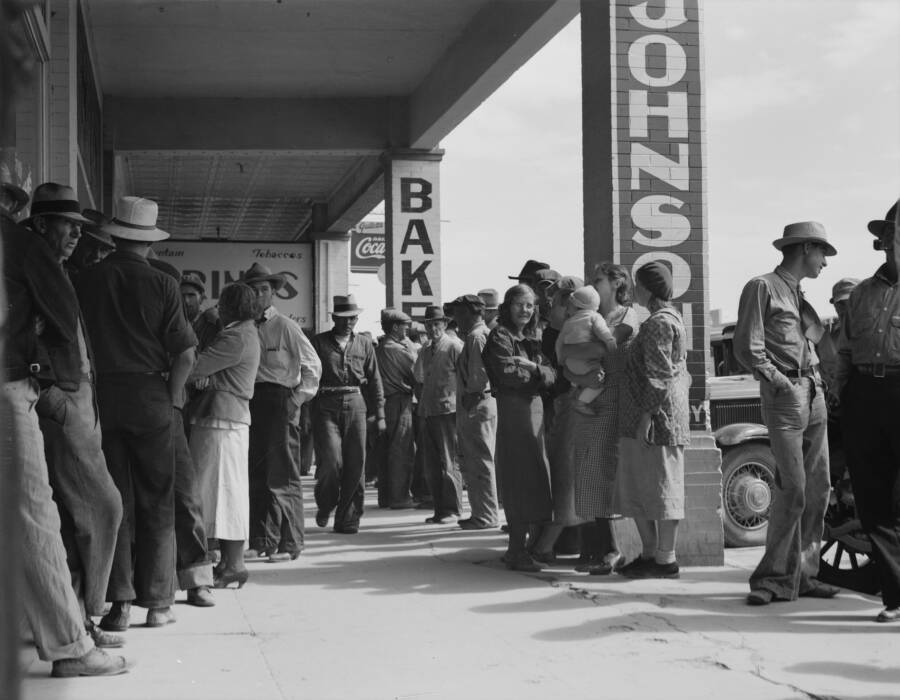
Public DomainDesperate Californians line up to wait for relief checks during the Great Depression. 1937.
Consumers tightened their spending, leading to a drop in demand for goods and services. Production facilities had to lay off workers, and unemployment spiked, reaching nearly 25 percent in 1933, the highest level in U.S. history. Banks started to fail, and in a time before deposit insurance, that meant that account holders lost everything. Americans rushed to withdraw their money, causing even more banks to shut their doors.
Shantytowns known as “Hoovervilles” spread across the country. Millions lined up at soup kitchens. Panic in the market transformed into panic over the country’s entire economy. This was only exacerbated by the Dust Bowl, a period of drought that devastated crops in the American West. The market wouldn’t reach its previous highs again until 1954.
Millions of citizens suffered throughout the 1930s, and Black Tuesday went down in infamy as the day that marked the beginning of this catastrophic new era.
After reading about Black Tuesday, look through 55 harrowing photos of life in New York City during the Great Depression. Then, learn the devastating story behind Dorothea Lange’s famous Migrant Mother photograph.