Marie-Angélique Memmie Le Blanc: The Feral Child Who Went From Rags To Riches
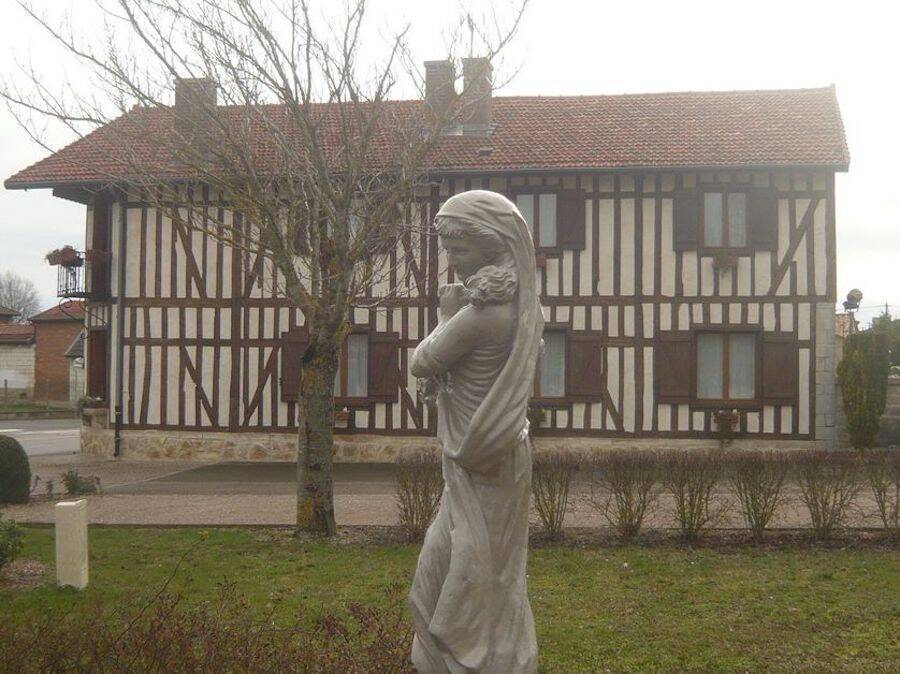
A statue of Marie-Angélique Memmie Le Blanc in Songy, France.
In 1731, villagers in Songy, France spotted a young girl dressed in animal rags stealing apples from an orchard. It was difficult for the villagers to tell how old she was, and her age was estimated to be anywhere from 10 to 18.
When the villagers sent a bulldog her way, she killed it with one fatal blow and escaped into the woods in mere moments. The villagers eventually captured her and soon realized that she didn’t speak any formal language. Instead, she communicated much like an animal, often howling.
Hospitalized in Chalons, she was baptized as Marie-Angélique Memmie Le Blanc. With that, doctors and other experts immediately moved toward “civilizing” her. It was clear that she had only been eating raw meat when doctors fed her cooked food — and all of her teeth fell out.
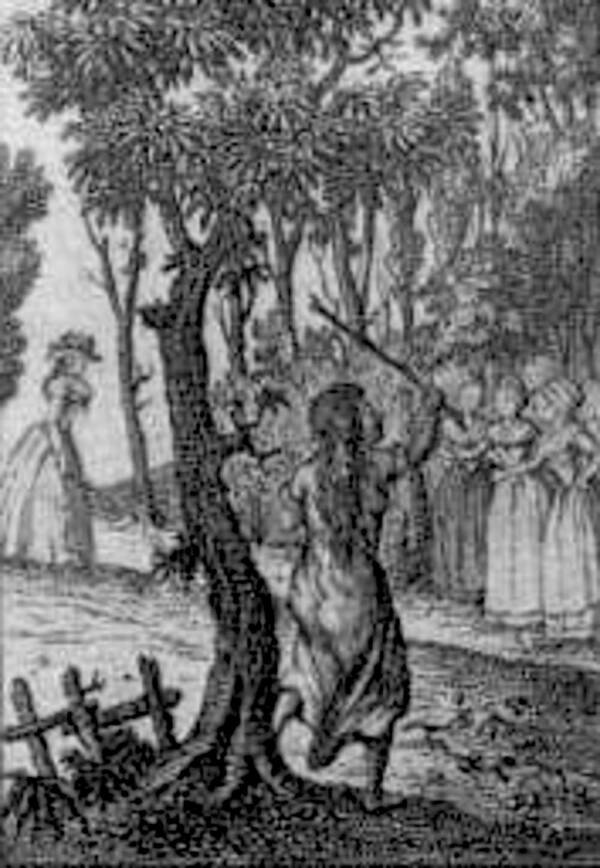
JSTORAn illustration of Le Blanc’s encounter with villagers from An Account of a Savage Girl.
The feral child’s origins were only revealed in 1755 when biographer Marie-Catherine Homassel-Hecquet published An Account of a Savage Girl in collaboration with Le Blanc. A Native American girl, Le Blanc had allegedly been painted black and sold as a slave in Wisconsin at age seven. Sold to a French woman, Le Blanc was put on a France-bound ship.
Many believe that the boat in question was shipwrecked, and Le Blanc washed ashore with another girl. From there, they both became feral people and slept in the wilderness, surviving on raw squirrels, foxes, and rabbits. At some point, the pair separated, and Le Blanc was eventually captured.
Despite her traumatic start to life, Le Blanc would eventually regain her health while in the hospital. Even more incredible, she soon learned to speak French under the tutelage of several patient teachers, apparently regaining linguistic abilities that had been lost for quite some time.
She was gawked at by intellectuals and high-society people in France as a former “savage” who had become refined. Mingling with nobility, Le Blanc was given a generous allowance by a duke and permitted to explore Europe. For a brief period of time, she even tried her hand at becoming a nun.
While the duke’s death in 1752 left Le Blanc without financial recourse, she was soon able to secure other patrons thanks to her numerous wealthy connections. By the time she died at age 63 in 1775, she was notably wealthy herself. It was said that she preferred to wear silk and velvet clothing — and yet she still maintained “a certain wildness” in her appearance.
Oxana Malaya: The Girl Raised By Dogs

MarkMcDermott/YouTubeOxana Malaya spent years living in a kennel with dogs.
In 1994, a feral child was discovered living among wild dogs in the village of Nova Blagovishchenka in Ukraine. Local police had never dealt with feral humans before, and they had to use food in order to distract the hounds while they lured the young girl away from her canine friends.
The eight-year-old was eventually identified as Oxana Malaya, a local girl whose alcoholic parents had abandoned her outside in the cold five years earlier. Instinctively, Malaya had crawled into a dog kennel to seek warm shelter and spent the next five years with its inhabitants.
Sustained by whatever scraps of leftovers the canines were fed, Malaya may have occasionally entered her old house for additional food. But she undoubtedly lived a largely feral life outdoors until the police were called.

MarkMcDermott/YouTubeExamined as a young adult, Malaya was found to have the mental capacity of a six-year-old.
Her bond to the pack of dogs had been so strong that it was difficult for police to overcome, but assimilating Malaya into society and teaching her how to behave like a human again proved to be even more challenging.
As a ward of the state, Malaya was admitted to several psychiatric institutes and group homes. For a while, she was unable to speak and continued to walk on all fours. But Malaya eventually learned how to talk again, thanks to the minimal language she already knew from her early years.
At an orphanage school, Malaya was successfully taught a more wide-ranging vocabulary. She also learned how to walk upright again and to communicate like other human beings — at least for the most part.
Though Malaya is now an adult, she still requires supervision at a full-time care facility and will likely never be fully independent. She is also said to speak in a flat, emotionless tone, almost as if she’s being ordered to talk. But her bark remains as strong as ever, and whenever she’s given an object, her very first instinct is to hide it — just like a dog does with a bone.