Famous Sideshow Performers: Myrtle Corbin — ‘The Four-Legged Girl’
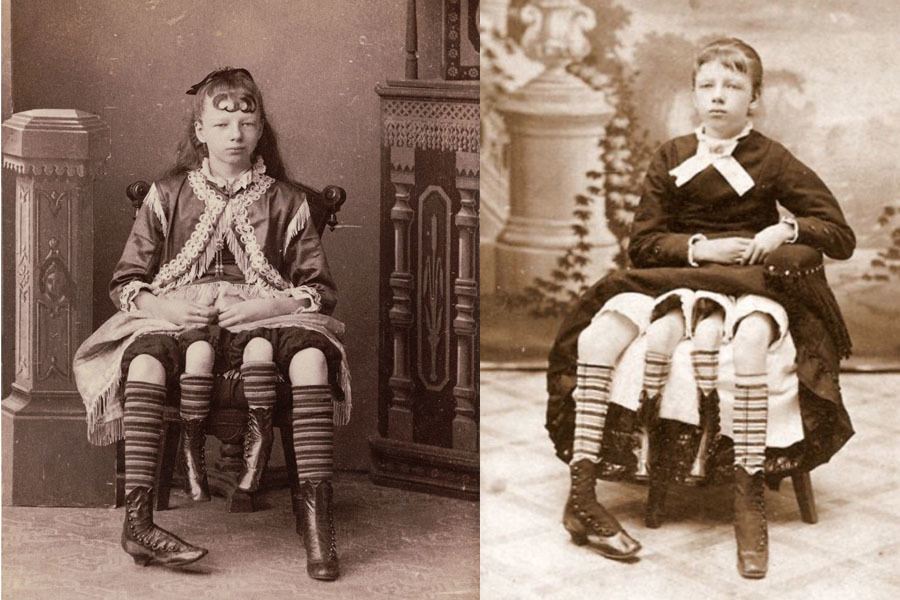
Wikimedia CommonsMyrtle Corbin had four legs due to a rare condition known as dipygus.
Born in 1868 in Tennessee, Myrtle Corbin entered the “freak show” circuit at the age of 13 and was billed as the “Four-Legged Girl from Texas.”
Due to a condition known as dipygus, Corbin had been born with two separate pelvises situated side by side. With each pelvis, she also had two sets of legs. One set was average-sized, while the other was small. The two smaller legs were side by side, flanked on either side by the longer legs.
According to medical reports, Corbin had the ability to move her two inner legs, but they were too weak to sustain her weight or be used for walking — and they weren’t even able to touch the ground. Doctors also noted that Corbin had two sets of internal and external reproductive anatomies.
Eventually, P.T. Barnum heard about the “four-legged girl” and decided to hire her for his show, introducing her to a large audience. Corbin worked for Barnum for about four years. Known for her “gentle” and “happy” disposition, Corbin became a very popular sideshow performer — earning up to $450 per week (roughly $14,000 today). In fact, she was such a popular sideshow performer that other circuses and “freak shows” began to feature phony four-legged people in an attempt to replicate her success.
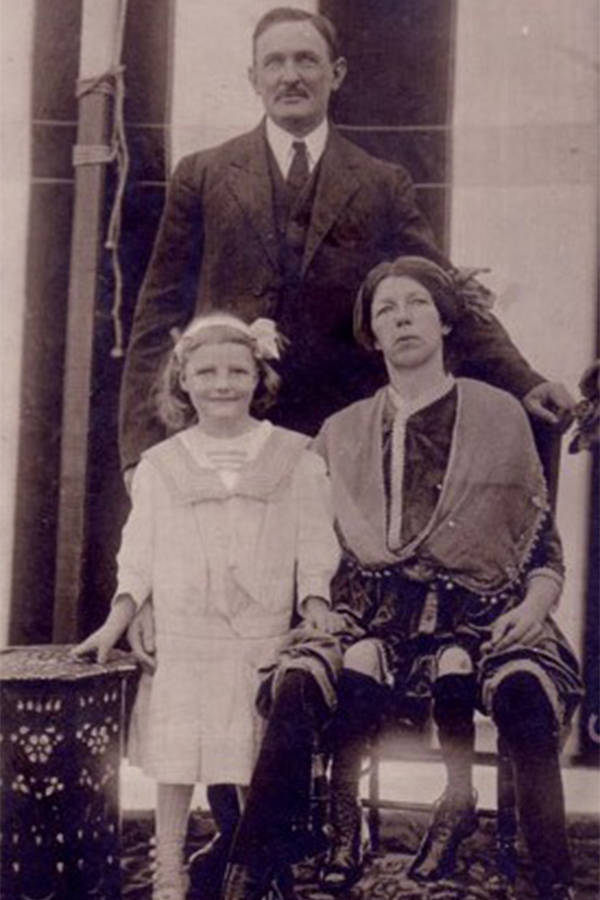
Wikimedia CommonsMyrtle Corbin with her husband and one of her daughters.
Following her successful circus career, Corbin married James Clinton Bicknell at the age of 18. They had five children, and Corbin enjoyed a relatively quiet life in her later years. Sadly, she died of a bacterial skin infection just six days short of her 60th birthday in 1928.
After she was buried, her family covered her casket in concrete out of fear that grave robbers would steal her corpse. After all, physicians and showmen had offered large sums of money for her body.
But her loved ones refused the offers — and stood vigil over her grave until the concrete was set.
Fedor Jeftichew — ‘Jo-Jo The Dog-Faced Boy’
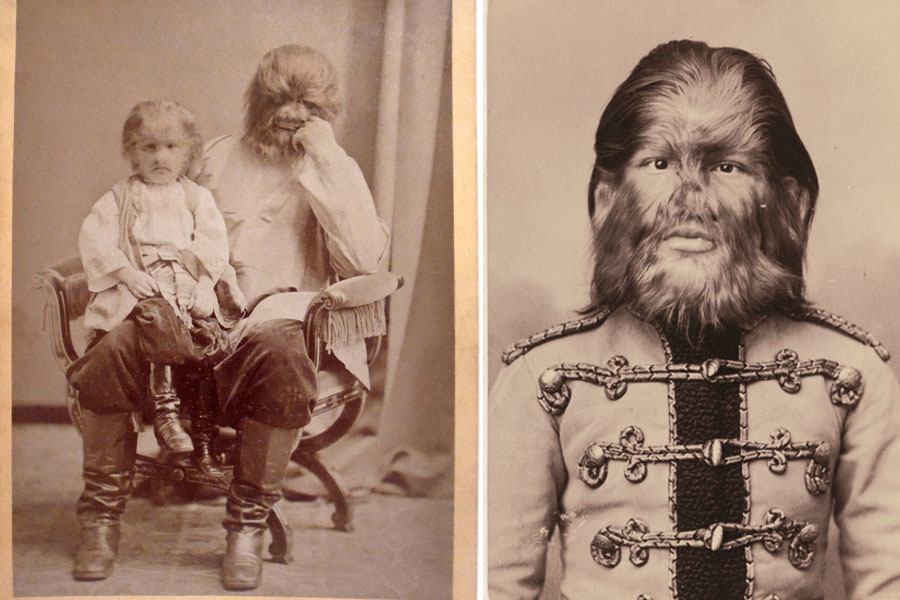
Wikimedia CommonsLeft: Jo-Jo the Dog-Faced Boy and his father. Right: A portrait of Jo-Jo.
Fedor Adrianovich Jeftichew was born in 1868 in St. Petersburg, Russia. From the beginning, it was clear that he was different.
Jeftichew had been born with hereditary hypertrichosis (aka werewolf syndrome), which causes an excessive amount of hair growth over the entire body. His father had the same condition, and both performed in European circuses during the 19th century. But while Fedor’s father sadly drank himself to death, Fedor was ultimately recruited by P.T. Barnum in 1884.
Back in the United States, Barnum advertised Fedor Jeftichew as a “dog-faced boy” and claimed that Jeftichew and his father had been captured by a hunter while living in a cave in the forest. Though Jeftichew was described as gentle, his father was depicted as a “savage” who was unable to be tamed and was thus killed by the hunter. Barnum claimed he had succeeded at taming Jeftichew himself. During shows, Jeftichew would bark and grow, although in reality he was very intelligent, and spoke multiple languages.

Public DomainThe sideshow performer Fedor Jeftichew in the 1880s.
Billed as “the most prodigious paragon of all prodigies secured by P.T. Barnum in over 50 years,” Jeftichew became one of the most popular sideshow performers in the United States. The New York Herald described him as being as playful as a puppy and “the most absorbingly interesting curiosity to ever reach these shores.”
Tragically, Fedor Jeftichew died of pneumonia at age 35 on January 31, 1904, in Greece. When news of his death reached the United States, he was mourned by fans and other sideshow performers all over the country.