Researchers haven't yet been able to decipher its ten pages' worth of cursive script written in Latin, but they suspect that the book may have once belonged to a merchant who could have simply dropped it in the latrine by accident.

LWL Archaeology for Westphalia/E. DaoodThe text in the notebook is written in Latin, and it’s still largely legible.
For most people, a centuries-old latrine surely sounds like a disgusting site. But for archaeologists, it could be a treasure trove. And an excavation of a medieval latrine in Paderborn, Germany, recently turned up a true treasure in the form of a leather-bound notebook from the 13th or 14th century.
While more work is needed to decipher the notebook’s text, certain words are legible and the object itself is in surprisingly good condition. Archaeologists hope to discover more about what it contains, and about the person who used it — and seemingly lost it — centuries ago.
The Medieval Notebook Found In The Ruins Of A German Latrine
According to a statement from the Regional Association of Westphalia-Lippe, the notebook was found during a preventative archaeology project ahead of the construction of a new city administration building in Paderborn, Germany.
During the project, which began in 2024, archaeologists came across a set of five latrines. Sealed, airtight containers, the latrines extended down into the limestone soil of a former quarry from the 11th century.

Denkmal3d, Heike TausendfreundThe medieval latrine where archaeologists found the notebook, as well as other objects from the Middle Ages.
The notebook, spotted by conservator Susanne Bretzel, initially looked “quite inconspicuous.” It was packed in “a wet clod of earth” and archaeologists didn’t realize it was a notebook until it had been cleaned (though it still had “a rather unpleasant odor” from its centuries in the latrine).
But once they realized what it was, the archaeologists knew they’d made a truly incredible find. The wood notebook, contained in a small leather case, had been preserved by the airtight environment of the latrine for centuries. Despite spending more than 700 years underground, it was almost completely intact. Archaeologists could even make out some words.
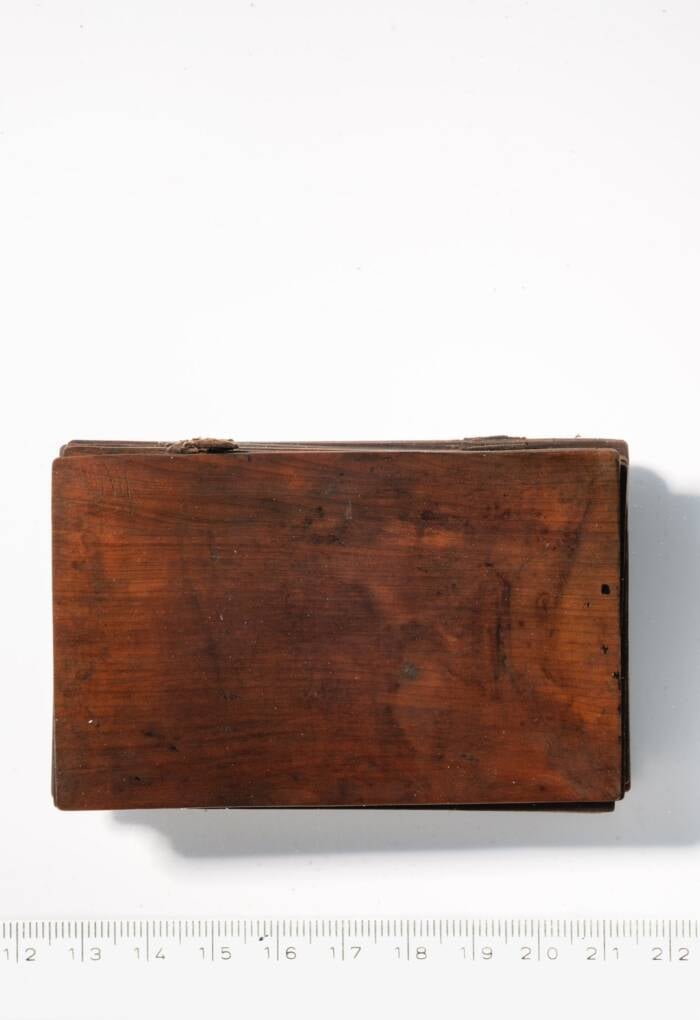
LWL/ S. BrentführerThe notebook was protected for centuries by the conditions within the ruins of the medieval latrine.
“I only had to clean the outside of the book, as the inner pages were so tightly bound that there was no dirt on them,” Bretzel said. “The wood also hadn’t warped, so the wax is still intact and the writing itself is easily legible.”
So what does the notebook contain?
What The Notebook Says About Medieval Life In Germany
The notebook is small, measuring just three inches by four inches and containing just ten pages. It’s held together with a leather binding embossed with rows of lilies, which suggests that the notebook was a prized object — lilies signified “purity, royal power, and divine favor” in the Middle Ages.

LWL/ S. BretzelThe leather binding of the notebook is embossed with lilies.
The first and last pages have wax on one side, while the other pages are double-sided. The text is written in wax (likely with a stylus made of metal, bone, or ivory) in two directions, depending on how the book was held. However, the archaeologists believe it was used by a single person.
The pages of the notebook are covered with cursive script written in Latin, which suggests that it dates to the 13th or 14th century, and that the its owner was likely upper-class, possibly a merchant.

The Latin text in the notebook is still visible, but a professional transcriber will work on translating the text from Latin to German and identifying misspelled or “corrupted” words.
But while some words are recognizable, the text itself needs further study. It will be transcribed, then translated into German. What’s more, the book was once considered “reusable” (its wax text could be smoothed and erased as needed), and modern technology could help unlock multiple layers of text.
Archaeologists also found other objects in the latrine — barrels, a knife, silk fragments that may have been used as toilet paper, and pottery — but the notebook stands out. They’re hoping to learn more about who once lived near the latrine, which could help in identifying the notebook’s owner.
“As soon as this latrine can be assigned to a specific plot of land, archival research could be used to try to identify the residents of that plot,” said city archaeologist Dr. Sveva Gai. “Then, in the best-case scenario, it would be possible to link the wax tablet to the name of a specific person.”
After reading about the medieval notebook that was found in a medieval latrine in Germany, discover the surprising true story of the Erfurt Latrine Disaster, when 60 nobles died after falling into a latrine in Germany. Then, learn about foricae, the communal public toilets of ancient Rome.