The 2,000-year-old discovery offers evidence of the rich trade network between the Roman Empire and the Baltic region.
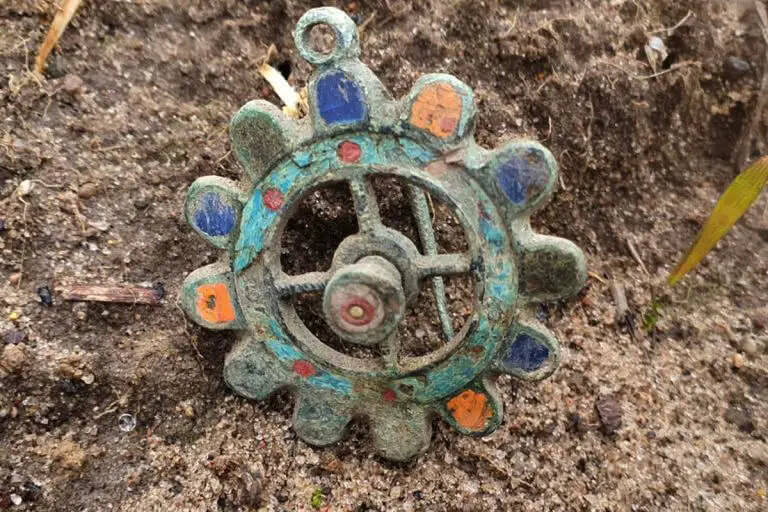
Grudziądz Fortress AssociationThe decorative brooch, known as a fibula.
During a routine archaeological survey near Grudziądz, Poland, members of the Grudziądz Fortress Association unearthed an ancient enameled fibula — a Roman-era brooch used to fasten garments.
It is just the second fibula of its kind ever found in the country, and it’s providing new insight into the trade route that ran between Rome and the Baltic region some 2,000 years ago.
The 2,000-Year-Old Brooch Found During A Routine Survey
As the archaeological team explained to one Polish news outlet, the artifact was dated to around the first or second century C.E. and was found at a site where objects like clasps, beads, a cosmetic spoon, belt fragments, a spur, and a ring have previously been discovered. This suggests that the area was once the site of a multicultural settlement along the Amber Road, which served as an important trade route between the Roman and Baltic worlds.
Based on the color and precision of its design, researchers believe it may have been created by the Wielbark culture, a community often associated with the Goths.
Enameled fibulae such as this were produced across the Roman provinces, particularly in Gaul and Rhaetia. Typically worn by girls, they were likely used to fasten clothing, though they may have also functioned as protective amulets.
Although the brooch is still under examination, researchers noted strong similarities to another fibula found in a child’s grave at the Babi Dół-Borcz cemetery in Somonino, located about 50 miles northwest of Grudziądz.
Similarities To Another Ancient Fibula Found At Babi Dół-Borcz
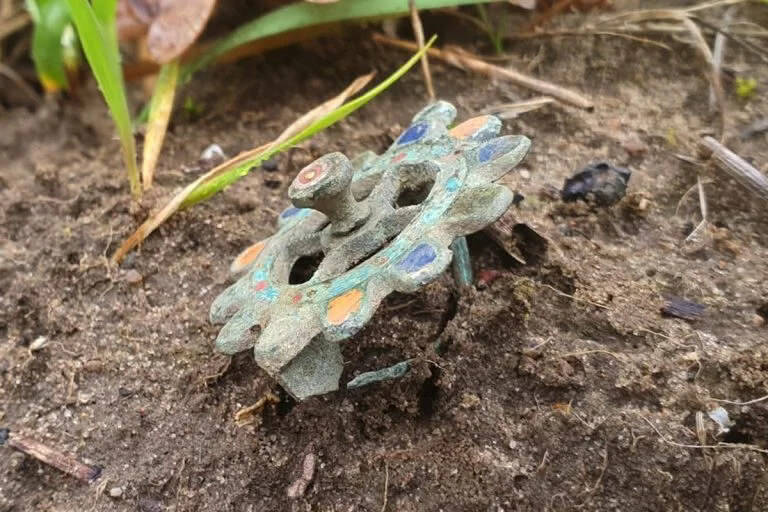
Grudziądz Fortress AssociationThe brooch is larger than the previously discovered fibula.
Babi Dół-Borcz was excavated between 1978 and 2015 by teams from Jagiellonian University and the University of Łódź. The brooch found there measured 1.3 inches in diameter with eight protrusions, which were decorated in alternating white and blue enamel with a red knob at the center.
The Grudziądz brooch is nearly identical, though it is slightly larger and features 12 decorative protrusions rather than eight.
The newly found fibula is believed to be a high-status import that was likely worn by a member of a local tribe who had access to long-distance trade. Its presence reinforces the understanding that ancient Poland was not isolated but rather a dynamic region that participated in extensive European exchange systems.
After undergoing professional conservation and documentation, the brooch is slated to become a permanent part of the collection at a museum in Bydgoszcz, where it will be put on public display.
Archaeological teams are now planning further excavations in the surrounding area, hoping to uncover settlement remains or burial sites that may provide more context about the community that once thrived at Grudziądz and the role it played within regional networks of exchange and cultural interaction.
After reading about the discovery of this ancient Roman brooch in Poland, step inside Poland’s Crooked Forest. Or, learn about the Pax Romana period of the Roman Empire.