

From pagan solstice celebrations to Victorian England to the present day, go inside the origins of the Christmas tree.
Every December, millions of families put evergreen trees inside their homes and cover them with lights and ornaments — but how many stop to wonder what exactly these trees have to do with the story of Christmas, let alone Christianity?
The answer is very little — in fact, the tradition predates the entire religion itself.
The Christmas tree actually originated with pagan winter solstice celebrations in Northern Europe more than 2,000 years ago. For ancient peoples in these regions, the winter solstice represented the most dangerous time of the year — a 12-day period when darkness dominated and survival was uncertain.
Evergreen trees held special significance because they retained their color while other trees appeared dead. They symbolized life persevering in the face of death, light triumphing over darkness. And so, pagan cultures adorned their homes with evergreen boughs to ward off evil spirits.
The period now known as the 12 Days of Christmas was indeed considered the darkest and most dangerous time of the year. Pagan myths described Odin and the Wild Hunt riding through storm clouds, ready to abduct anyone without shelter. Believers covered their homes in aromatic plants like pine and fir, smudging walls with resin as protection.
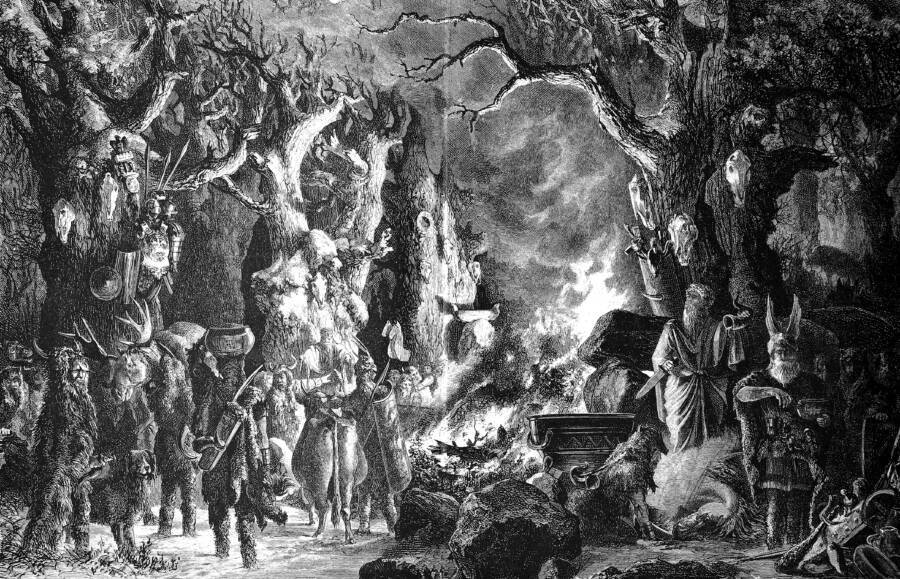
Bildagentur-online/Universal Images Group via Getty ImagesA 19th-century print depicting Germanic Yuletide celebrations.
Similar traditions existed in ancient Rome, Egypt, and Greece, where evergreens served both protective and spiritual purposes.
When Christianity spread across Europe, these traditions did not go away. Rather than eliminating them, the Church gradually incorporated evergreen symbolism into Christian practice.
By the 16th century, the modern Christmas tree emerged in what was then German territory, specifically in Alsace. Historical records confirm that a Christmas tree was put up in the Strasbourg Cathedral in 1539, after which the tradition spread rapidly throughout the region — so rapidly that laws were enacted limiting households to one tree and banning the cutting of pine branches.
Protestant reformer Martin Luther is also credited with adding candles to Christmas trees after being inspired by stars during a forest walk. Eventually, German immigrants brought the tradition to other parts of Europe and eventually to America — where it faced significant resistance at first. Puritans, for example, viewed Christmas celebrations as pagan mockery and made them illegal in Massachusetts, opposition which lasted into the 19th century.
The tradition finally gained acceptance through popular culture — particularly an 1848 illustration of Queen Victoria and Prince Albert with their children around a Christmas tree — and technological innovation, as Thomas Edison’s electric lights replaced dangerous candles.
Today, more than 25 million real Christmas trees are sold annually in the United States, while 84 percent of families display an artificial tree. And what began as a pagan protection ritual has become a defining symbol of Christmas around the world.
Learn more about the music used in our podcast. History Uncovered is part of the Airwave Media network. Learn more about your ad choices by visiting megaphone.fm/adchoices.