Tracks in the limestone on Monte Cònero seem to have been left behind by multiple sea turtles fleeing from an earthquake nearly 80 million years ago.
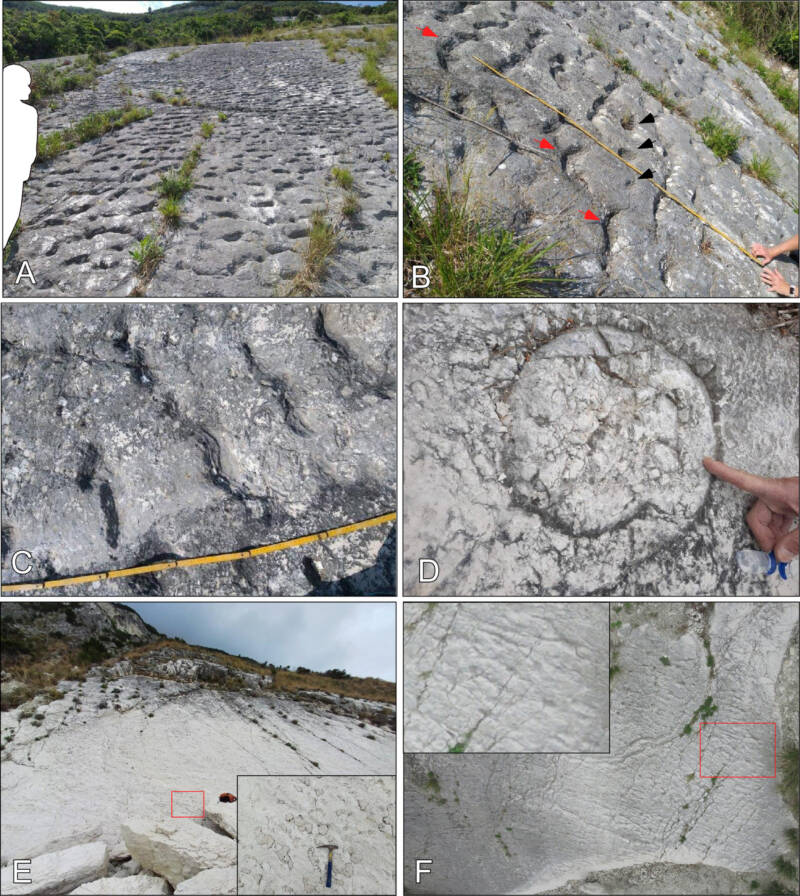
Montanari et al./Cretaceous Research, 2025The prehistoric sea turtle tracks in the limestone of Monte Cònero.
Rock climbers in northern Italy have stumbled upon an extraordinary paleontological find: fossilized evidence of what scientists believe was a massive sea turtle stampede dating back 80 million years to the Late Cretaceous period.
The initial discovery was made in the spring of 2019 by free climbers exploring the limestone cliffs of eastern Italy’s Monte Cònero. They noticed unusual markings in the rock face and reported their findings to local geologists, who surveyed the area. Now, the results of their study have been published in the journal Cretaceous Research.
Identifying Which Sea Creatures Left The Tracks
The fossilized tracks, preserved in what was once a prehistoric seabed, include what appear to be both flipper marks and body impressions from multiple turtles. Scientists estimate the animals ranged from two to five feet in length based on the size of the imprints. That said, the researchers weren’t even sure, at first, if turtles were the creatures that had left the tracks.
“Excluding fish, which do not use their fins to paddle on the seafloor… we have to consider marine reptiles of three kinds: plesiosaurs (giant reptiles typically with a long neck and a small head), mosasaurs (i.e., large marine reptiles first found near the Meuse River)… and sea turtles,” the scientists explained in the study.
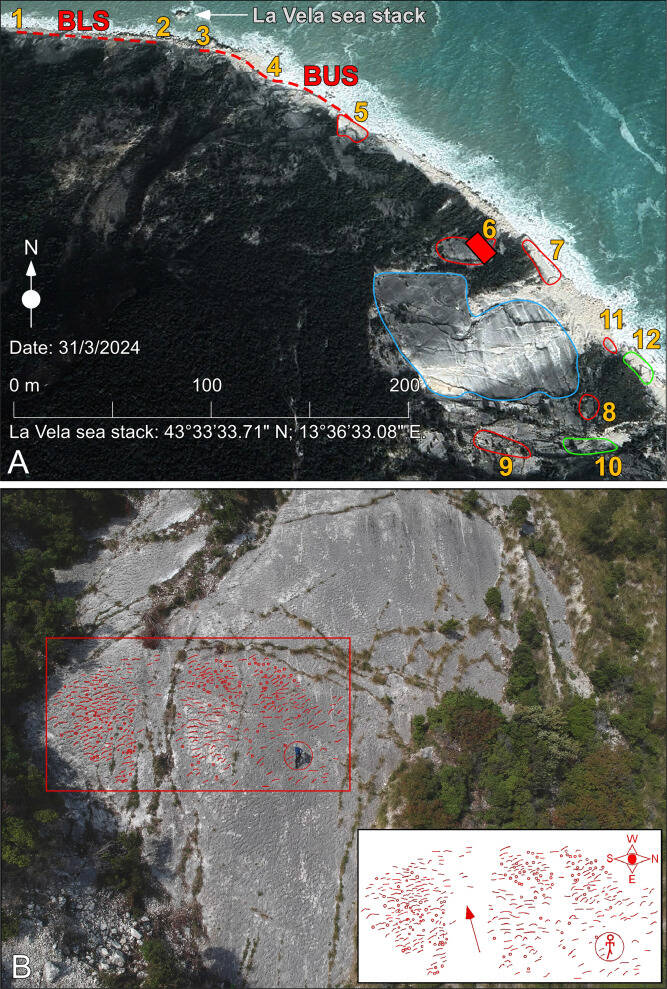
Montanari et al./Cretaceous Research, 2025An aerial view of the prehistoric tracks.
The tracks are approximately 80 million years old. At that time, the region was covered by a shallow sea and home to a wide variety of marine life, including turtles, plesiosaurs, and mosasaurs. Some turtle species gather in large groups at certain times, such as while they’re laying eggs. Plesiosaurs and mosasaurs were more solitary than turtles, which is why experts believe they didn’t leave these tracks behind.
“The prevalence of sea turtle species in these environments leads us to hypothesize that the myriad trace fossils of the La Vela Slabs represent a mass displacement of a very large number of these animals,” wrote the study authors. “Slabs represent a mass displacement of a very large number of these animals that were lingering near the shallow water carbonate platform of Monte Cònero, an ideal place for laying eggs but also a fertile ground for foraging.”
So, what caused so many turtles to leave these tracks behind?
The Earthquake That Caused The Sea Turtle Stampede
“The footprints probably represent a stampede of panicking sea turtles that were mobilized en masse by an earthquake,” the study claims. “These tracks were covered by a fluxoturbidite triggered by the same earthquake.”
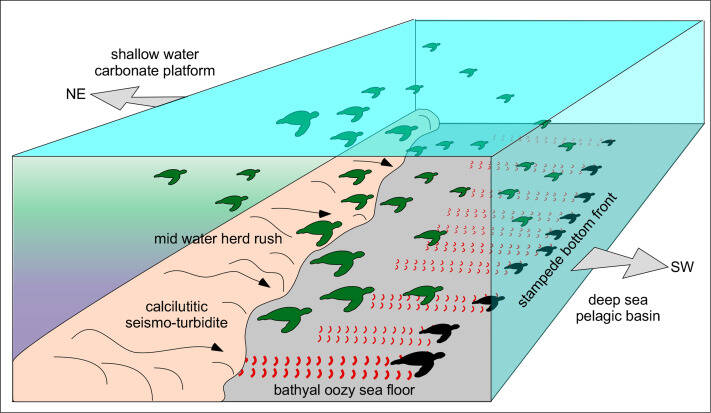
Montanari et al./Cretaceous Research, 2025A box model of the panicking sea turtles.
That is, an underwater avalanche caused by the earthquake preserved the record of the sea turtles’ stampede for tens of millions of years. During the Late Cretaceous, Earth was experiencing an intense period of climate change thought to be triggered by an asteroid impact, known as the Early Campanian Event. As such, volcanic activity would have been high.
While these conclusions are still somewhat uncertain, the researchers remained confident that the tracks were indeed left by turtles. If nothing else, this discovery gives rock climbers one more reason to keep a camera on hand.
After reading about the prehistoric sea turtle tracks found in Italy, look through these vintage illustrations of sea creatures. Then, discover 10 terrifying prehistoric creatures that weren’t dinosaurs.