Starting in 1909, these tunnels underneath Los Angeles allowed streetcars and trains to go straight through the area's notoriously hilly terrain — but by the 1920s, with Prohibition in full swing, the tunnels were repurposed for alcohol smuggling.

Jessi Pena/Unsplash, @shashabao3/TikTokTikToker @shashabao3 is bringing attention to Los Angeles’ “forgotten underground city.”
A network of underground tunnels once used by streetcars, bootleggers, and corrupt businessmen sits right beneath Los Angeles. This so-called “forgotten underground city” may no longer be quite so forgotten, thanks to a recent video bringing renewed attention to it.
In a video with more than 2.3 million views, @shashabao3 presents images meant to depict the underground city beneath Los Angeles — “SubTropolis,” he calls it.
But while “SubTropolis” is just as real as the tunnels below Los Angeles, @shashabao3 has a few of his wires crossed.
SubTropolis is in Kansas City, Missouri. Meanwhile, Los Angeles certainly has its own subterranean history that most people know nothing about. Here’s the story of both.
SubTropolis: The Vast Expanse Beneath Kansas City
Kansas City sits atop a massive deposit of limestone. For decades in the early 20th century, various companies mined here to gather material for construction projects across the region. But when mining slowed down, it left behind all these empty tunnels beneath the city, KC Yesterday reported.
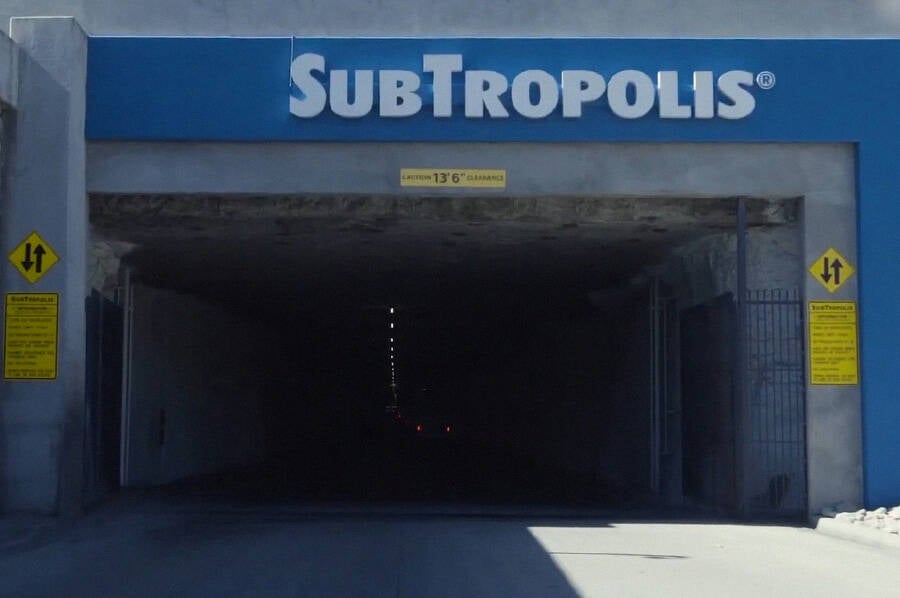
Making Viral/YouTubeSubTropolis in Kansas City was opened as a business complex in the 1960s.
Lamar Hunt, who founded the Kansas City Chiefs, saw the empty space as an opportunity and transformed it into a business complex, officially opening “SubTropolis” in the 1960s. What started as an old mine is now the world’s largest underground business complex. It attracted major tenants like Ford, Pillsbury, and Russell Stover. Ford, for example, used it to store unsold cars.
According to Atlas Obscura, SubTropolis covers 55 million square feet and has nearly seven miles of paved, lit roads that are wide enough for semi-trucks to roam through.
The temperature underground stays between 65 and 70 degrees year-round with no climate control needed, which makes it surprisingly good for storing a number of things.
“We’re probably using about 75 percent less electricity underground than we would in an above-ground facility,” said Joe Paris, co-founder of Paris Brothers, a specialty foods company headquartered in SubTropolis. “Whether it’s electronics or whether it’s food, you don’t have temperature and humidity fluctuations.”
The U.S. Postal Service is also a tenant, storing millions of stamp copies there. The National Archives keeps federal records underground. Millions of pounds of government cheese is similarly stored in the area. Even the original film reels of Gone with the Wind and The Wizard of Oz are kept there because the cool, stable environment preserves them better than anything above ground could.
Does Los Angeles Have A Secret Underground City Made Up Of Tunnels?
In the early 1900s, downtown Los Angeles was surrounded by steep hills that the city’s streetcar network couldn’t easily climb. According to the history channel It’s History, engineers solved the problem by going through the hills instead of around them. The Hill Street Tunnel opened in 1909 in order to let streetcars pass directly under the hill and cut roughly 15 minutes off the trip to Hollywood and Glendale.

@pwesttok/TikTokIn the 1920s, the tunnels were used by streetcars, bootleggers, and corrupt businessmen.
More tunnels followed, and by the 1920s there were an estimated 11 miles of tunnel running beneath the city.
A separate, smaller network was built around the same time for different purposes. The city’s Civic Center had tunnels connecting courthouses, jails, and banks that were used to move money, prisoners, and documents without crossing the street. The entrances were tucked into building basements, out of sight.
When Prohibition made alcohol illegal starting in 1920, the tunnels found a new use. Organized crime moved illegal alcohol through them, connecting to speakeasies hidden behind the fronts of ordinary businesses. Alcohol came in by ship, moved through Skid Row, and went underground. Police corruption kept the raids light.
The tunnels became a center of crime and corruption not just for alcohol smuggling, but also for murders, fraud, and other Mafia activity.
One of the biggest scandals tied to the tunnels was the Julian Petroleum fraud of the mid-1920s.
C.C. Julian ran a Ponzi scheme that sold more than $150 million in fraudulent shares. He used the tunnels to move money discreetly, but when the scheme collapsed in 1927, Julian fled to China to avoid jail time. He died by suicide in 1934.
When Prohibition ended in 1933, the tunnels lost their purpose and were mostly forgotten. Some were sealed. Others were covered over by new construction. Urban explorers started rediscovering them in the 1980s and ’90s. Today, parts of the network near Skid Row are used as informal shelter by unhoused people.
@shashabao3 Seriously what timeline have we entered #subtropolis
After reading about Los Angeles’ underground tunnels, discover the secret tunnels beneath Disney’s Magic Kingdom — and why Walt Disney had them built. Then, learn about the tunnel network discovered beneath a college campus in Arizona.