Amateur paleontologist Jason Howery was surveying a lake in Nodaway County, Missouri when he suddenly saw a prehistoric mammoth femur weighing 92 pounds.

Jason Howery/StoryfulPaleontologist Jason Howery with the mammoth bone he found in a Missouri lake.
Today, Missouri consists largely of quiet rolling plains and thick leafy forests home to wildlife like deer and raccoons. But tens of thousands of years ago, during the Ice Age, the area was home to now-extinct behemoths like mastodons and giant ground sloths. Now, the bones of one of those prehistoric animals has been found.
Missouri paleontologist Jason Howery found the bone of a Columbian mammoth while searching for Ice Age remains — a spectacular discovery that sheds light on the state’s prehistoric past.
The Massive Mammoth Bone Found In A Missouri Lake
According to FOX4, Jason Howery has a long track record of finding Ice Age remains, including those of a giant deer, a horse, and a bison. But his most exciting find yet came during his search in Nodaway County, when Howery stumbled across a Columbian mammoth bone.
“When I first got there, it was the very first thing that I saw, and I looked down and there it was and I was like, ‘No way,'” Howery told FOX4. “There’s a specific texture to ice age bone that doesn’t feel like anything else in the world. When you feel it, it has this sticky, glassy texture to it. So as soon as my hands hit it, I was like, ‘I know this feeling.'”
This mammoth bone was located at a known “butcher site,” one of a dozen such sites in North America where prehistoric humans once butchered their prey en masse. The remains of prehistoric animals, as well as human tools, had been found at the site before.
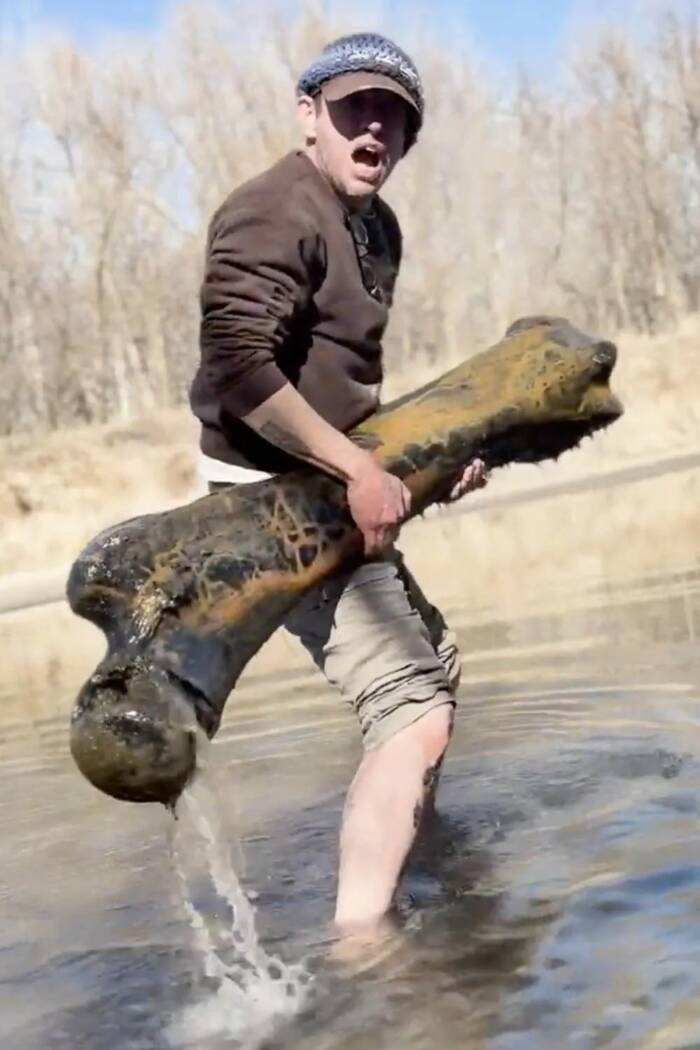
Jason Howery/StoryfulJason Howery found the mammoth bone in a lake, and instantly knew by its texture that he’d found something from the Ice Age.
“There have been somewhere around fifty confirmed butcher sites in North America,” Howery explained. “It’s rare. It’s extremely rare.”
Howery, a self-funded paleontologist, is hoping to raise money to learn more about the bone. Ideally, he’d like to subject the bone to a CT scan and radiocarbon dating in order to determine its exact age.
But in the meantime, the bone simply stands as a remarkable artifact from Missouri’s prehistoric past.
Columbian Mammoths During The Ice Age
In the early Paleozoic era, Missouri was covered by a shallow sea, which shrank over the following 200 million years. During the Ice Age, glaciers coated the north part of the state, whereas the southern part of the state was home to prehistoric beasts like camels, mastodons, and mammoths.
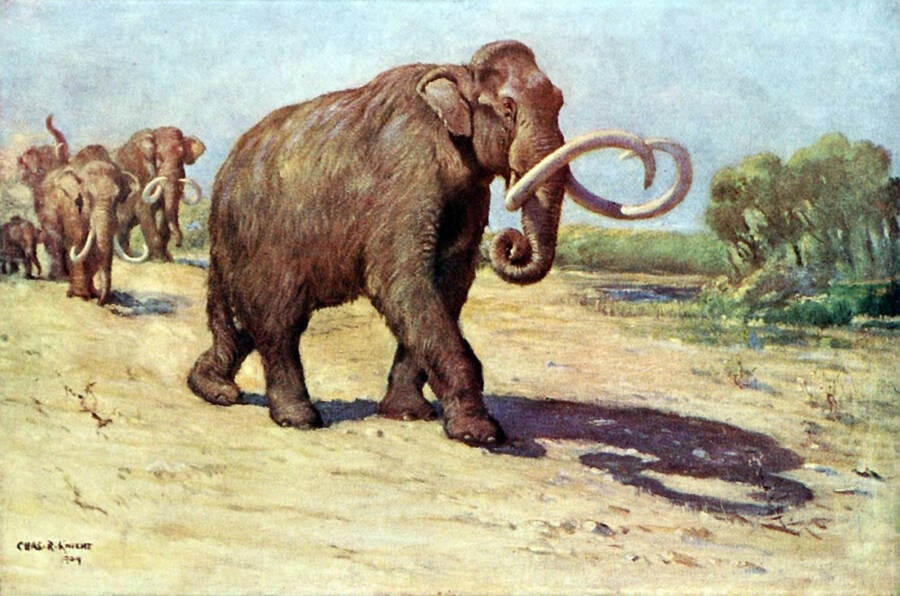
Public DomainThe bone that Howery found belonged to a Columbian mammoth, an enormous creature that once roamed across North America.
The bone that Howery found belonged to a Columbian mammoth, a creature that once roamed across North America. According to the National Park Service, its bones have been found throughout the United States and Mexico, where mammoths thrived in areas rich with grasslands, savannas, and aspen parklands. Though both male and female Columbian mammoths grew tusks, the males of the species were considerably larger, and could grow up to 13 feet tall at the shoulder while weighing roughly 22,000 pounds.
So how did prehistoric humans hunt such massive animals? The answer is still up for debate, but researchers have posited that our ancestors may have thrown spears, teamed up to take down the animals, impaled charging animals, or scavenged the remains of animals who were already wounded.
Howery is hoping to inspire curiosity about questions like these. He shares his Ice Age discoveries with community programs and schools, with the goal to get kids to “put their phones down and get out into nature and explore…[the] history that is still out there right below their feet.”
In the meantime, he’ll keep searching for Ice Age remains across Missouri. But as Howery recently said, even searches that turn up nothing are still satisfying adventures.
“You don’t always find things,” he remarked, “but you find peace, you know?”
After reading about the mammoth bone that was found by a local paleontologist in Missouri, discover the astounding stories of some of the most incredible prehistoric animals to ever walk the Earth. Then, go inside the curious question of when exactly mammoths went extinct.