While researchers have long known that HPV was in existence before recorded history even began, they theorized that it was first passed to early humans by Neanderthals — but new evidence says otherwise.
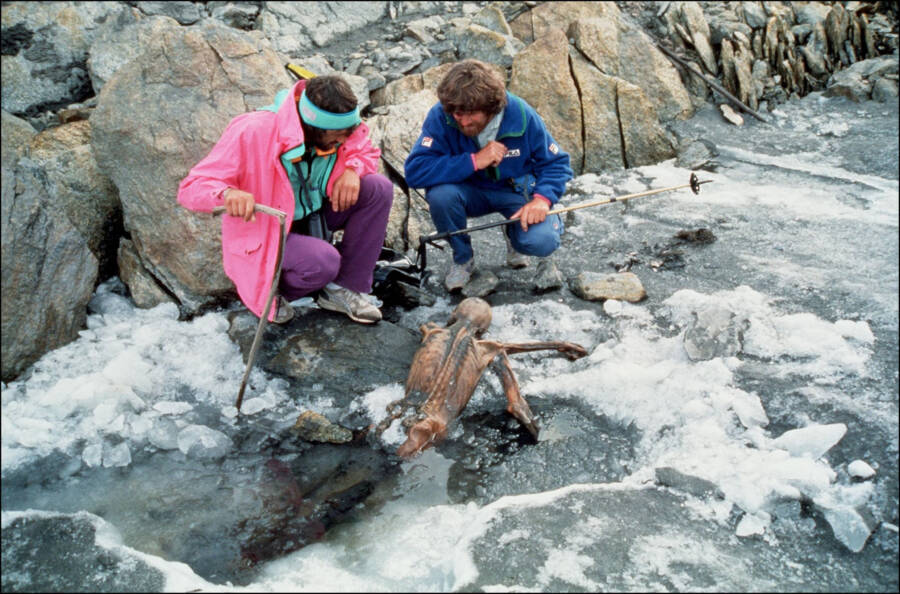
Paul HANNY/Gamma-Rapho via Getty ImagesNew research found evidence of HPV16 in Ötzi’s genome, revealing groundbreaking insights into the virus’ evolutionary history.
Both Ötzi the Iceman, the oldest well-preserved human ever found, as well as a prehistoric man who lived in Siberia 45,000 years ago were recently found to be carriers of a cancer-causing strain of human papillomavirus (HPV), according to new research posted to bioRxiv.
Since his discovery along the Austrian-Italian border in 1991, Ötzi has been the subject of several scientific analyses that have revealed details of his life some 5,300 years ago. Researchers have, for instance, learned that he was likely killed after an arrow struck him in the shoulder, uncovered what his last meal was, and even revealed what ailments had plagued him, including broken bones, intestinal parasites, and lungs blackened by soot.
Now, analysis of genetic data from Ötzi and another prehistoric individual has revealed that both were likely infected with HPV16, which would mark the “earliest molecular evidence” of the disease in human history, researchers say. The research has yet to be peer-reviewed, but if the findings are accurate, they could help to identify when and how humans first came into contact with the virus.
Pushing Back The Historical Timeline Of HPV

Wikimedia CommonsA reconstruction of an early Neanderthal man.
“Our results suggest that HPV16 was already present in modern humans during the Upper Paleolithic, indicating a long-standing host-virus independent of Neanderthal transmission,” the researchers wrote in the new preprint paper.
This is an especially notable finding, as it is commonly believed that Neanderthals, who overlapped with modern humans in Eurasia from 60,000 to 34,000 years ago, were responsible for transmitting the virus to Homo sapiens. The team’s sample size is admittedly small, and so the origins of HPV are still largely shrouded in mystery, but the research does at least challenge the Neanderthal-transmission theory to a considerable degree.
“This is a very nice finding,” Ville Pimenoff, a computational geneticist at the University of Oulu who was not involved in the study, told Science. “Homo sapiens was basically infected by these viruses for all of its existence.”
Scientists are starting to gain a better understanding of just how intertwined the evolutionary history of HPV is with that of humankind itself. Viruses in the Papillomaviridae family are prehistoric and have co-diverged with their vertebrate hosts over extensive timescales, exhibiting strict host specificity that mirrors the phylogeny of their hosts. In other words, the virus and its host evolved in lock step, side by side.
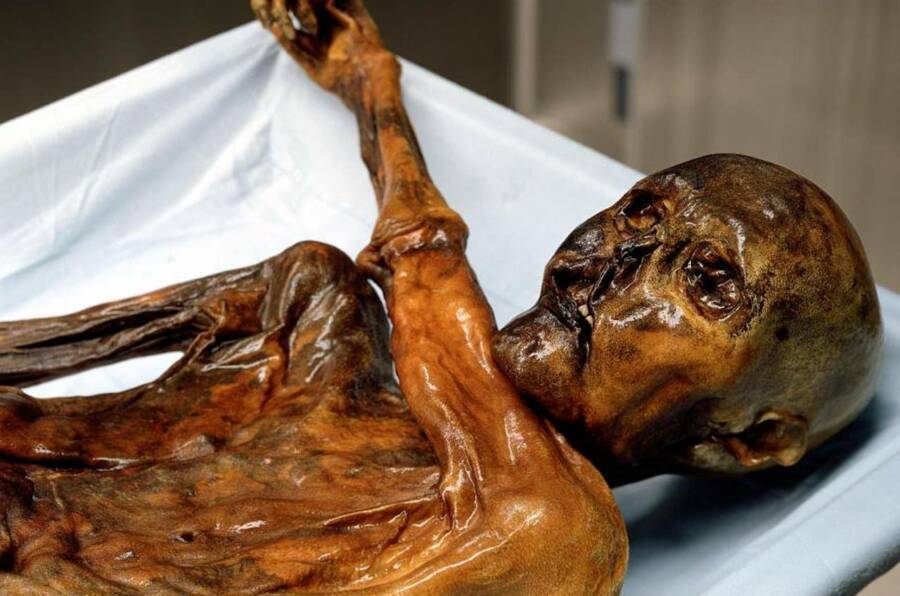
South Tyrol Museum of ArchaeologyÖtzi is one of the best-preserved prehistoric mummies ever found.
Phylogenetic studies suggest that the timescale of papillomavirus evolution spans millions of years, largely inferred from a model of virus-host co-divergence. This means, essentially, that as different species evolved, their associated papillomaviruses evolved with them. And while general papillomaviruses are very old, the specific high-risk types that affect humans today and can cause cancer, such as HPV16, have divergence times that align with significant events in human prehistory.
Research into how these specific high-risk HPV lineages evolved can also provide insight into how ancient human populations interacted and spread viruses. Modern analyses indicate that the major variant lineages of HPV16 (A, B, C, and D) split apart around 500,000 years ago – predating the emergence of Homo sapiens and coinciding with the evolutionary divergence between Neanderthals and modern humans.
“The results indicate that HPV16 has been associated with anatomically modern humans for a very long time, likely well before major population splits outside Africa,” study co-author Marcelo Briones told Live Science.
“This supports the idea that oncogenic human papillomaviruses are not recent pathogens but long-term companions of their hosts, evolving alongside primates and humans over extended evolutionary timescales.”
Potential Challenges To The Neanderthal-Transmission Theory Of HPV
Both Ötzi and the prehistoric Siberian man also studied here, known as Ust’-Ishim, were chosen for this analysis because they represent two of the most well-preserved early human genomes ever found. Ötzi died roughly 5,300 years ago and was naturally mummified, but Ust’-Ishim, who was found in 2008, was much older. He lived around 45,000 years ago in what is now Siberia, and all that remains of him is a single leg bone. Still, that was enough material to sequence one of the oldest human genomes known to science.
Through these genomes, Briones and colleagues were able to find multiple DNA fragments matching HPV16, indicating both men were afflicted with the virus.
“We’re pretty confident there’s a signal there… We have the oldest evidence of HPV,” said study first author Juliana Yazigi.

Wikimedia CommonsA map of potential sites of Neanderthal-human interbreeding.
Given how far apart Ötzi and Ust’-Ishim lived, both geographically and in the historical timeline, both men showing signs of HPV16 provides further evidence that this disease has been with humanity for perhaps millions of years. It could also indicate, Briones says, that perhaps Homo sapiens transmitted the cancer-causing virus to Neanderthals, and not the other way around, contrary to popular belief.
Other experts feel this claim may be “overstated,” however. Koenraad Van Doorslaer, interim co-chair of the immunobiology department at the University of Arizona, tells Live Science that because Ust’-Ishim also has Neanderthal DNA in his genome, “it does not prove that HPV16 does not come from Neanderthals.”
Still, Van Doorslaer says he is “genuinely excited about the implications of this study because it supports some critical assumptions about the history of this family of important viruses.”
“Is this gonna make better vaccines, better treatments, better cures? Probably not. But not all science should be about that,” he says. “It should just be about learning cool things.”
After reading about this discovery, learn more about nine of history’s most fascinating mummies. Then, read about six of the most interesting diseases to ever ravage humanity.