The man died shortly after the eruption of Mount Vesuvius in 79 C.E., which destroyed the city of Pompeii and left its ruins frozen in time under a blanket of ash.
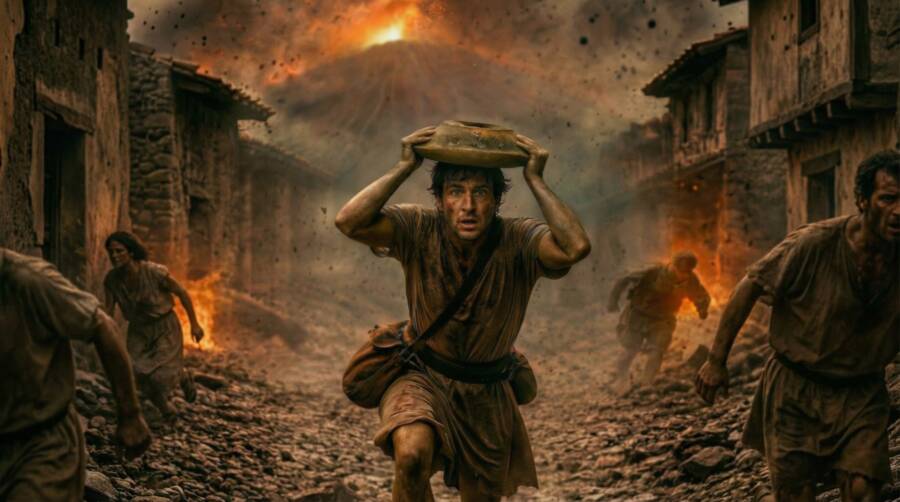
Italian Ministry of CultureThe new AI rendering of a man killed in Pompeii by the eruption of Mount Vesuvius in 79 C.E.
Some 2,000 years ago, Mount Vesuvius erupted with terrifying force, raining ash and debris down upon the Roman city of Pompeii. One local man attempting to flee then raced toward the coast and tried to protect himself by holding a terracotta mortar over his head.
Tragically, he perished — but now, archaeologists have just recreated his final moments using artificial intelligence.
The A.I. Reconstruction Of A Pompeii Victim’s Final Moments
According to a statement from the Italian Ministry of Culture, the A.I. rendering of the Pompeii victim was made after the discovery of his body in the Porta Stabia necropolis, just outside of the city’s walls. He was found alongside another skeleton, and archaeologists believe that both men were attempting to reach the beach during the eruption of Mount Vesuvius.
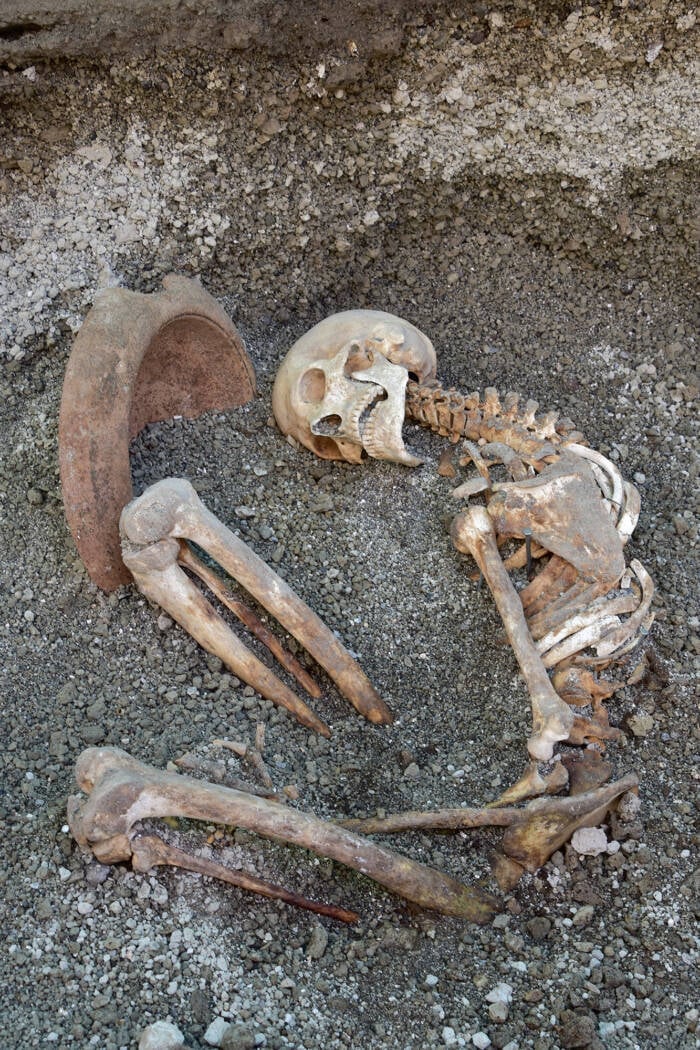
Italian Ministry of CultureThe recently discovered Pompeii victim who was found alongside the terracotta mortar he used to protect himself from falling volcanic debris.
The reconstructed man, the older of the two, seemingly died first on the day of the eruption (likely August 24).
He was found near a fractured terracotta mortar, which he presumably used to try to protect himself from the shower of lapilli — stones made from solidified lava droplets — that rained down on Pompeii. The man was also found with a small iron ring, ten bronze coins, and a ceramic lamp, which he likely needed to navigate the darkness that had descended upon the city.
Archaeologists believe that he was killed by the lapilli, as the fractures on the terracotta mortar found near his body suggest that he was pummeled by volcanic debris. His final moments were reconstructed by the Archaeological Park of Pompeii and the University of Padua in order to produce “a scientifically sound yet accessible image” that could “make the results of archaeological research more accessible to a non-specialist audience.”
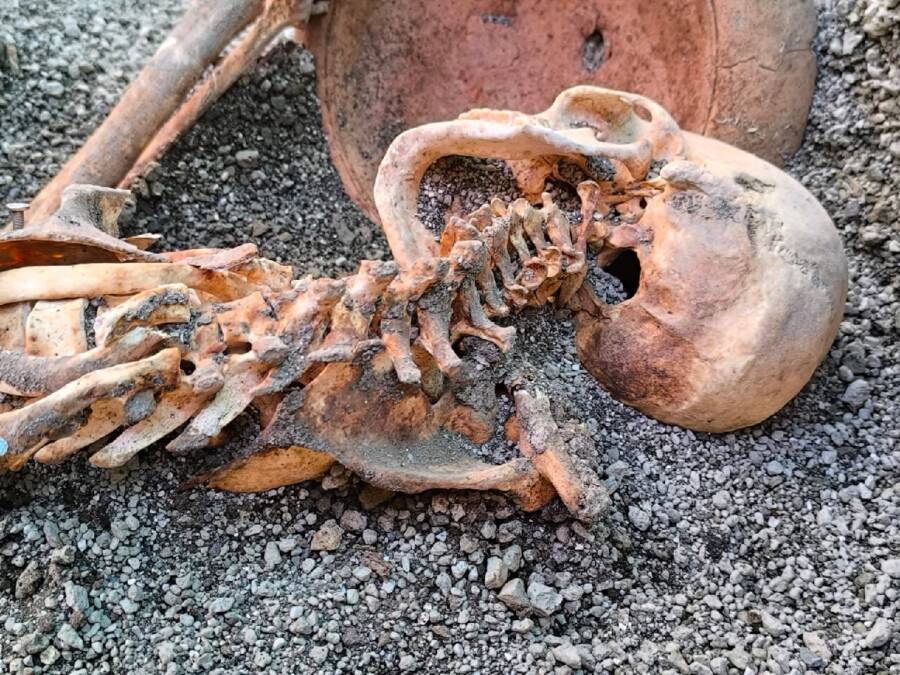
Italian Ministry of CultureA closer look at the skeleton of the Pompeii man whose final moments were recently reconstructed with the use of artificial intelligence.
“The man of Pompeii fled with a mortar on his head, a lamp in his hand, and ten coins: he carried whatever he thought was useful for orienting himself in the darkness,” said Professor Luciano Floridi of the Digital Ethics Center at Yale. “Two thousand years later, AI is helping us reconstruct his last moments… AI does not replace the archaeologist. Under its control, it expands and deepens his potential; and makes accessible to many what was previously accessible only to a few.”
Indeed, archaeologists are hopeful that artificial intelligence can offer a new perspective on the destruction of Pompeii, one of the most devastating natural disasters in world history.
How The Eruption Of Mount Vesuvius Destroyed Pompeii In 79 C.E.
The eruption of Mount Vesuvius took place in 79 C.E. It’s long been believed that the volcano erupted in August, but evidence in recent years has also suggested that it could have erupted in the autumn.
It spewed a huge cloud of pumice and ash nine miles into the atmosphere and, by 1 p.m., a cloud of thick ash blocked out the Sun and began to fall on the city like heavy snow. Then, volcanic debris — like the kind that killed the newly-reconstructed Pompeii victim — began to rain down on the city.
This first wave of destruction killed many, but the eruption of Mount Vesuvius soon grew even worse. That night, hot ash and gas poured down the side of the mountain, followed by a second wave of volcanic mud and rock. Many people in the nearby town of Herculaneum were burned or suffocated to death, their city buried by the volcanic debris.
Then, the next morning, a pyroclastic flow — a mix of lava, volcanic ash, and hot gas that can move as fast as 200 miles per hour — smashed into Pompeii, killing anyone left in the city. This is what killed the second, younger man, who was found alongside the reconstructed Pompeii victim.
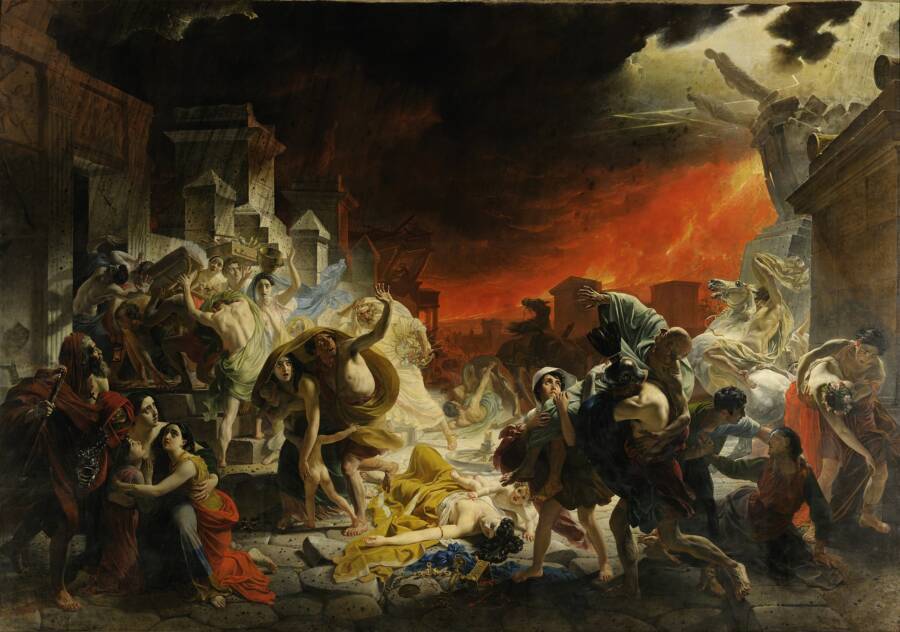
Public DomainThe Last Day Of Pompeii by 19th-century painter Karl Bryullov.
Over the last 2,000 years, the dramatic destruction of Pompeii has been depicted in books, paintings, and operas. Now, A.I. may provide another way to view and understand this horrific episode of destruction.
“If used well, AI can contribute to a renewal of classical studies, narrating the classical world in a more immersive way,” Gabriel Zuchtriegel, the director of the Pompeii Archaeological Park, remarked in the ministry statement. “[R]econstructions help us involve more people in this adventure.”
After reading about the A.I. reconstruction of a Pompeii victim, look through this chilling gallery of Pompeii bodies found frozen in time. Then, peruse this surprising collection of Roman graffiti found amid the Pompeii ruins as well as this gallery of Pompeii frescoes.