Legend has it that Pope Joan disguised herself as a man and was elected to lead the Catholic Church in 855, but she was stoned to death in 858 when her true identity was revealed after she gave birth during a ceremonial procession.
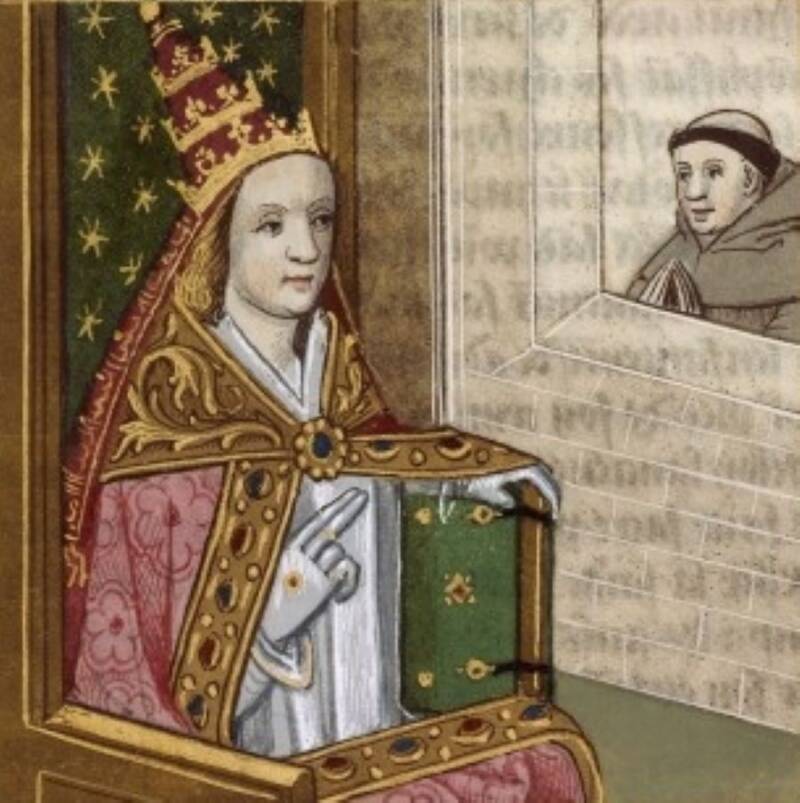
Public DomainA 16th-century illustrated manuscript depicting Pope Joan wearing a papal tiara.
Around 30 C.E., Peter the disciple was named the first pope. Since then, there have been 267 bishops of Rome, and all of them have been men — according to official records, at least. Legend has it that a woman named Pope Joan secretly led the Catholic Church in the ninth century.
As the story goes, Joan disguised herself as a man, rose through the ranks of the Church, and was elected pope in 855. Her ruse was discovered when she got pregnant and had her baby in the middle of a procession two years later. She was then either stoned to death or died in childbirth, depending on the version of the tale.
The story of Pope Joan first appeared around the 13th century, but it has changed countless times over the centuries. Today, scholars believe the legend is entirely fictional, but for some 200 years, people regarded it as fact.
So, how did this tale start? And how did it spread so widely across medieval Europe?
The Legend Of Pope Joan
The myth of Pope Joan seemingly began with Jean de Mailly, a Dominican friar and chronicler who lived in France in the 13th century. Around 1250, he wrote Chronica Universalis Mettensis, in which he related the story of an unnamed female pope. According to de Mailly, this “popess” disguised herself as a man, went into labor while mounting a horse one day, and was subsequently stoned.
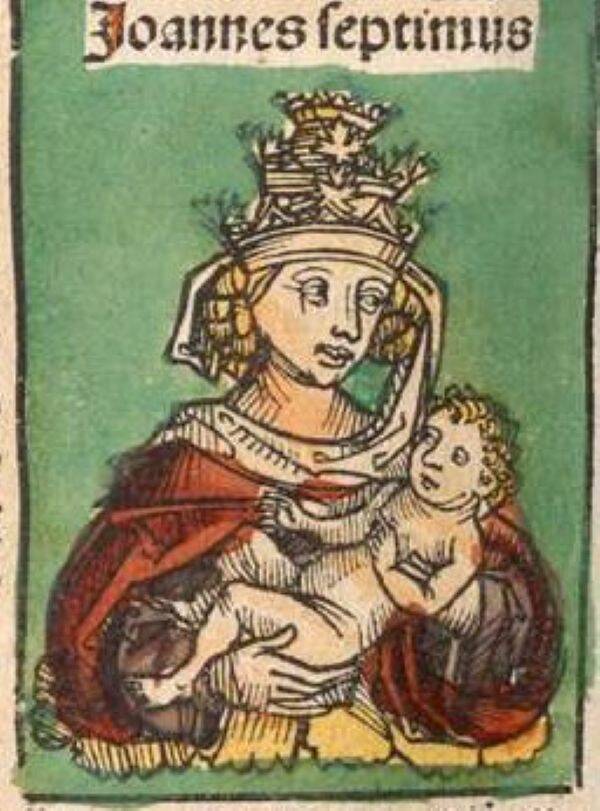
Public DomainSome versions of the legend state that Pope Joan’s baby was killed with her, while others claim he grew up to be a bishop himself.
Over the next few decades, several other chroniclers repeated this story, changing it slightly each time. One popular version was written by Martin of Opava, who was the first to name the pope as “John Anglicus.” In his Chronicle of the Popes and Emperors, he recorded:
“John Anglicus, born at Mainz, was Pope for two years, seven months, and four days and died in Rome… It is claimed that this John was a woman, who as a girl had been led to Athens dressed in the clothes of a man by a certain lover of hers. There she became proficient in a diversity of branches of knowledge, until she had no equal… A high opinion of her life and learning arose in [Rome]; and she was chosen for Pope. While Pope, however, she became pregnant by her companion. Through ignorance of the exact time when the birth was expected, she was delivered of a child while in procession from St. Peter’s to the Lateran.”
Martin of Opava went on to explain that Pope Joan’s name was left off of official lists of pontiffs “both because of her female sex and on account of the foulness of the matter.”
The time period in which Joan led the Church varied in early accounts, with some versions of her story claiming she’d been elected as late as the 12th century. However, the commonly accepted date of her ascension to the papacy came to be 855.
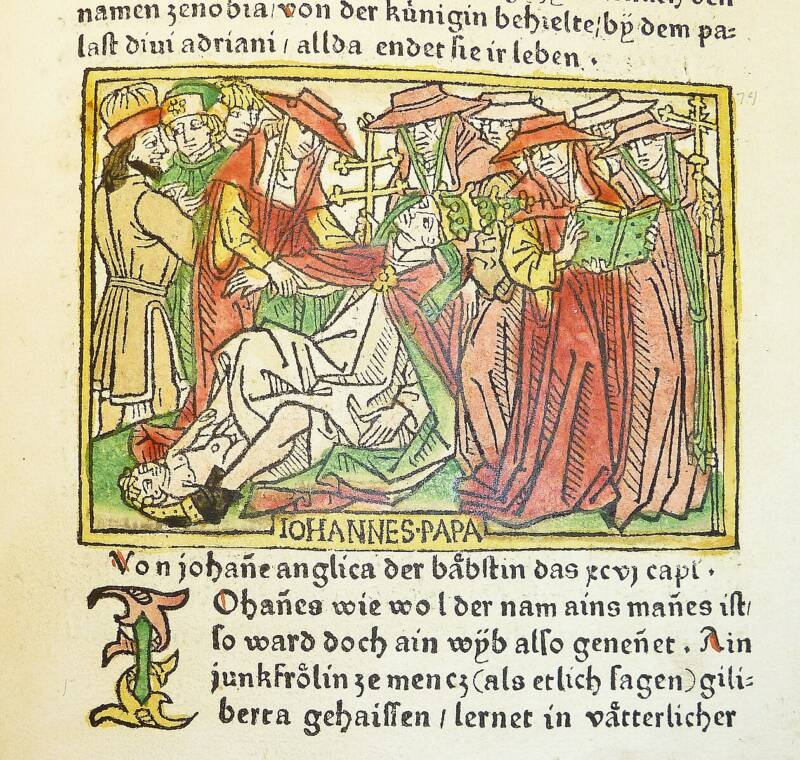
Public DomainA medieval woodcut illustration of Pope Joan giving birth.
Pope Joan’s fate also varied from tale to tale. In some stories, she died in childbirth. In others, she was dragged behind a horse, stoned, and buried in the spot where she took her final breath.
A text that’s sometimes attributed to the Italian Renaissance poet Petrarch claims that the discovery of Joan’s true identity caused bloody rain in Brescia and a swarm of monstrous locusts in France. While this all sounds extraordinary today, people in the Middle Ages did believe the myth — and they accepted it as fact for centuries.
Medieval Belief In The Story Of Pope Joan
It’s unclear why Jean de Mailly and his contemporaries began writing about a female pope, but some historians believe the myth may have stemmed from accounts of Marozia, a Roman woman who allegedly had a sexual affair with Pope Sergius III in the early 10th century and was later awarded the title of senatrix or “senatoress” of Rome by Pope John X. This gave her a level of influence that was unprecedented for women at the time.
Marozia’s story was widespread, so perhaps it didn’t seem so absurd to Romans that a woman could hold a leadership position. Indeed, until the 1500s, many Catholics simply went along with the chronicles that documented the life of Pope Joan. When the Siena Cathedral was built in the 13th century, a bust of Joan was added alongside the statues of every other pontiff.
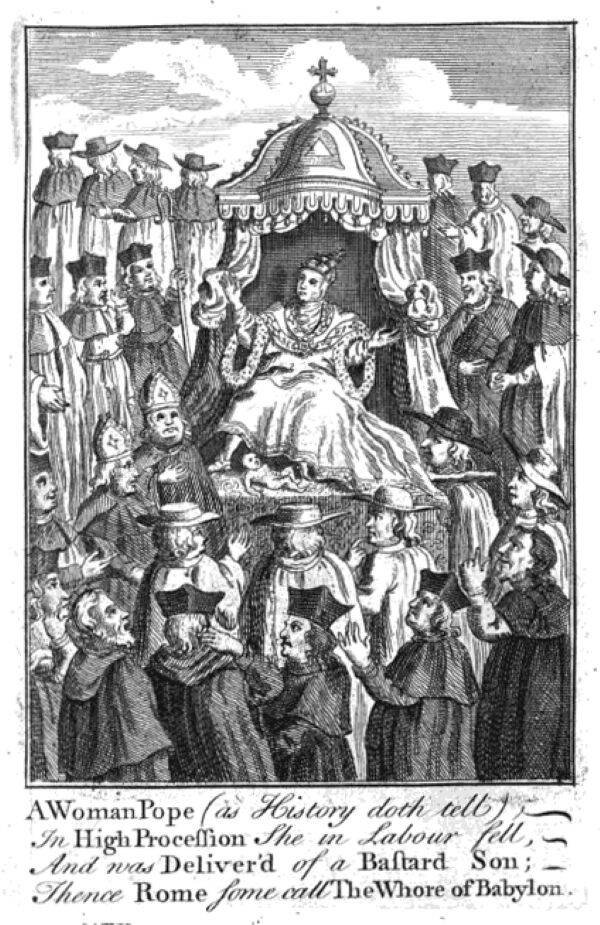
Public DomainA 17th-century depiction of Pope Joan referring to her as the “Whore of Babylon.”
There are even rumors that medieval popes were “checked” to ensure that another female could never sneakily become pontiff. Popes were purportedly crowned upon a special marble chair with a hole in the seat through which a cardinal standing below could confirm the presence of male genitalia. This legend goes so far as to claim that the cardinal would shout, “Duos habet et bene pendentes” — “He has two, and they hang well.”
What’s more, for a period of time during the Middle Ages, part of the supposed route where Pope Joan gave birth was seemingly blocked. This may have contributed to the belief in Martin of Opava’s claims of a “shunned street” that pontiffs no longer used for processions.
By the late 16th century, however, scholars were beginning to debunk the myth of Pope Joan.
Was There Really A Female Pontiff?
Beginning in the 1580s, French writer Florimond de Raemond published at least three treatises laying out why Joan’s story had to be fictional. His work led to the bust of Joan being removed from the Siena Cathedral in 1601.
Today, the Catholic Church officially denies the existence of Pope Joan. If nothing else, the timeline simply doesn’t fit.
Had there actually been a female pontiff, she most likely would have existed in the late 11th century, when the papacy was highly contested. Several men staked their own individual claims to the position — perhaps a woman could have done so, too.
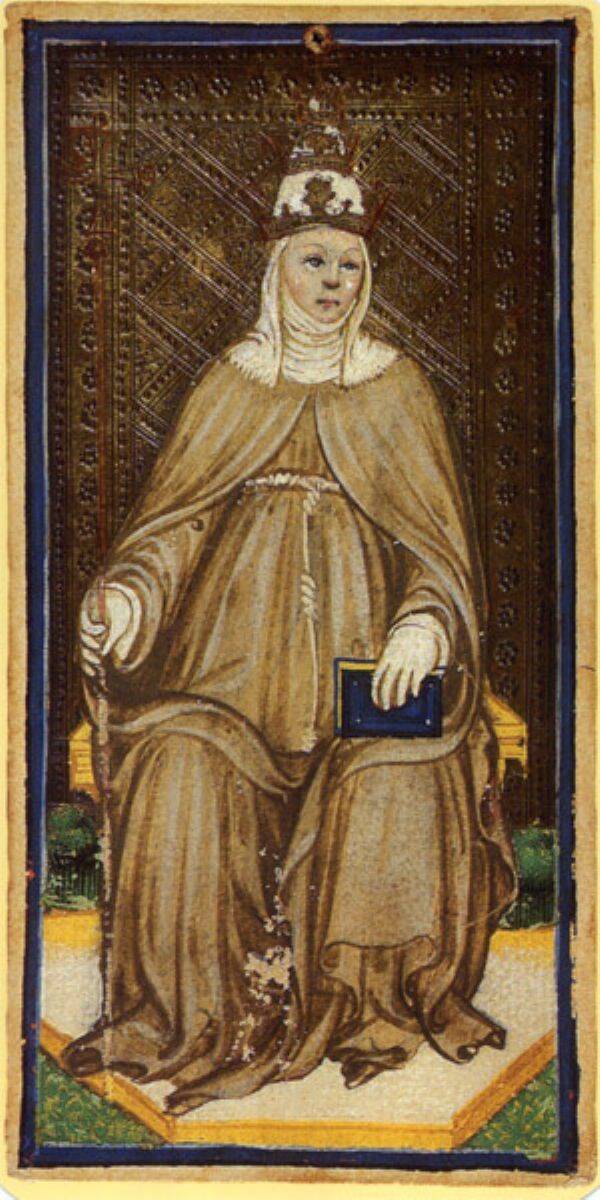
Public DomainThe “popess” or “high priestess” tarot card is sometimes said to depict Pope Joan.
Legend most commonly states that Pope Joan ruled between Pope Leo IV and Pope Benedict III. However, there were only two months between the time that Leo died (July 855) and Benedict ascended to the papacy (September 855). Pope John VIII did rule from 872 to 882 — and some people believe that Joan could have adopted the name John to hide her true identity — but it’s unlikely that John was actually a woman.
Even though the Church says that Pope Joan never existed, the legend still pops up now and again. Throughout history, Joan’s story has been used to criticize the Church, primarily as a commentary on the corruption of the papacy. Protestants also wielded the myth to discredit Catholics during the Protestant Reformation. But while Joan’s tale is fascinating, it’s almost certainly fictional.
After learning about the legend of Pope Joan, go inside the corrupt reign of Pope Alexander VI. Then, read about the Cadaver Synod, when a pope’s corpse was exhumed and put on trial.