There are currently six accepted kingdoms of life, such as plants, animals, and fungi — and Prototaxites may have represented a seventh life form that's now extinct.
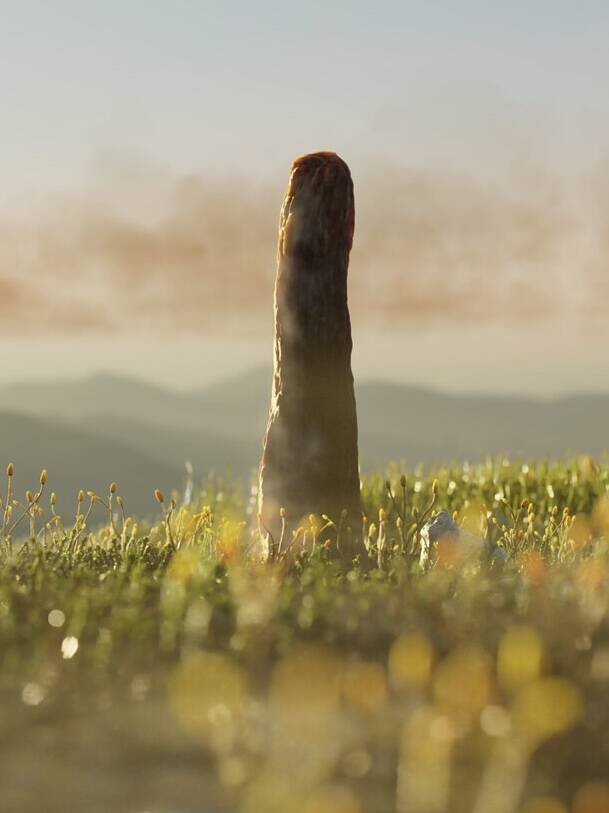
Matt Humpage/Northern Rogue StudiosAn artist’s 3D rendering of what Prototaxites looked like.
In the mid-19th century, scientists examined the prehistoric fossil of a strange life form dubbed Prototaxites, meaning “early yew.” At roughly 400 million years old, these organisms predated trees. They stood 25 feet tall and towered above the Lilliputian plants, mushrooms, and bugs that dotted the landscape.
But the question of exactly what these spire-shaped objects were has remained a mystery. Now, a new study published in Science Advances could explain why Prototaxites have been so difficult to categorize: They may have been an entirely unique form of life altogether.
The Challenge Of Categorizing ‘Prototaxites’
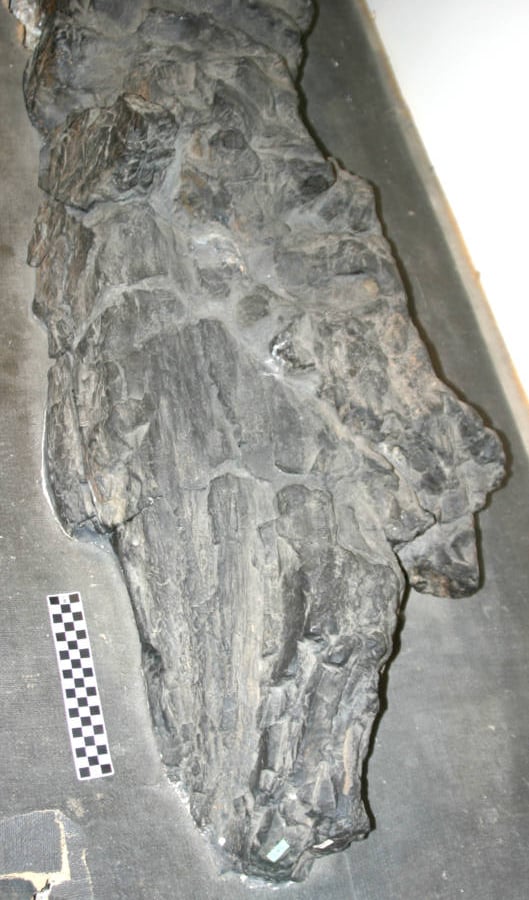
G.J. Retallack/Wikimedia CommonsA Prototaxites fossil found in New York.
Over the decades, researchers have tried to group Prototaxites into pre-determined categories like conifers, fungi, and algae. However, a recent comparison with fossil fungi from the same prehistoric rock deposit where a Prototaxites specimen was found shows that Prototaxites had a completely different chemistry and cellular structure, meaning it cannot be classified as a fungus. This new study argues that these organisms were an entirely unknown type of multicellular life on equal footing with plants, animals, fungi, protists, bacteria, and archaea.
“It feels like it doesn’t fit comfortably anywhere,” researcher Matthew Nelsen of the Field Museum of Natural History told Scientific American. “People have tried to shoehorn it into these different groups, but there are always things that don’t make sense.”
Superficially, Prototaxites somewhat resembled fungi. The organism was composed of interwoven tubes like fungi, but that’s where the similarities end.
Whereas the tubes that make up fungi are orderly and thread-like, the tubes that made up Prototaxites branched wildly. The specimen also contained no trace of chitin, a polymer found in the cell walls of all fungi. What’s more, some of the tubes seen in the Prototaxites specimen had banded walls resembling structures found in modern vascular plants.
“In the books and books of anatomy written about living fungi, we never find structures like that,” Alexander Hetherington, one of the study’s authors, told Science.
An Entirely New Form Of Life
The key characteristics of Prototaxites are its trunk-like structure with concentric rings, a tissue structure similar to fungal mycelium, growth patterns that resemble both plants and fungi, and evidence that suggests it consumed other organic matter rather than photosynthesizing. Most remarkably, these would have been the largest terrestrial organisms of their time. It’s easy to see why they have captivated researchers.
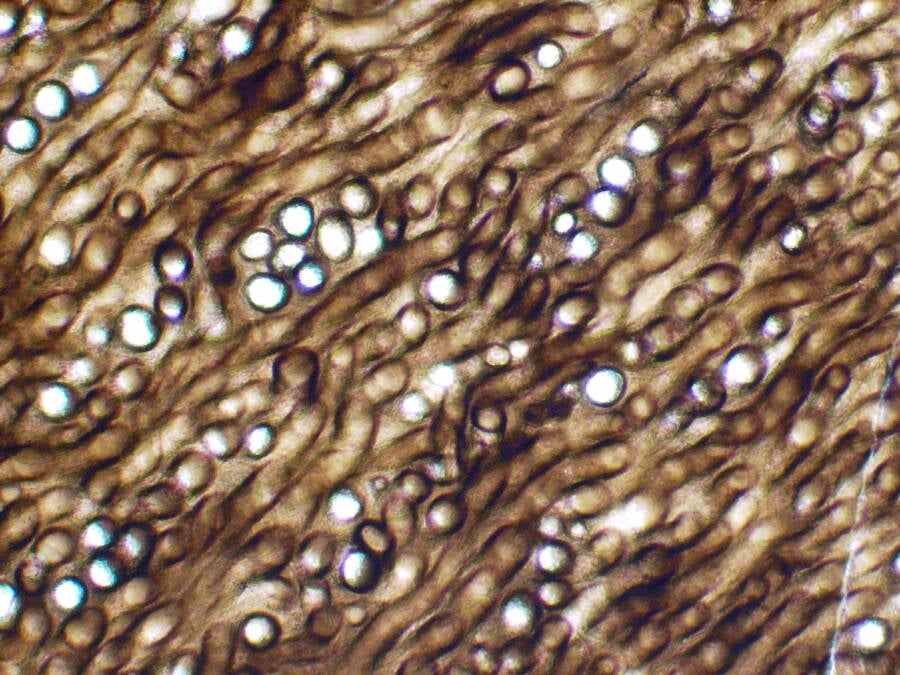
Public DomainA view of the microstructure of Prototaxites.
Even if Prototaxites had turned out to be a fungus, though, it still would have independently evolved into a unique form of complex, multicellular life. But the more researchers study this strange organism, the more it differentiates itself. According to Nelsen, “it is just a really wild thing that refuses to fit neatly into any group.”
It may seem like splitting hairs, but if the researchers can fully rule out the notion that Prototaxites was a fungus — even a weird one — then they can focus on other questions, like how this organism grew so large in a world that was otherwise dominated by ankle-high plants and little organic matter.
“Simply acknowledging that we don’t know is a big step forward,” Hetherington said. “Then we can turn our attention to the more exciting ecosystem questions.”
After learning about this strange new life form, read about the oldest fossils ever found on Earth. Or, discover the evidence scientists have found of life on Mars.