This mysterious concentration of iron has the mass of Mars and is longer than 463 million Earths lined up in a row.
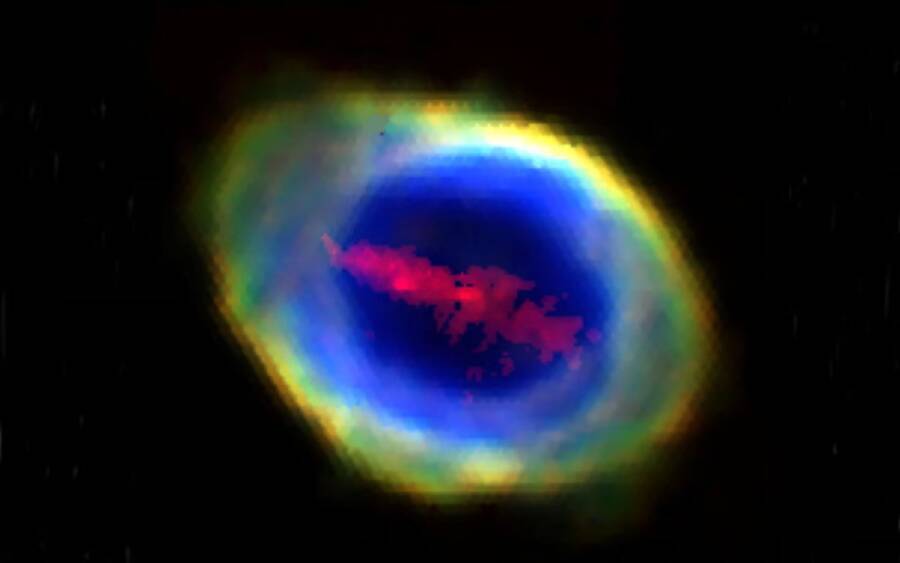
Roger Wesson et al./MNRASA composite image of the Ring Nebula obtained by the WEAVE instrument, with the iron cloud represented by the red stripe at the center.
Ever since it was first discovered by the French astronomer Charles Messier in 1779, the Ring Nebula has been a continuous subject of study — one that continues to reveal new secrets, nearly 250 years later.
Recently, researchers observed a large, bar-shaped cloud of iron atoms stretching roughly 3.7 trillion miles across the face of the nebula. This discovery was made thanks to the new WEAVE spectrograph that came online in conjunction with Spain’s William Herschel Telescope (WHT) in 2023. Although WEAVE (WHT Enhanced Area Velocity Explorer) is still very new, it has already delivered remarkable results.
The Mysterious Cloud Of Iron Discovered At The Center Of The Ring Nebula
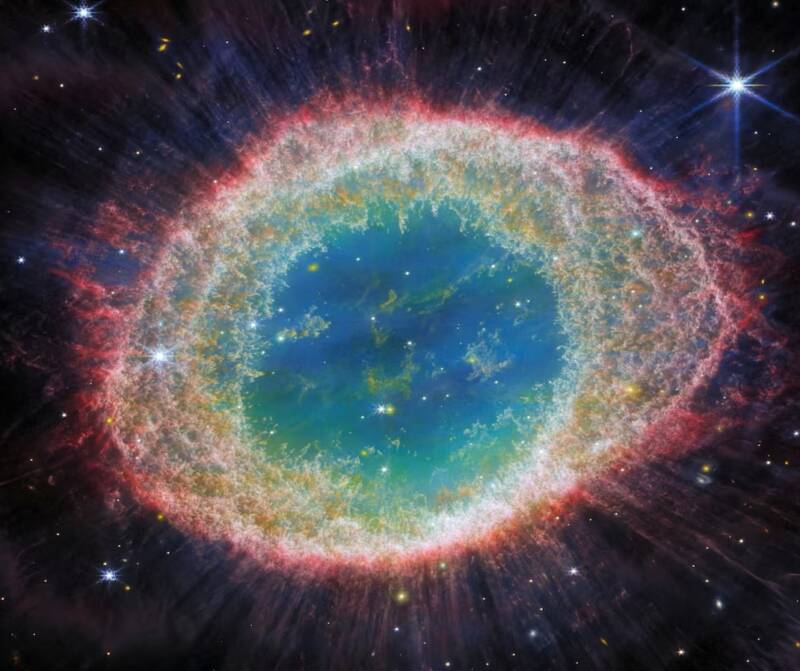
NASAA telescopic image of the Ring Nebula.
Looking at the face of the Ring Nebula — a glowing shell of gas and dust expelled by a dying star that sits 2,500 light-years from Earth — the instrument’s Large Integral Field Unit (LIFU) allowed astronomers to get detailed spectra across its entirety for the first time. And this is when they spotted the massive iron bar at its center. Their observations have since been published in the Monthly Notices of the Royal Astronomical Society.
“When we processed the data and scrolled through the images, one thing popped out as clear as anything — this previously unknown ‘bar’ of ionized atoms, in the middle of the familiar and iconic ring,” lead study author Roger Wesson of Cardiff University and the University of London said in a statement.
These iron atoms are collectively comparable to the mass of Mars. According to the study, one possible explanation for such a massive agglomeration of iron is that it could be the remnants of a rocky planet that had been vaporized when the star that created the nebula burst — a fate that could one day befall Earth and its surrounding rocky planets.
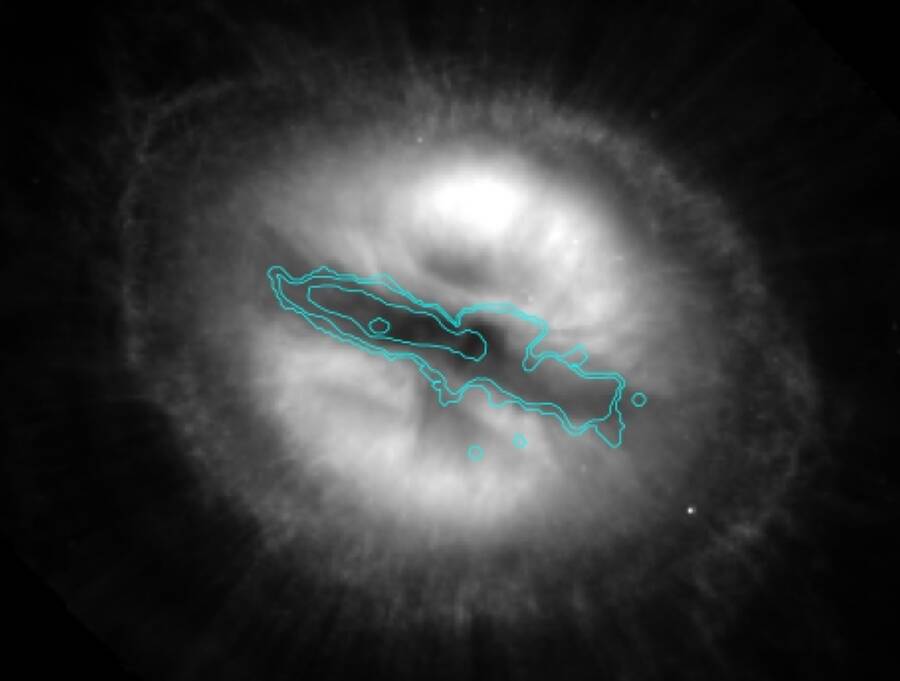
Roger Wesson et al./MNRASAn outline of the iron bar observed inside the Ring Nebula.
“It is exciting to see that even a very familiar object — much studied over many decades — can throw up a new surprise when observed in a new way,” Wesson told Reuters. “It’s a classic object for professional and amateur astronomers alike to observe. Although it’s too faint to see with the naked eye, it’s quite easy to spot with binoculars.”
Wesson noted that iron was the only chemical element that took on this shape. No other elements form a bar shape like this.
“This is weird, frankly,” said study co-author Janet Drew. “Its importance lies in the simple fact that we have no ready explanation for it, yet. The origin of the iron might trace back to the vaporization of a planet. But there could be another way to make the feature that doesn’t involve a planet.”
Further study could provide some insight here, particularly about how the nebula formed after the dying star at its center shed its outer layers.
What Additional Research Could Reveal About How This Cloud Of Iron Formed
“We definitely need to know more — particularly whether any other chemical elements co-exist with the newly-detected iron, as this would probably tell us the right class of model to pursue,” Drew added. “Right now, we are missing this important information.”
A follow-up study is in the works to explore future avenues of research. Scientists plan to obtain more data using WAVE’s LIFU at a higher spectral resolution to try and gain a better understanding of how the bar of iron formed. Eight other surveys are set to be carried out by WEAVE over the next five years as well, with Drew leading the research into other ionized nebulae across the Milky Way.
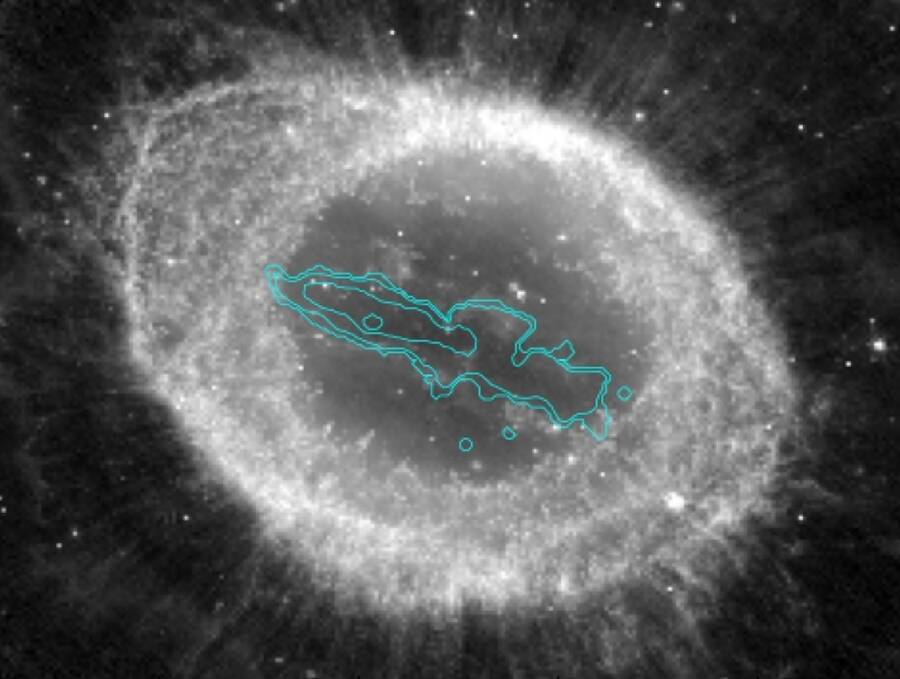
Roger Wesson et al./MNRASOverlaid images of the nebula and the iron bar at its center.
“It would be very surprising if the iron bar in the Ring is unique,” Wesson said. “So hopefully, as we observe and analyze more nebulae created in the same way, we will discover more examples of this phenomenon, which will help us to understand where the iron comes from.”
Around 3,000 similar nebulae are known throughout our galaxy, so there is plenty of opportunity for further research. By studying these extraordinary celestial bodies, astronomers can gain a stronger understanding of how stars and planets die — and how their matter is then recycled by the universe.
“Even though the Ring Nebula has been studied using many different telescopes and instruments, WEAVE has allowed us to observe it in a new way, providing so much more detail than before,” Wesson added.
After reading about the iron bar found inside the Ring Nebula, check out 44 vintage NASA photos that define the Space Age. Then, check out 21 amazing photos of Earth from space.