While working at Abu Ghraib prison in Iraq, Sabrina Harman was infamously photographed with abused prisoners, including a pile of naked and hooded men.
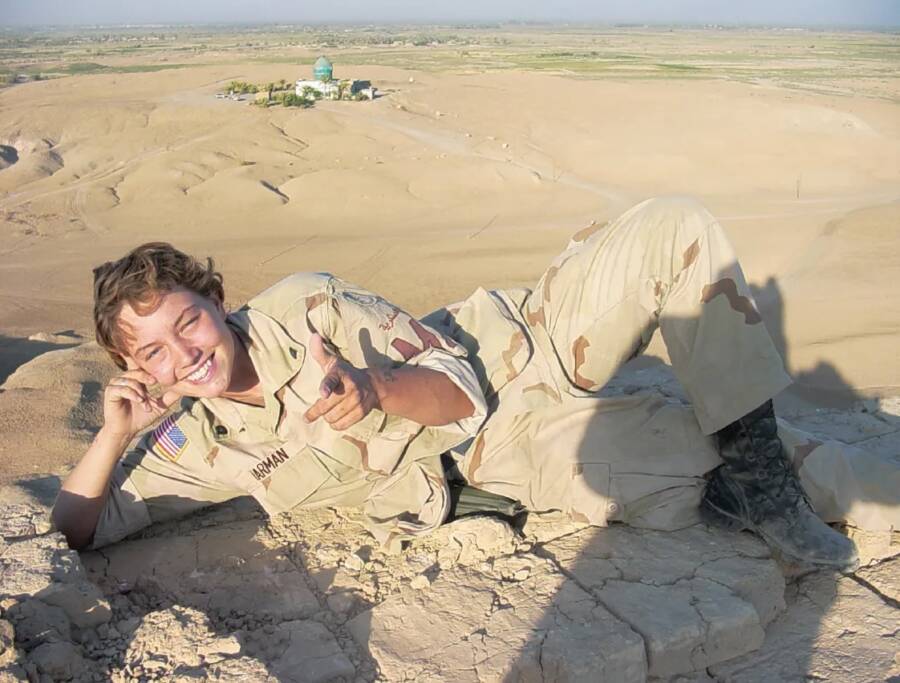
Sabrina HarmanSabrina Harman was one of a handful of American soldiers who served time for abusing prisoners at Abu Ghraib.
In April 2004, graphic photographs showing prisoner torture at the Abu Ghraib prison in Iraq shocked the world. The images chronicled sexual humiliation, psychological torture, and physical abuse. Worst of all, many of the photos showed U.S. military members grinning nearby, including a 26-year-old Army reservist from Virginia named Sabrina Harman.
Harman is featured prominently in some of the most damning photos from Abu Ghraib, including one in which she grins and gives a thumbs up while posing behind a pile of naked, hooded men. She faced five years in prison for her actions, though she was ultimately sentenced to just six months.
So who was Sabrina Harman, and how did she make her way to Abu Ghraib?
Sabrina Harman, The Army Reservist Who Enlisted After 9/11
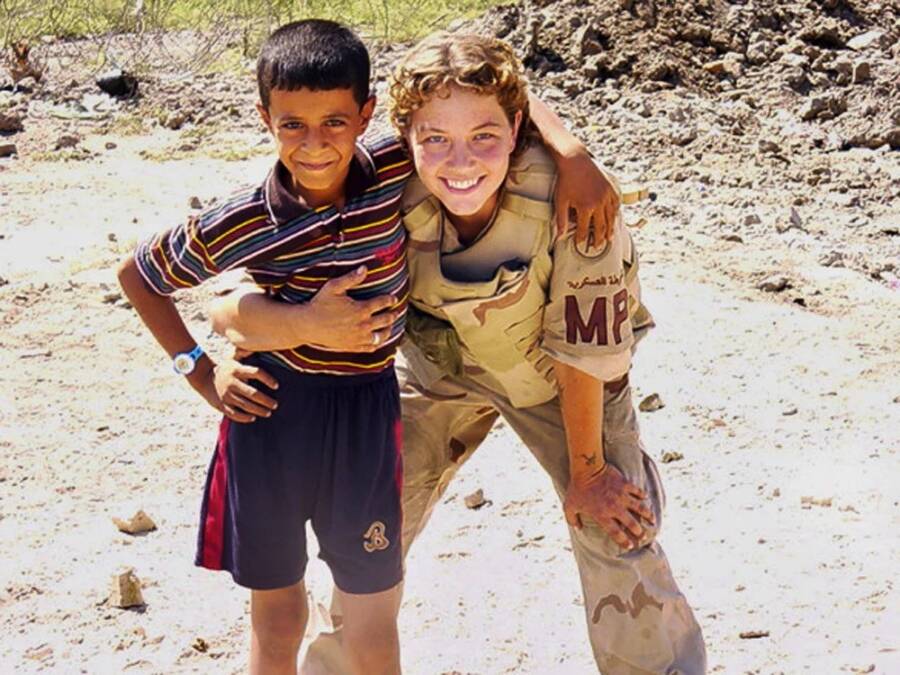
Harman FamilySabrina Harman in Al Hillah with an Iraqi boy in an undated photo.
Born on Jan. 5, 1978, Sabrina D. Harman grew up in Virginia. Her father was a homicide detective, and her mother was a “forensics buff,” according to NBC News. As such, Harman grew up around talk of violence and murder, though her fellow soldiers later remembered her to be exceptionally gentle. They told the New Yorker that she would even go out of her way to save bugs.
After the September 11 attacks, Harman left her job as an assistant manager at a Papa John’s Pizza in Fairfax County and enlisted as a reservist in the U.S. Army. She was assigned to the 372nd Military Police Company which, in the spring of 2003, was sent to Al Hillah, Iraq, to support the Iraqi police force.
There, Harman and her fellow soldiers acted like peacekeepers. They patrolled the town, socialized with its residents, and helped train policemen. According to the New Yorker, they expected that the Iraq War would soon be over and that they would be sent home. As such, the mood was light.
Instead, the 372nd was next assigned to Abu Ghraib, a notorious Iraqi prison where Saddam Hussein imprisoned and tortured dissidents.
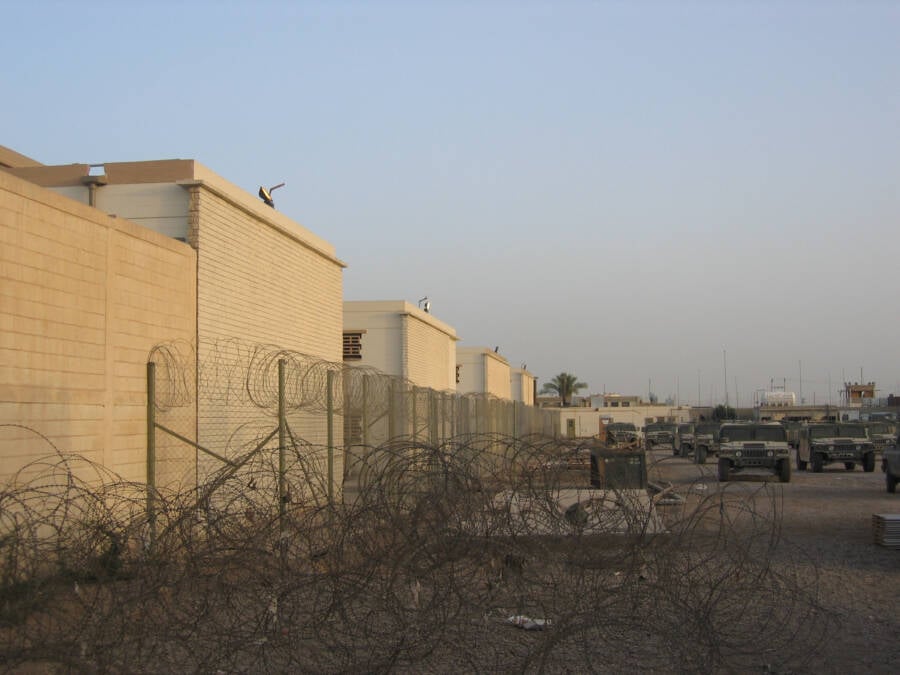
Fdy3k/Wikimedia CommonsExterior of the notorious Abu Ghraib prison in Iraq.
Though Sabrina Harman and her colleagues had no training in interrogation — and had not even been trained in the Geneva convention — they were tasked with helping “break down” prisoners.
On her first night at the Abu Ghraib prison, Harman had a foreboding feeling. She wrote to her roommate back in the United States, saying: “I have a bad feeling about this place. I want to leave as soon as possible!”
The Abuse Of Detainees At Abu Ghraib
As Sabrina Harman told NBC in 2004, she and her colleagues were brought Iraqi detainees by Army intelligence officers, CIA operatives, or by contractors. Though the soldiers of the 372nd had been trained for combat, not as prison guards, their job was to get the men talking.
“They would bring in one to several prisoners at a time already hooded and cuffed,” Harman explained. “The job of the [military police] was to keep them awake, make it hell so they would talk.”
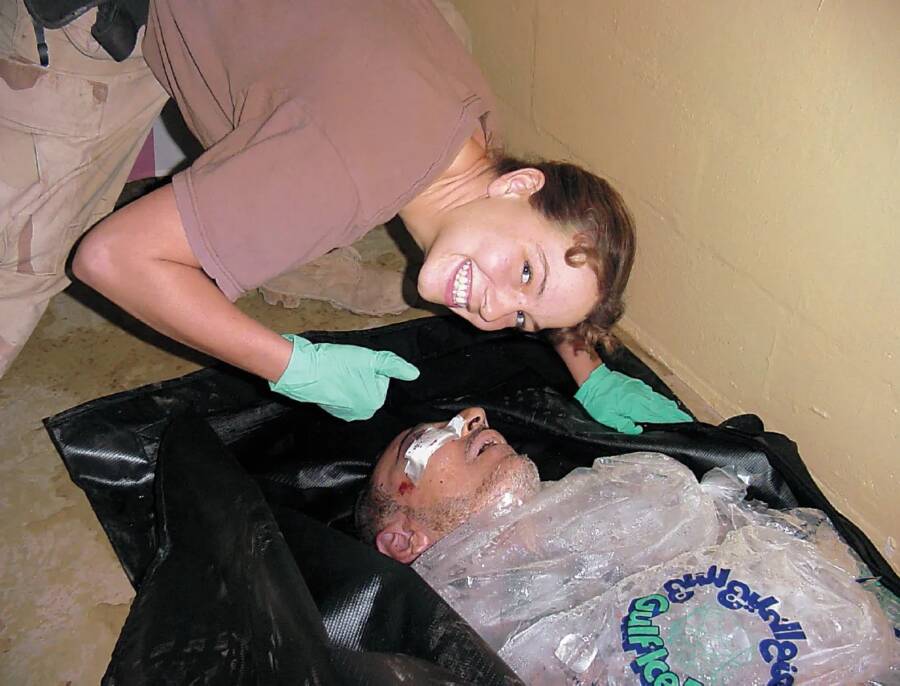
Public DomainSabrina Harman with the body of a detainee named Manadel al-Jamadi. Though smiling, Harman was disturbed that al-Jamadi’s death had been described as a “heart attack,” and took photos of his other injuries.
Upon their arrival, Harman and her colleagues were bewildered by what they saw. The detainees at Abu Ghraib were stripped naked, put in stress positions, forced to exercise or stand on boxes, and placed in humiliating situations, like with women’s underwear their heads. Prisoners who cooperated were allowed things like cigarettes or hot food. Uncooperative prisoners were deprived of food, sleep, clothing, and even their mattresses.
“In the beginning,” Sabrina Harman recalled to the New Yorker, “you see somebody naked and you see underwear on their head and you’re like, ‘Oh, that’s pretty bad — I can’t believe I just saw that.’ And then you go to bed and you come back the next day and you see something worse. Well, it seems like the day before wasn’t so bad.”
Harman and her colleagues did not invent the abuse at Abu Ghraib, but they did participate in it. And they photographed it. When Harman was told about a prisoner who’d died of a “heart attack,” she went to see the body, and noticed injuries which suggested that the prisoner had been beaten.
“There was no way he died of a heart attack because of all the cuts and blood coming out of his nose,” Harman later stated in the documentary Standard Operating Procedure (2008). She took photos, Harman continued, “to prove to anybody who looked at this guy… This guy did not die of a heart attack. Look at all these other existing injuries that they tried to cover up.”
But while Harman expressed horror about the death of the detainee, she also participated in the abuse of other prisoners. Ultimately, she would be accused of photographing a corpse and posing for a picture with it, jumping on prisoners as they lay in a pile, writing “rapeist” on a prisoner’s leg, and with attaching wires to a prisoner’s hands while he stood on a box with his head covered. Harman told him he would be electrocuted if he fell off the box, and a photograph of the hooded prisoner, nicknamed “Gilligan,” by the soldiers, became one of the most infamous from Abu Ghraib.
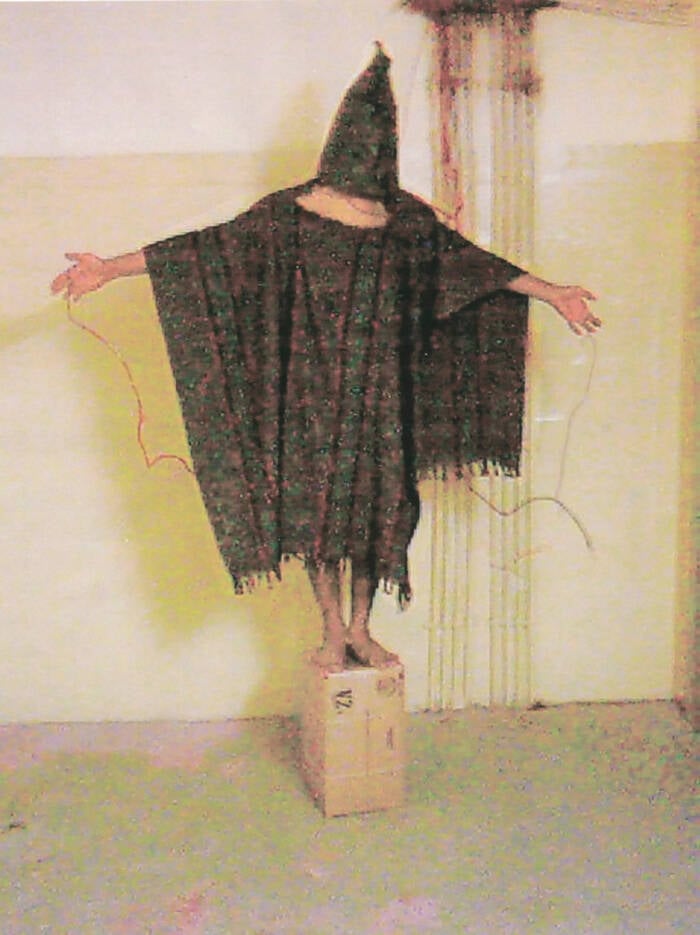
Public DomainThe prisoner nicknamed “Gilligan,” who Harman and others perched on a box. They told him he would be electrocuted if he fell off.
Indeed, Harman appeared in a number of photographs from Abu Ghraib. In one of the most infamous images, she smiles and gives a thumbs up while posing behind a pile of naked prisoners with hoods over their heads. In another, she gives a thumbs-up in front of a detainee who had been seemingly bitten by a dog. But while Harman looks jovial in the pictures, she had begun to realize that what she and the others was doing was wrong.
“At first I thought it was funny, but these people are going too far,” Harman wrote to her roommate. “I can’t handle whats going on. I cant get it out of my head… [I]t’s awful. I thought I could handle anything, but I was wrong.”
Then, in 2004, photos that Harman and others had taken at Abu Ghraib came to light.
Sabrina Harman’s Punishment For What Happened At Abu Ghraib
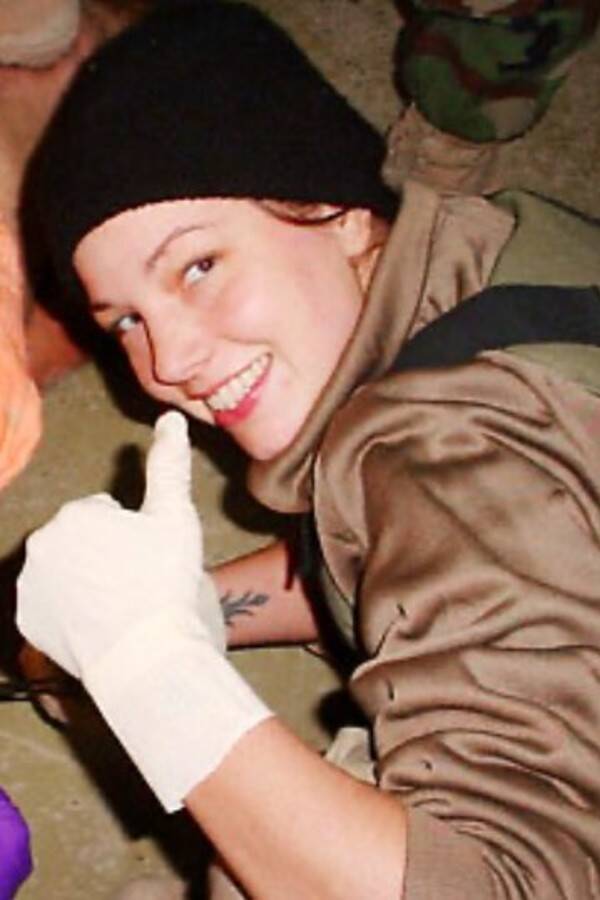
Public DomainSabrina Harman giving the thumbs up while treating a prisoner, who was seemingly bitten by a dog.
Rumors of what was happening at Abu Ghraib swirled throughout 2003, and in January 2004, the Army assigned Major General Antonio M. Taguba to investigate. Taguba found that “numerous incidents of sadistic, blatant, and wanton criminal abuses were inflicted on several detainees” and that “this systemic and illegal abuse of detainees was intentionally perpetrated by several members of the military police guard force.”
Then, that, April, the CBS program 60 Minutes II revealed the abuse at Abu Ghraib. The network published photos which showed the abuse of detainees, as well as the grinning faces of U.S. service members — including Sabrina Harman. The scandal outraged the world, especially since the photos showed clear violations of the Geneva Convention.
Though the Abu Ghraib prison scandal was indicative of the larger U.S. policy of “enhanced interrogation,” U.S. president George W. Bush claimed that the abuse had been perpetrated by just a few individuals. And in the end, just seven reservists who had worked at Abu Ghraib — including Harman — faced charges for the abuse of detainees at the prison.
Harman faced charges of conspiracy, dereliction of duty, and maltreatment of subordinates, for which she could have spent five years in prison. In the end, Harman was found guilty of one count of conspiracy to maltreat detainees, four counts of maltreating detainees, and one count of dereliction of duty, and sentenced to six months in military prison.
“As a soldier and military police officer, I failed my duties and failed my mission to protect and defend,” Harman stated after her sentencing, according to The New York Times. “I not only let down the people in Iraq, but I let down every single soldier that serves today.”
She continued: “My actions potentially caused an increased hatred and insurgency toward the United States, putting soldiers and civilians at greater risk. I take full responsibility for my actions… The decisions I made were mine and mine alone.”
Sabrina Harman was one of a handful of soldiers who served time for abusing prisoners at Abu Ghraib. Next, read about William Calley, the only soldier charged for the My Lai massacre in Vietnam. And then learn about the capture of Saddam Hussein.