The now-extinct sea cow species, Salwasiren qatarensis, likely played a key role in its ocean ecosystems, much like modern-day dugongs.
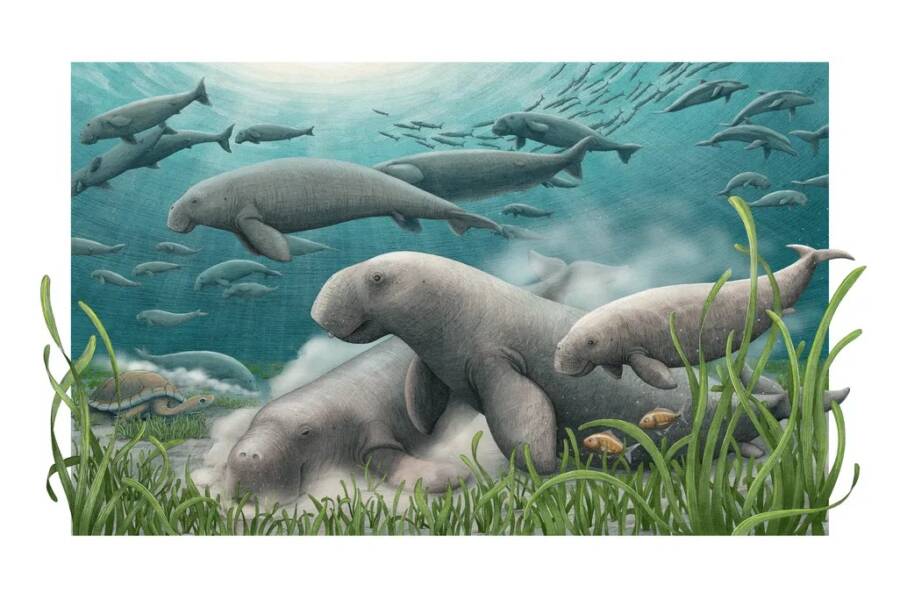
Alex BoersmaAn illustration of prehistoric sea cows.
Today, it is known that dugongs, also known as sea cows, play an important role in their ocean ecosystems by consuming seagrass, digging up important nutrients, and reshaping the seafloor. These animals are sometimes even dubbed “ecosystem engineers.”
Now, a new study suggests that sea cows have been doing this crucial ecosystem work for tens of millions of years, and that a previously unknown — but now extinct — sea cow species once played a part in that prehistoric “engineering.”
Research conducted on 21-million-year-old fossils from Qatar by experts at the Smithsonian’s National Museum of Natural History (NMNH) and the Qatar Museums revealed the new species, Salwasiren qatarensis. The analysis also suggested that the sea cow’s role as an ecosystem engineer is not a recent one.
The Salwasiren qatarensis was likely a smaller version of today’s dugongs. Their presence in the Al Maszhabiya site suggests that the area was once rich with seagrass, and that other types of sea cows evolved in the Persian Gulf over the millennia, changing the seafloor again and again.
All About Salwasiren Qatarensis, The Newly Identified Prehistoric Sea Cows
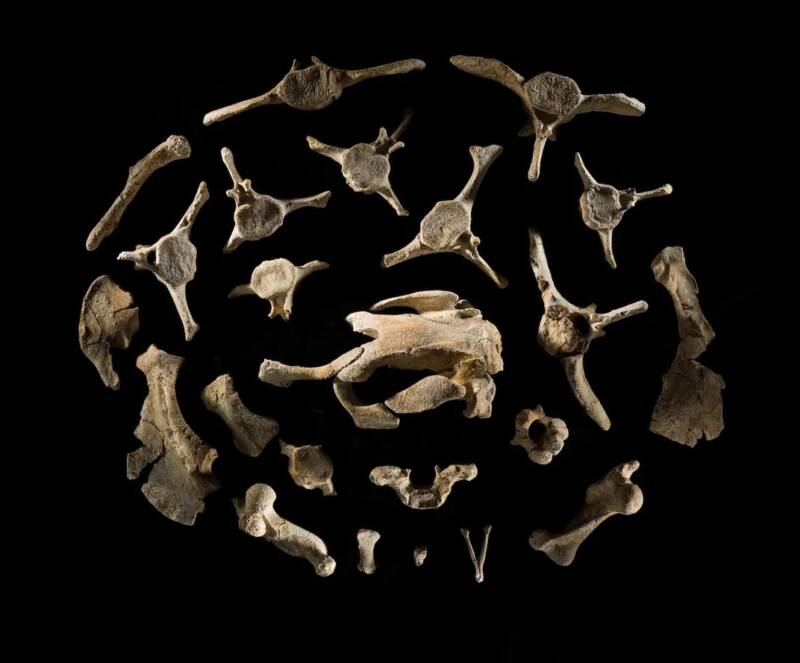
Qatar Museums, Doha, State of Qatar. Photo by James Di Loreto/SmithsonianSalwasiren qatarensis fossils.
The Salwasiren qatarensis was described in a recent report in the journal PeerJ, which also highlights the crucial role the sea cows played as ecosystem engineers. The animals were smaller than modern dugongs, which can weigh up to eight times more than the Salwasiren qatarensis (the prehistoric creature probably weighed about 250 pounds).
The discovery came after researchers identified fossils at the Al Maszhabiya site in Qatar that resembled modern dugongs, but contained hind limb bones, which modern dugongs no longer possess due to evolution. These prehistoric sea cows also had straighter snouts and smaller tusks.
Due to the amount of Salwasiren qatarensis fossils present at the site, researchers suggested that Al Maszhabiya was once a hotspot for biodiversity. The region likely boasted plentiful seagrass beds that flourished in the area tens of millions of years ago.
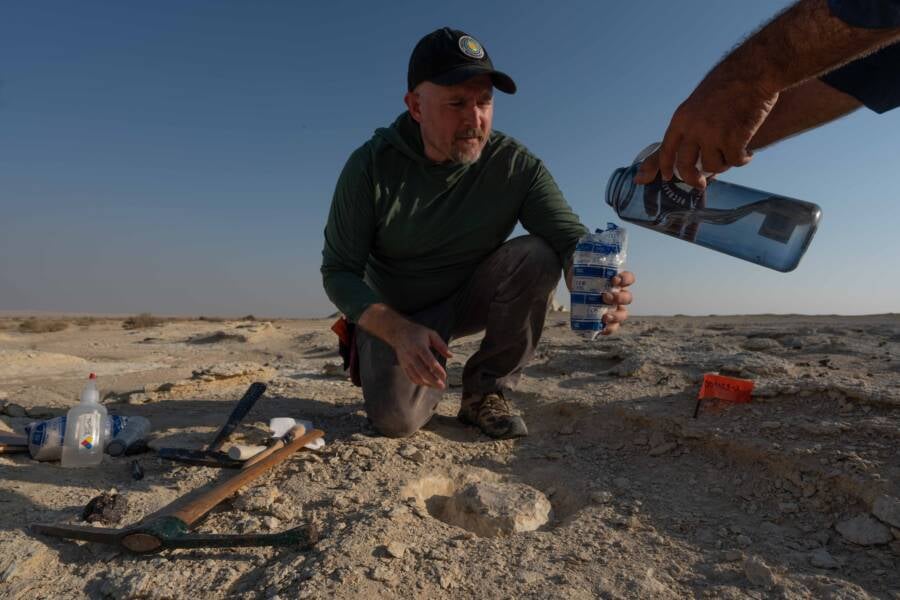
Clare FieselerNicholas Pyenson, who helped lead the new study, excavating fossils at Al Maszhabiya.
“The density of the Al Maszhabiya bonebed gives us a big clue that Salwasiren played the role of a seagrass ecosystem engineer in the Early Miocene the way that dugongs do today,” Nicholas Pyenson, who helped lead the new study, said in a statement. “There’s been a full replacement of the evolutionary actors but not their ecological roles.”
As the Salwasiren qatarensis grazed the seagrass, they likely dug up nutrients from the seafloor, which benefitted the other living things in the area. As they feasted, they probably also helped reshape the seafloor itself, further adding to the impact they had on the environment.
“We know today that many marine mammals can have a disproportionate impact on ocean ecosystems. [But] we don’t know how long that’s been going on,” Pyenson explained to the Smithsonian Magazine. “So, this is one of the first times, I think, we can point and say, ‘Gosh, this has probably been going on for tens of millions of years.'”
The Al Maszhabiya Site And Its Massive Trove Of Prehistoric Fossils
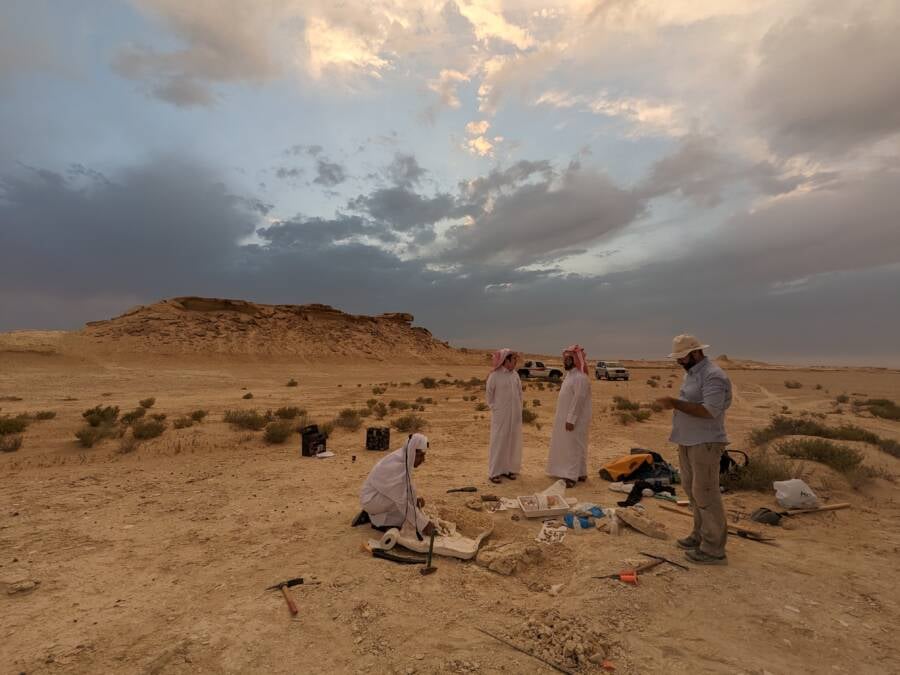
Nicholas D. Pyenson/SmithsonianQatar Museums staff members at the Al Maszhabiya site.
The Al Maszhabiya site was first discovered in the 1970s, but at the time, it wasn’t clear that the fossils came from sea cows. Instead, it was thought they belonged to prehistoric reptiles. Upon revisiting the site in the early 2000s, paleontologists realized the true nature of the remains.
However, it took many years for thorough research on these sea cow fossils to get started. After Pyenson and his co-author Christopher Marshall learned about the treasure trove of fossils in the 2010s, delays like the COVID-19 pandemic and the 2022 FIFA World Cup, which was hosted in Qatar, meant that they couldn’t start properly analyzing the fossils until 2023.
Since their arrival at the site, the research team has been able to identify 200 different locations of sea cow fossils. Many of the fossils were found less than 10 miles away from a bay where dugongs live today.
The Smithsonian’s National Museum of Natural History (NMNH) and the Qatar Museums are continuing to work together to further study the sea cow fossils and other prehistoric finds at Al Maszhabiya. Researchers with Qatar Museums are also working to get the site recognized as a UNESCO World Heritage Site.
Next, see how bison are revitalizing Yellowstone’s ecosystem. Then, learn about the prehistoric polar rhino recently identified by researchers.