Two little pieces of pyrite, also known as "fool's gold," that were unearthed at the Barnham archaeological site are the "smoking gun" proving that early humans were intentionally making fire as far back as 400,000 years ago.
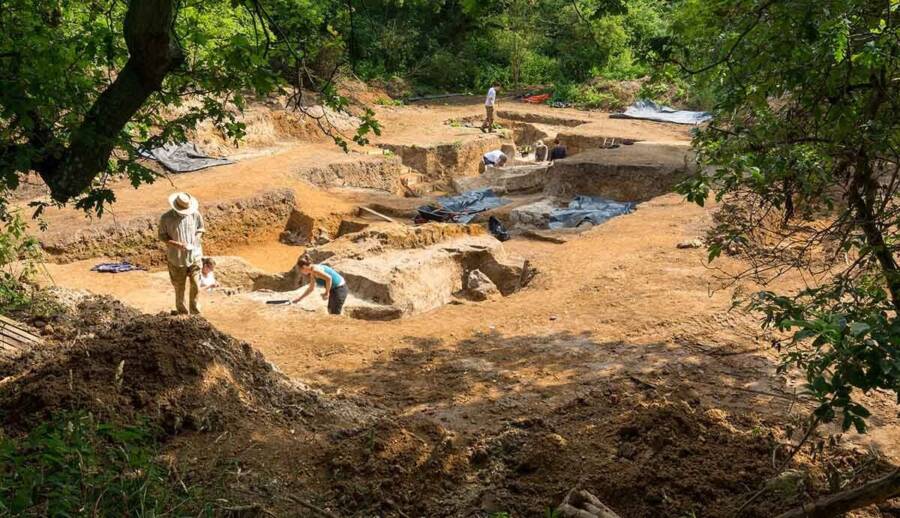
Pathways to Ancient Britain Project & Jordan MansfieldThe archaeological site in Barnham, England, where researchers have found the oldest-known evidence of humans making fire.
While excavating an ancient site near Barnham, Suffolk, England, archaeologists found a wealth of remains from prehistoric wildlife, including bison, elephants, deer, frogs, fish, and even monkeys. But the most exciting artifacts that they uncovered were two small pieces of pyrite — evidence that early humans were making fire here.
Archaeologists estimate that this fire-making took place some 400,000 years ago — about 350,000 years earlier than experts thought this milestone in human development was first achieved. Evidence suggests that the early humans living here not only knew how to make fire, but had also learned how to control it and had already started benefitting from this advancement in multiple ways.
Researchers now believe that the story of when fire was first discovered has just been rewritten.
Discoveries At Barnham Provide Evidence Of The Oldest-Known Fire-Making In Human History
According to a study published in Nature, the discovery of the fire-making pyrite rocks was made at a disused clay pit near Barnham. Researchers have been working at the site since the 1980s, but it was only during a recent dig that archaeologists started to document evidence of humankind’s earliest-known creation of fire.
Specifically, they found “fire-cracked flint handaxes” as well as sediment that showed signs of repeated burning. Fires, of course, can occur naturally. But the small pieces of pyrite that researchers found at the site suggest that the fires here had been set intentionally, especially because pyrite was not a local material. Early people would have carried the pyrite from somewhere else, seemingly with the intention to use it to produce sparks in order to make fires.
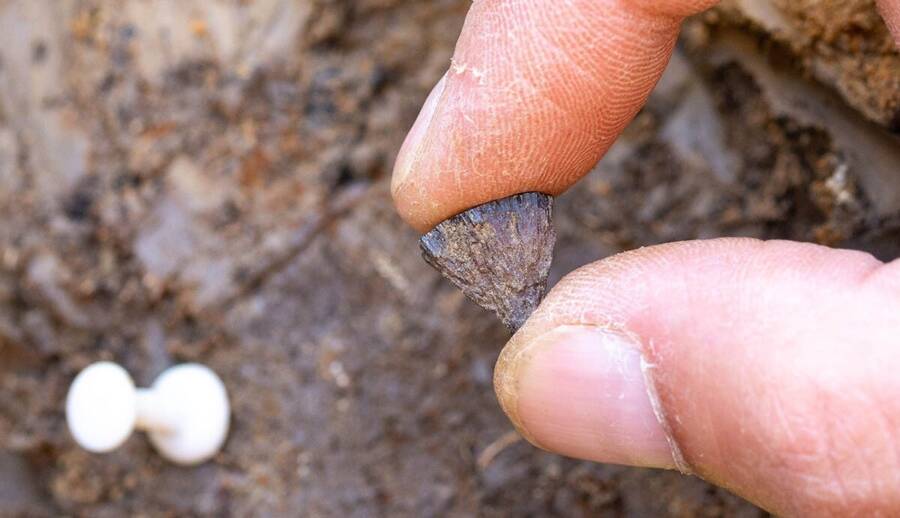
Pathways to Ancient Britain Project/Jordan MansfieldThis small piece of pyrite is the “smoking gun” proving that this site had been used for fire-making 400,000 years ago.
“As soon as we saw the pyrite, we realized we had found something remarkable,” study co-author Simon Parfitt of University College London remarked to the National History Museum. “Because pyrite doesn’t occur naturally in that landscape, its presence shows they had the ability to make fire at will. It would have been an essential part of a fire-making toolkit.”
This discovery is especially remarkable because it suggests that early humans were intentionally making fire far earlier than previously known. Researchers have found evidence of intentional fire-making at a 50,000-year-old site in northern France, but the Barnham site pushes the timeline of fire-making back by an astounding 350,000 years.
But who exactly was making these fires?
Who Made The Historic Fires Uncovered At Barnham?
At the time of the Barnham fires, some 400,000 years ago, our human ancestors, Homo sapiens, were still in Africa. So, the fire-makers here in Barnham were a different species of early human, though researchers aren’t positive who it was.
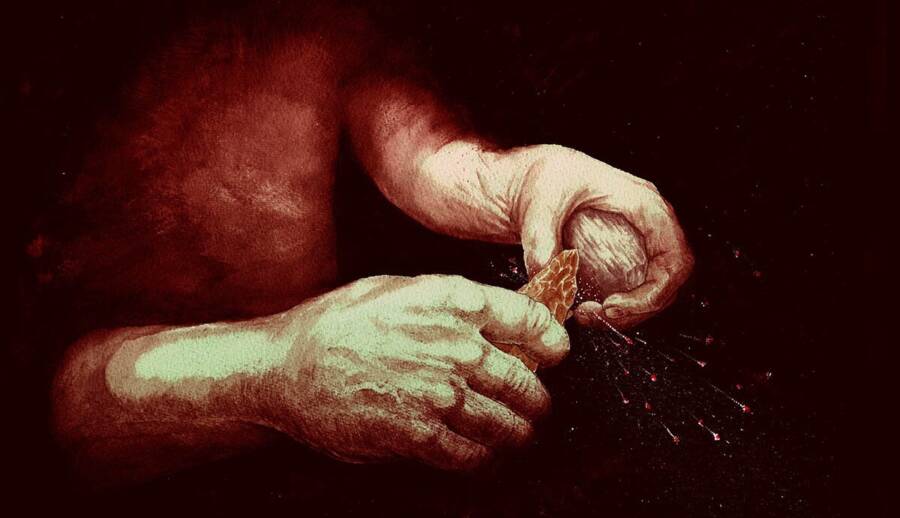
Craig Williams/The Trustees of the British MuseumA depiction of an early human making fire by using pyrite to produce a spark.
For now, researchers suspect that the fire-makers at Barnham were early Neanderthals. However, it’s difficult to know for certain, as they haven’t yet discovered any human remains at the site.
Whoever these fire-makers were, researchers suspect that they migrated from continental Europe — where they probably first learned to use pyrite to make fires — during a cold period. Once in England, their fire-making technology would have helped them to ward off predators, keep warm on icy nights, and experiment with cooking food. However, recent research suggests that there’s no definitive answer to the question of why humans first began making fires.
Regardless, researchers argue that the advent of fire-making would have also led to better nutrition, which helped early humans grow bigger brains and develop new skills. Meanwhile, fires also became social nexuses, where people could gather and share knowledge.
“Fire is a source of warmth, and on cold, dark nights it can extend the day,” said Dr. Silvia Bello, a National History Museum expert on human behavior. “Surely at times when people couldn’t hunt, the fire was a good space to gather, interact with each other and potentially learn and teach.”
She added: “There is always this aspect, that is a bit less visible in archaeology, which is the transmission of knowledge. The knowledge from adults to the kids, or the opportunity of learning from each other how to make and use tools. I imagine that fires were good learning areas.”
After reading about the discovery of humankind’s earliest-known fire-making, learn about the most fearsome prehistoric animals. Then, go inside the question of when woolly mammoths went extinct.