During a municipal drainage project in the heart of Tønsberg, workers happened upon this ring less than three inches below the surface.
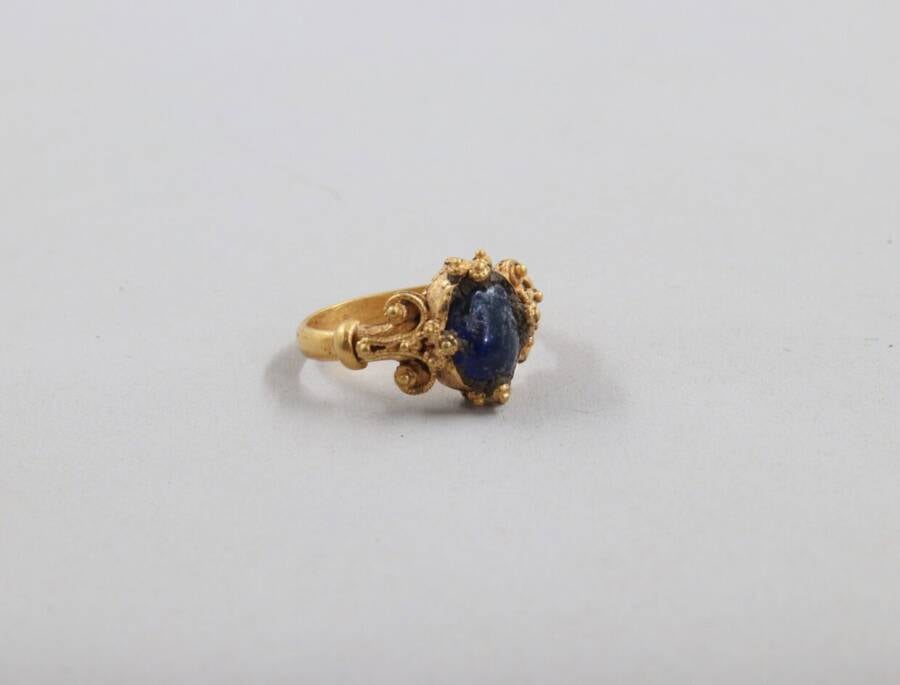
Norwegian Institute for Cultural Heritage ResearchThe ring’s ornate construction suggests that it once belonged to a woman of high status.
Laborers were recently hard at work in Tønsberg, Norway, during an excavation project related to stormwater management, when a glint of gold caught one of their eyes. They had spotted a tiny, delicate, gold ring, which experts believe dates back to the Middle Ages.
Given its ornate gold band, archaeologists believe that it likely once belonged to a woman of the upper class, and that the blue color of its stone was meant to cool “inner heat” and promote chastity.
A “Dream Find”: Uncovering The Medieval Ring In Tønsberg
According to the Norwegian Institute for Cultural Heritage Research, the medieval gold ring was first verified by Linda Åsheim, one of the onsite archaeologists in central Tønsberg affiliated with the stormwater project. Åsheim said she had an “out-of-body” experience when she first laid eyes on the ring.
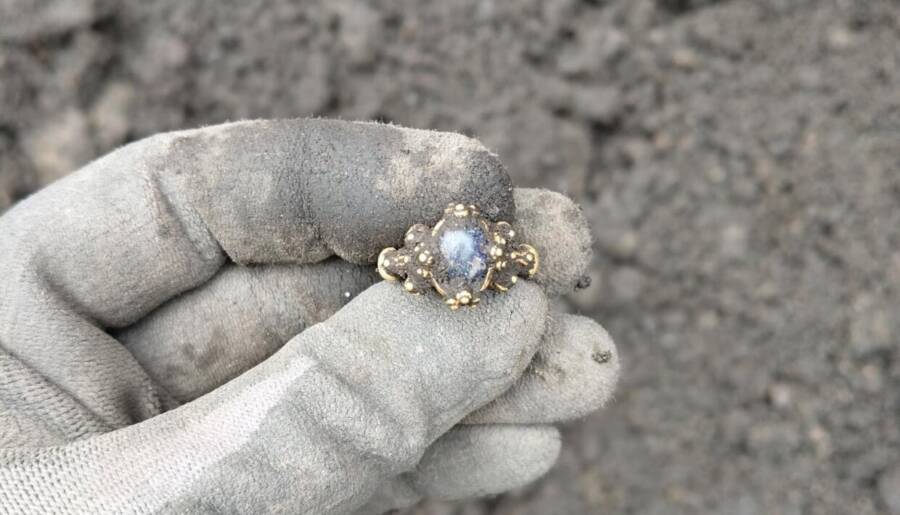
Linda Åsheim/Norwegian Institute for Cultural Heritage ResearchThe medieval ring, shortly after its discovery in Tønsberg.
“I was completely shaken, and had to ask the construction guys if they were messing with me,” Åsheim remarked. She added, “And now I just have to quit being an archaeologist, because now I’ve reached the top.”
The ring that Åsheim identified is small and delicate, a tangle of spiraled gold filigree and small round balls known as granulation. It’s set with a dark blue stone the color of a sapphire or opal, but appears to actually be made of glass. Archaeologists believe that it was likely meant to mimic the more precious stones, possibly through the addition of cobalt.
Though the archaeological layer where the ring was found has not been dated, a spruce twig in an upper layer was dated to between 1167 and 1269. And experts agree that the ring has a medieval design.
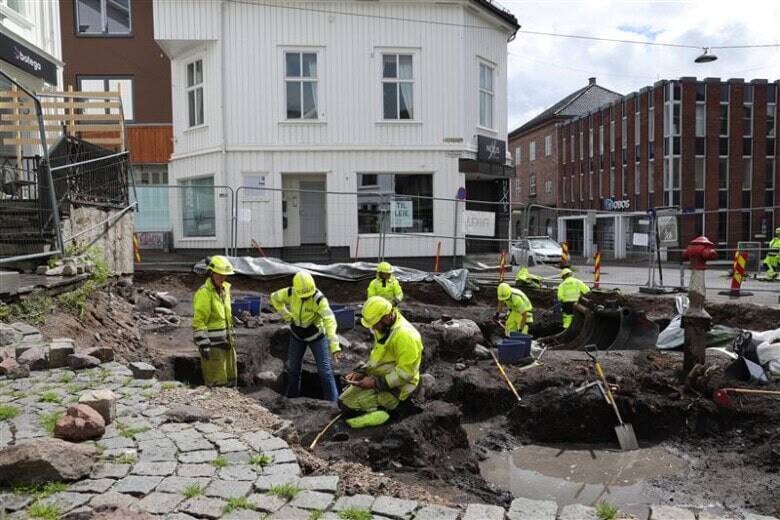
Norwegian Institute for Cultural Heritage ResearchThe excavation site in Tønsberg where the medieval gold ring was found.
“The design of the spirals at the top of the ring rail in particular resembles finger rings dating to the 9th-11th centuries,” Marianne Vedeler, a professor at the Museum of Cultural History, explained. “The combination of filigree and granulation came to Norway in the early Middle Ages from the Byzantine area, partly via Carolingian [era] (750 to 900) goldsmithing.”
But who did this stunning ring belong to? While the identity of the ring’s owner may remain a mystery, the ring itself offers some clues about the type of person who once wore it centuries ago.
The Story Behind The Gold Ring From The Middle Ages Found In Tønsberg
Tønsberg was an important town during the Middle Ages, located in the shadow of the royal castle complex known as Tunsberghus, or Tønsberg Fortress. As such, the ring could easily have belonged to a royal or a member of the clergy. But the small size of the ring (it has an estimated ring size of 50-55) suggests that it belonged to a woman, likely of the upper class.
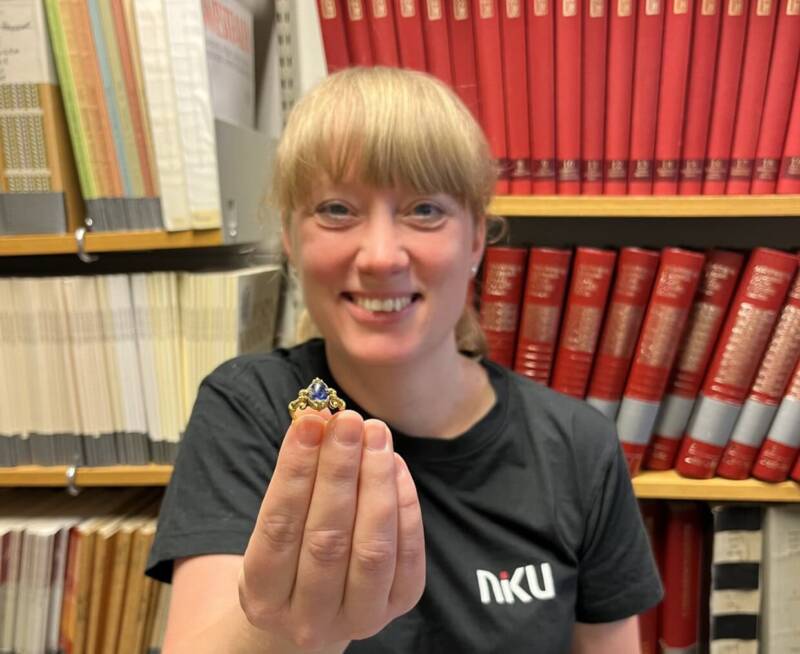
Johanne Torheim/Norwegian Institute for Cultural Heritage ResearchLinda Åsheim with the gold ring she found during excavations in Tønsberg.
What’s more, the ring’s blue stone had special meaning during the Middle Ages. Blue stones symbolized divine powers, and were thought to have healing properties. Medieval people also believed that blue stones could help cool someone’s “inner heat” and thus help them to remain chaste.
The ring shape itself, an unbroken circle, was also possibly seen as a protection from evil. And given its delicate decorative properties, and blue stone, it likely also symbolized power and social status.
But while the identity of the ring’s owner remains a mystery, it stands as one of the most thrilling archaeological finds in Norway in recent memory. Some 200 historical rings are in the country’s national database, though just 63 of them come from the Middle Ages.
“It has been 15 years since we last found a gold ring in Tønsberg,” project manager Hanne Ekstrøm Jordahl remarked, “and this one is a fantastically beautiful and rare specimen.”
After reading about the medieval gold ring that was found in Norway, look through these surprisingly raunchy images from medieval manuscripts. Then, learn about some of the strangest customs that existed during the Middle Ages.