The mummy was first discovered buried outside of the turquoise mine in the 1970s alongside grave goods like a snuff kit for hallucinogenic drugs.
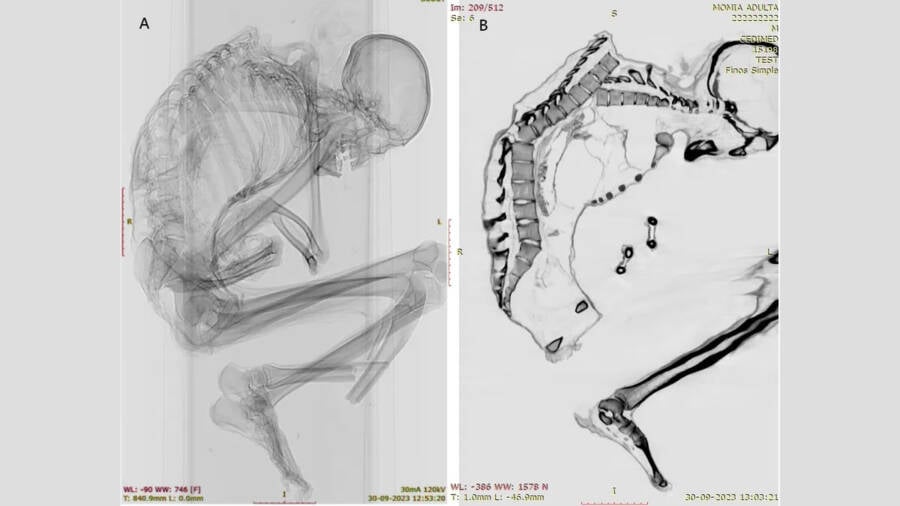
Francisco Garrido and Catalina MoralesX-rays and CT scans of the mummified man revealed the extent of his injuries.
New forensic analysis of a mummified man discovered in Chile’s Atacama Desert has revealed that the individual seemingly died around 1,100 years ago following a catastrophic accident inside a turquoise mine.
CT scans and X-ray imagery showed signs of blunt force trauma on the man’s skeleton, suggesting he died because of a rockfall or mine collapse. These findings, published recently in the International Journal of Osteoarchaeology, are providing new insight into the history of turquoise mining in Chile.
New Technologies Reveal Centuries-Old Injuries
The mummified remains were originally excavated in the 1970s near El Salvador, Chile, located in the heart of the Atacama Desert. Archaeologists recovered the body, along with an array of grave goods, just outside the entrance of a pre-Hispanic turquoise mine. The burial items included a bow and arrow, leather pouches containing ore fragments, beads, and a snuff kit typically used for hallucinogenic drugs.
While a visible fracture in the mummy’s lower left leg bone initially suggested a traumatic event, a comprehensive analysis was not completed until 2023, and the results have now been released.
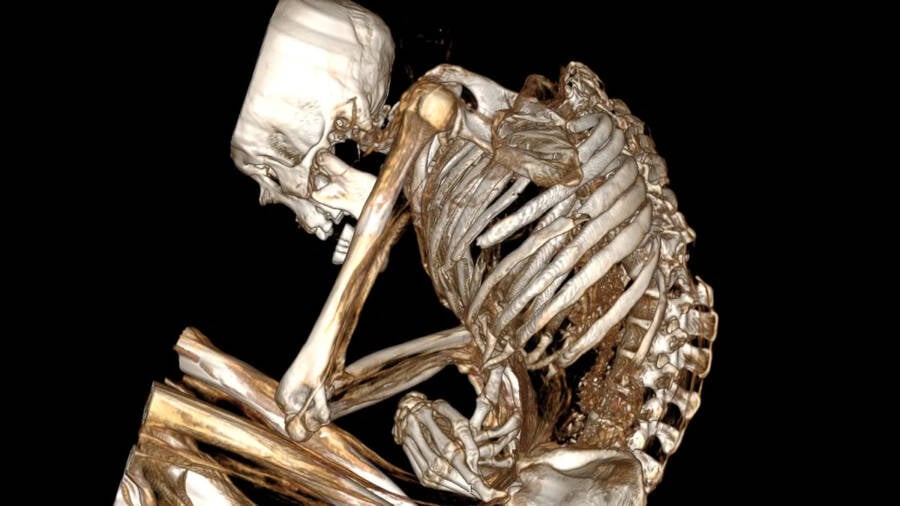
Francisco Garrido and Catalina MoralesEvidence suggests the man was killed in a mine collapse.
Researchers led by archaeologists Francisco Garrido and Catalina Morales of the National Museum of Natural History in Santiago utilized CT scans and X-ray imagery to examine the internal injuries of the mummy. The results painted a grim picture of a mining disaster.
“We found extensive injuries to the man’s back, ribs, collarbone, shoulder blades and lower limb bones,” the researchers wrote in the study. “Considering the archaeological context, this individual likely died while extracting turquoise, when a rock fell on his back from the ceiling of the mine.”
The lack of healing on the bone fractures confirmed that all injuries occurred immediately prior to death.
Radiocarbon dating indicated that the man died sometime between 894 and 1016 C.E. He was between 25 and 40 years old and stood just over five feet tall. Now, his untimely death is revealing more about life in the Atacama Desert some 1,100 years ago.
Unique Insight Into Pre-Hispanic Turquoise Mining
Turquoise mining took place in the Atacama Desert for 2,000 years, but most of the mines were open-air and shallow. As such, protective equipment was not typically used. However, the researchers noted that the mine at El Salvador was one of the few that had subterranean galleries.
“It is likely that a miner would have entered the mine and used stone hammers to extract turquoise from the surrounding rock,” Garrido and Morales told Live Science. “In the event of a rockfall, there was no form of protection.”
The discovery came as part of a broader effort to understand the trade networks of the South-Central Andes. The turquoise extracted from these mines was turned into beads, which were traded across the region.
Researchers emphasized that further study is needed to better understand the living conditions and physical toll placed on miners who extracted these valuable stones for trade and ritual use. The mummy, meanwhile, serves as a preserved reminder of the risks involved in one of humanity’s oldest professions.
After reading about the mummy of this Chilean turquoise miner, learn about the Llullaillaco Maiden, the mummified woman found at the summit of a volcano in the Andes. Then, discover the stories of nine more famous mummies.