Earlier studies suggested that the Tyrannosaurus rex died by age 30, but recent research into the growth rings in the leg bones of 17 T. rex specimens has revealed that the creatures continued to grow until they were at least 40.
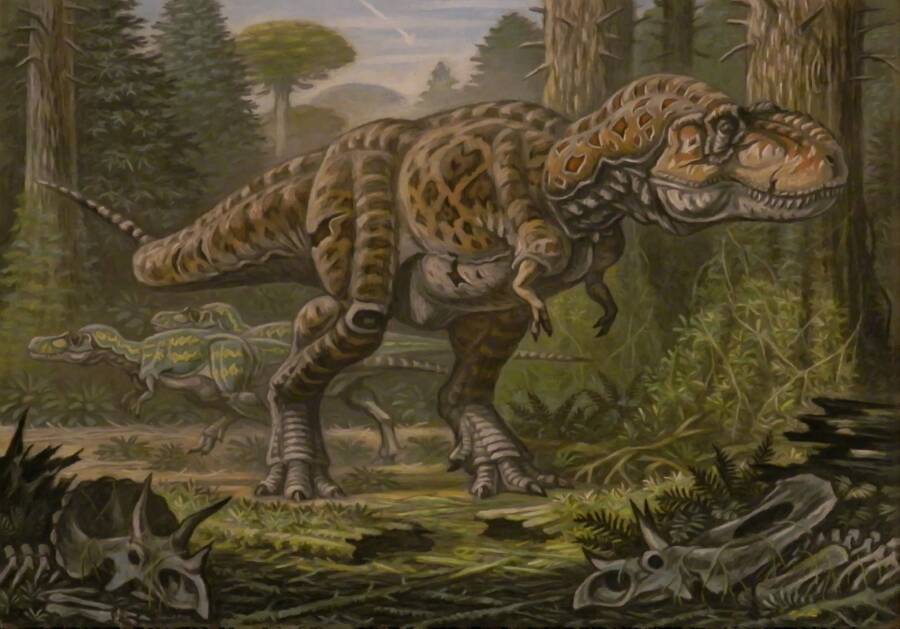
ABelov2014/Wikimedia CommonsAn artist’s illustration of an adult T. rex.
Much like trees, dinosaur bones contain concentric growth rings that can point to a fossil’s age. A recent study of the leg bones of the Tyrannosaurus rex revealed that some of these rings are easier to see than others — and this discovery is completely rewriting the lifespan of the “king of the dinosaurs.”
While previous analysis of T. rex growth rings suggested that the massive reptiles died by 30, scientists now believe they may have continued growing until they were at least 40 years old.
Reevaluating The Lifespan Of The Tyrannosaurus Rex
In the study, published in the journal PeerJ, lead author Holly Woodward of Oklahoma State University and her colleagues carried out the “most comprehensive histological analysis of Tyrannosaurus to date.”
Previous studies had either missed or completely ignored the fainter rings in T. rex leg bones, some of which are only visible in cross-polarized light. Woodward said she nearly did, too.
“I sort of discounted it at first,” she told Scientific American, “until I started looking at all these specimens and seeing it in a lot of them.”
Although dinosaurs’ growth rings are similar to tree rings, they differ in one major way: A cross-section of bones only records the last decade or two of the animal’s life. Fortunately, Woodward and her team had access to 17 specimens of different ages, enabling them to create a new model that pulls data from each individual dinosaur.
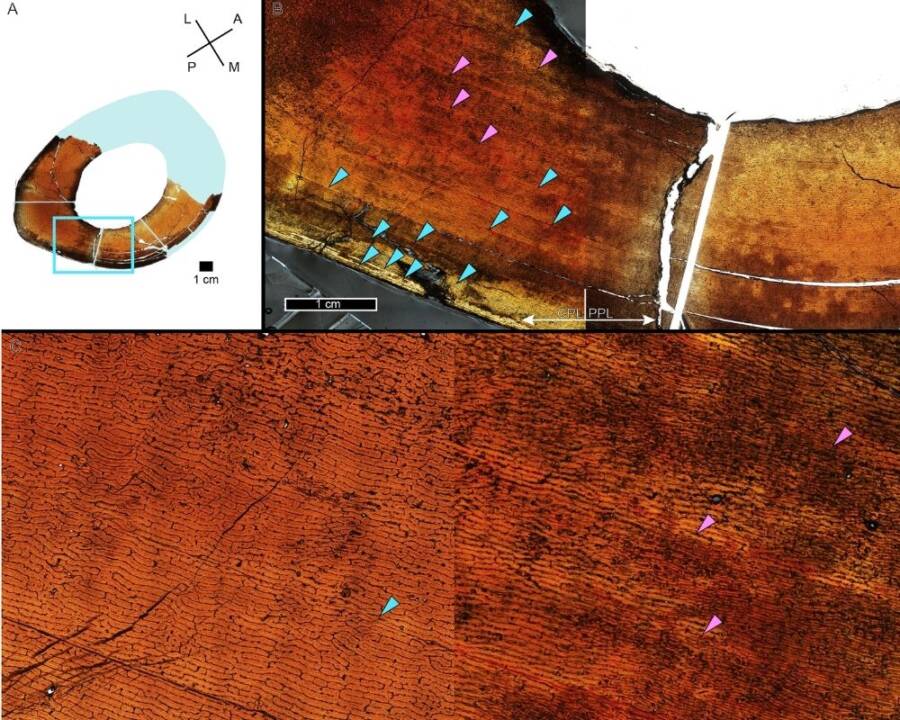
Woodward et al./PeerJ, 2026A view of the rings in a T. rex bone from the study.
“Best estimates from previous studies were that T. rex typically stopped growing around age 25,” said Woodward in a statement.
“We came up with a new statistical approach that stitches together growth records from different specimens to estimate the growth trajectory of T. rex across all stages of life in greater detail than any previous study,” explained mathematician and paleobiologist Nathan Myhrvold.
Contrary to previous research results, it now seems that the T. rex had a slower, steadier growth period, rather than a rush toward adulthood. Even as recently as 2024, research suggested that the species had an “explosive growth during teenage years,” but that no longer stands uncontested.
“A four-decade growth phase may have allowed younger tyrannosaurs to fill a variety of ecological roles within their environments,” said study co-author Jack Horner. “That could be one factor that allowed them to dominate the end of the Cretaceous Period as apex carnivores.”
Other Revelations From The T. Rex Study
This latest research also found that some specimens labeled as T. rex may be an entirely different, related species.
“One important finding of the study is that the growth curves of two of the more famous specimens, known by their nicknames ‘Jane’ and ‘Petey,’ are statistically incompatible with the others,” Woodward said. “Although growth records alone cannot establish whether they were separate species, the evidence suggests that intriguing possibility, among other possible explanations.”
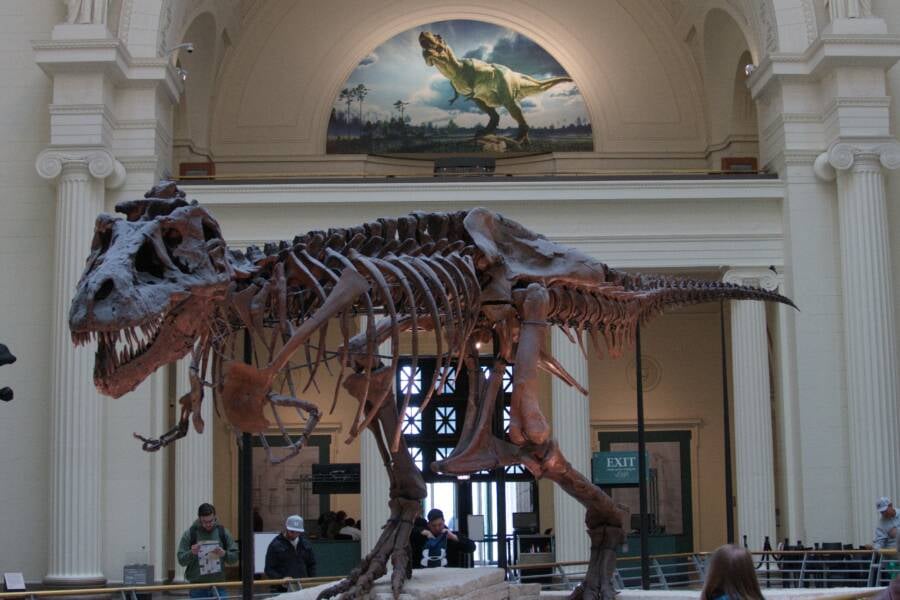
Amphibol/Wikimedia CommonsA T. rex specimen known as “Sue” at the Field Museum of Natural History in Chicago.
There are still some holes in the growth cycle of T. rex, especially since there are so few juvenile specimens in the fossil record. Still, the research represents a new pathway for other scientists to reevaluate the lifespans of different dinosaurs.
“Even after more than a century of study, Tyrannosaurus rex continues to surprise paleontologists,” said Woodward.
“By combining expanded sampling, innovative statistics and careful bone analysis,” Woodward continued, “the new study offers a clearer, more accurate picture of Tyrannosaurus rex as a living animal, growing from juvenile to giant.”
After learning about the real lifespan of the T. rex, look through our list of 31 fascinating dinosaur facts. Or, discover what killed the dinosaurs.