The Anglo-Zanzibar War

Public DomainAn illustration of British ships bombarding the sultan’s palace in Zanzibar.
Time and time again throughout history, wars have dragged on for far too long. Many last years. Some have lasted decades. The Anglo-Zanzibar War, on the other hand, holds the distinction of being the shortest war in recorded history, raging for a mere 38 minutes.
The crisis leading up to the war began on August 25, 1896, when pro-British Sultan Hamad bin Thuwaini died after just three years in power, and his cousin Khalid bin Barghash immediately seized the throne.
Rumors circulated that Khalid had poisoned his predecessor, likely because he disagreed with British colonial rule and wanted sovereignty so his country could profit from the lucrative slave trade. The British, however, who sought to abolish slavery entirely, had other plans.
The British government demanded that Khalid cede the throne to their preferred candidate, Hamoud bin Mohammed, giving him until 9 a.m. local time on August 27, 1896, to comply. Khalid, to his detriment, badly miscalculated Britain’s resolve and believed they were bluffing. So, he surrounded the royal palace in Zanzibar with guards and artillery.
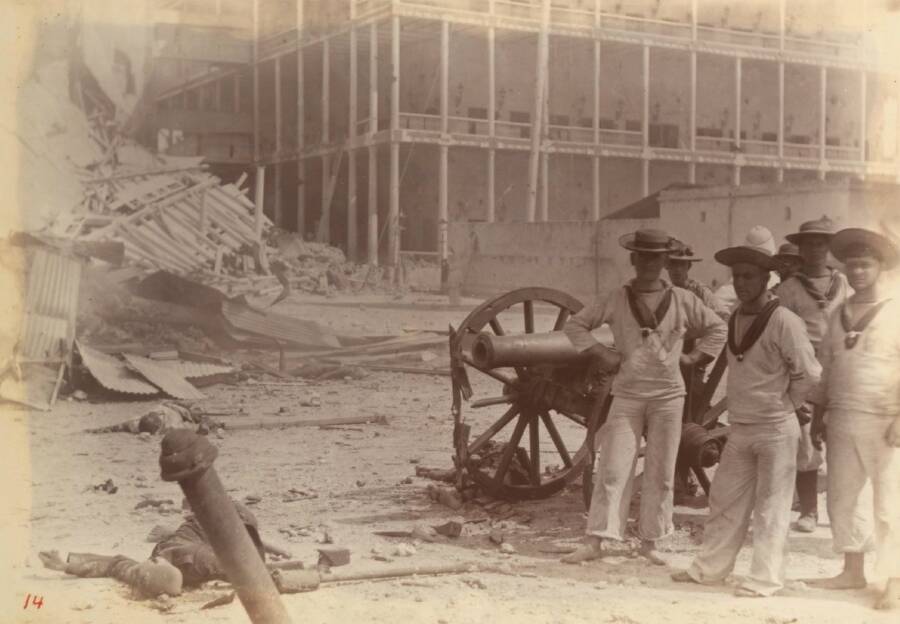
Public DomainBritish troops posing with a captured Zanzibari gun.
In response, the British Royal Navy sent five ships to surround the harbor closest to the palace, while Royal Marines and sailors landed on shore. And at exactly 9:00, when Khalid refused to abdicate, the bombardment commenced. The wooden structure, Khalid learned, didn’t stand a chance against the British barrage.
Nor did the sultan’s singular naval vessel, the Glasgow — a luxury yacht that had been gifted by Queen Victoria — which was entirely unsuited for combat and destroyed by the Royal Navy within minutes.
It was a brutal, entirely one-sided war. After just 38 minutes, Khalid’s army fled. Meanwhile, British and pro-British forces reported just one injury among their 1,000 troops, while Khalid’s men and the civilians who were unfortunate enough to be in the area at the time suffered 500 casualties. Khalid escaped to the nearby German consulate requesting asylum, but Britain finally captured him during World War I, after which he agreed to live in exile.
Britain installed their chosen sultan and subsequently outlawed slavery in Zanzibar a year later.