Found at a burial ground in the Astrakhan region, this sabre measures almost four feet long and dates back to the second half of the 13th century.

Astrakhan Museum-ReserveThe medieval sabre found in Astrakhan, Russia.
The “Eagle’s Nest” burial ground in Astrakhan, Russia, has yet again proven to be one of the region’s most astounding archaeological sites. During excavations there last year, archaeologists uncovered dozens of medieval Muslim graves, one of which contained an unusually large — and incredibly well-preserved — sabre from the 13th century.
The sabre is so long that archaeologists suspect that it had to be custom made for a warrior who was unusually tall. But it’s far from the only unusual thing that archaeologists found during recent excavations at the Eagle’s Nest.
The Exceptionally Long Medieval Sabre Found In Astrakhan
According to a statement from the Astrakhan Museum-Reserve, the medieval sabre was discovered during excavations at the “Eagle’s Nest” settlement-cum-burial site in the Krasnoyarsk District that took place last year. During this excavation, archaeologists uncovered 50 Muslim burials — as well as two additional graves with unusual attributes.
One — grave No. 53 — contained the sabre.
Within this oval-shaped grave, which dates to the mid-13th century, archaeologists found a body facing east, covered in “a dark coating” that they believe could be the remnants of “leather armor and a helmet.” Alongside the body, they found a flat arrowhead, two square arrowheads, and the sabre, tucked inside a wooden sheath.
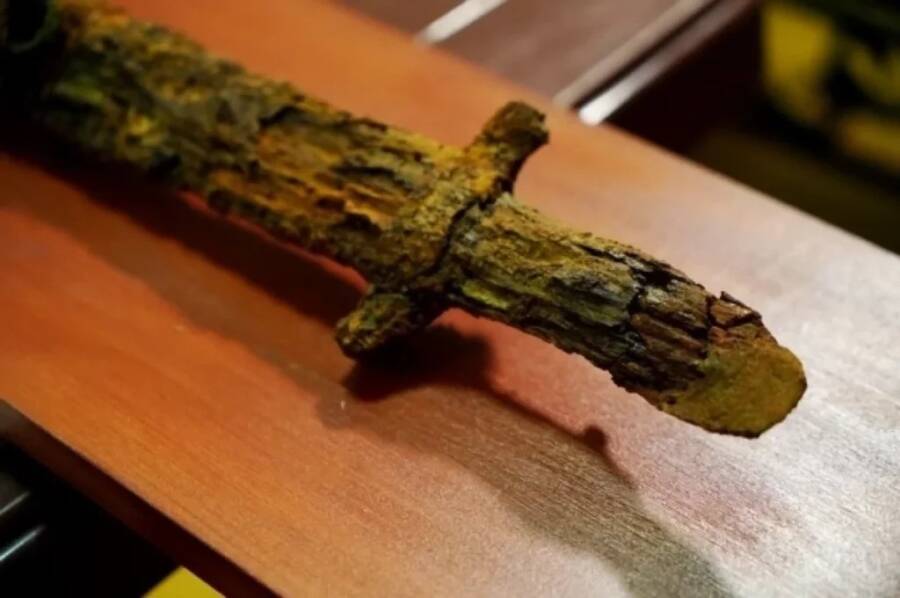
Astrakhan Museum-ReserveThe hilt of the medieval sabre found at the Eagle’s Nest burial site.
“The [sabre] was removed by archaeologists from the excavation site as a block, including the soil; it weighed [33 pounds],” restorer Mikhail Golovachev explained of the preservation process, which took four months.
He continued: “This is a unique case of preservation. The fact that the iron blade was kept in a wooden scabbard played a significant role in its preservation. The wood was preserved with iron oxides.”
Once it had been restored, archaeologists realized that it was an unusual artifact. The sabre was long — more than three and a half feet long, at a time when most sabres were just over two feet. For this reason, archaeologists believe that it wasn’t “mass-produced” but likely made for someone in particular.
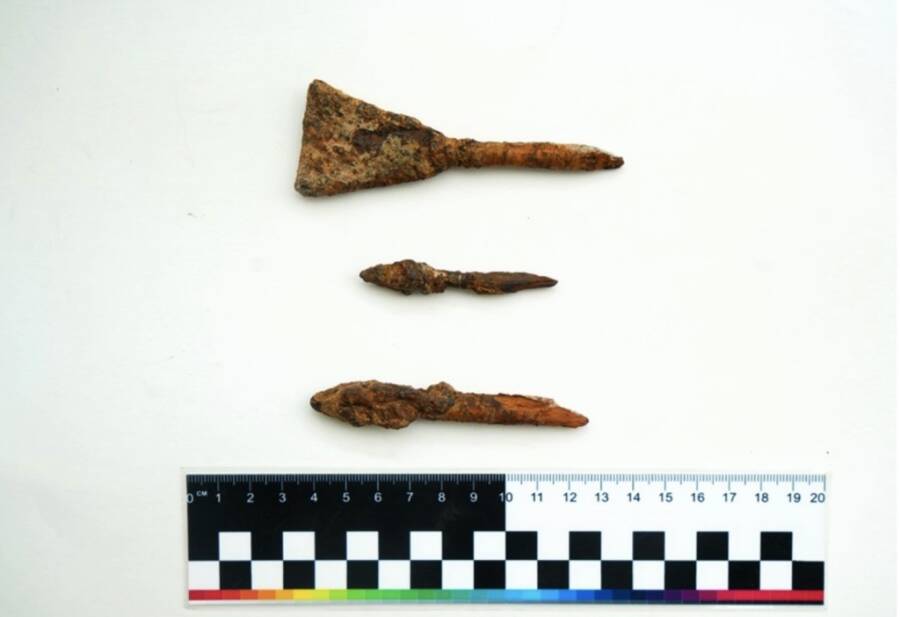
Astrakhan Museum-ReserveThe arrowheads found at the Astrakhan burial site.
“In our case, I think it was a custom order for a specific person, who would have been about [six feet, five inches tall], as they would have needed a long reach to draw the blade from its scabbard,” Golovachev explained.
Strangely, however, the person buried alongside the sabre was not this height. They stood only about five feet, nine inches tall.
But that’s hardly the only mystery that archaeologists uncovered during their excavations at the Eagle’s Nest.
Unusual And Violent Burials At The “Eagle’s Nest” In Astrakhan
The other unusual burial at the Eagle’s Nest was grave No. 52, an earlier burial that was discovered about seven inches above grave No. 53 (which included the sabre). Here, archaeologists found hints of a man who’d died an especially violent death.
“He was lying on his stomach, and it was clear his hands had been bound even before he was pushed into the grave: the arm bones protruded from beneath the left side of his ribs, with his hands positioned very close to each other,” said Tatyana Grechkina, chief researcher at the Nasledie Scientific and Production Institution. “The front of his skull was facing upward, meaning his neck had clearly been broken, after which he was likely thrown into the grave. His legs were apparently also bound at the ankles.”
However, archaeologists also found the leg bones of a horse buried nearby, alongside a harness. According to Grechkina, this “contradicts the idea that this was an execution,” but it’s unclear why the man would have been buried in such a position.
It’s also unclear how these burials fit into the area’s larger historical context at this time. The late 1200s were a turbulent time in what’s now southern Russia, as the Mongol Empire began to break apart while the children and grandchildren of Genghis Khan — not to mention other regional rulers — repeatedly battled each other for control of certain areas in the wake of his death.
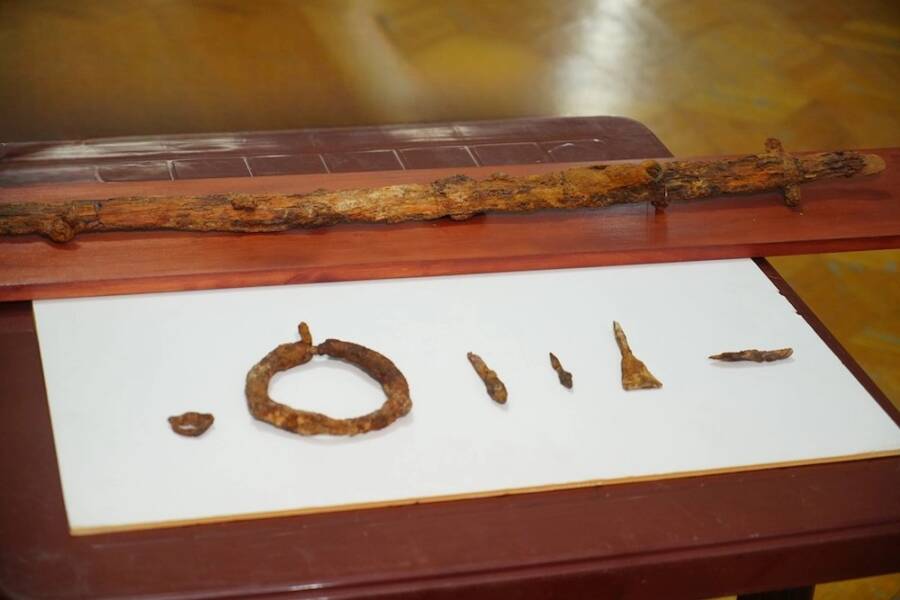
Astrakhan Museum-ReserveIn addition to the sabre and arrowheads, archaeologists also found a stirrup, a belt buckle, and a fragment from a knife.
Indeed, the burials found at the Eagle’s Nest — especially grave No. 52 and grave No. 53 — have offered more questions than answers.
Who wielded the sabre? Why was the bound man buried in such a position? Answers are elusive, but the artifacts will be processed and soon put on display, after which more answers may emerge.
After reading about the unusually long medieval sabre that was found in Russia, look through this stunning collection of armor through the ages. Then, discover the story of the Shotel Sword, the double-edged curved blade traditionally wielded in Ethiopia.