Chancellorsville, The ‘Perfect’ Union Assault That Became A Confederate Victory
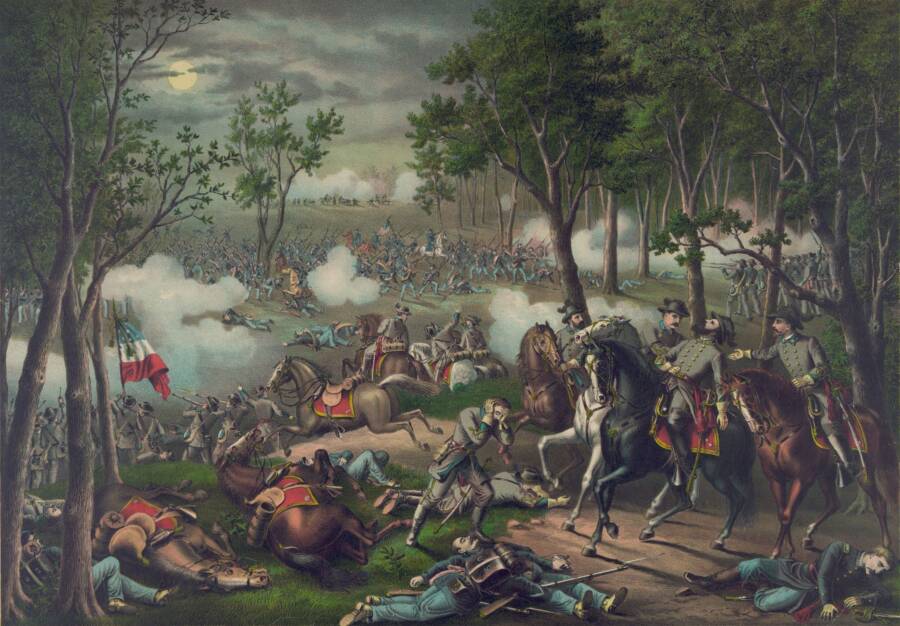
Library of CongressA depiction of the Battle of Chancellorsville, which has been described as Robert E. Lee’s “greatest victory.”
In the spring of 1863, Major General Joseph Hooker, recently appointed by Lincoln to lead the Army of the Potomac, devised a plan to take the war directly to Lee. “My plans are perfect,” Hooker stated, according to the National Park Service, “and when I start to carry them out, may God have mercy on General Lee, for I will have none.”
But the ensuing Battle of Chancellorsville would turn into a crushing Union defeat — and one of the bloodiest battles of the Civil War.
It began on April 30, 1863, when Hooker led 97,382 Union troops to meet Lee in Virginia. Hooker hoped to pin Lee down at Fredericksburg and force him to retreat. But Lee, who had just 57,352 men, fought back instead.
Indeed, history would judge that Lee, not Hooker, executed a “perfect battle.” In the face of a much larger Union force, Lee held his ground. He left 10,000 of his troops to man Fredericksburg and turned the bulk of his army west, where the Union and Confederate forces met at Chancellorsville on May 1.
Though Hooker assured his subordinates that he had Lee “just where I want him,” the Confederates swiftly gained the upper hand. While Lee’s men faced Hooker’s head-on, Confederate Lieutenant General Thomas J. “Stonewall” Jackson quietly circled to the Union’s rear flank. On May 2, they erupted out of the woods with guns blazing. “Along the road it was pandemonium,” one Massachusetts soldier recalled, “and on the side of the road it was chaos.”
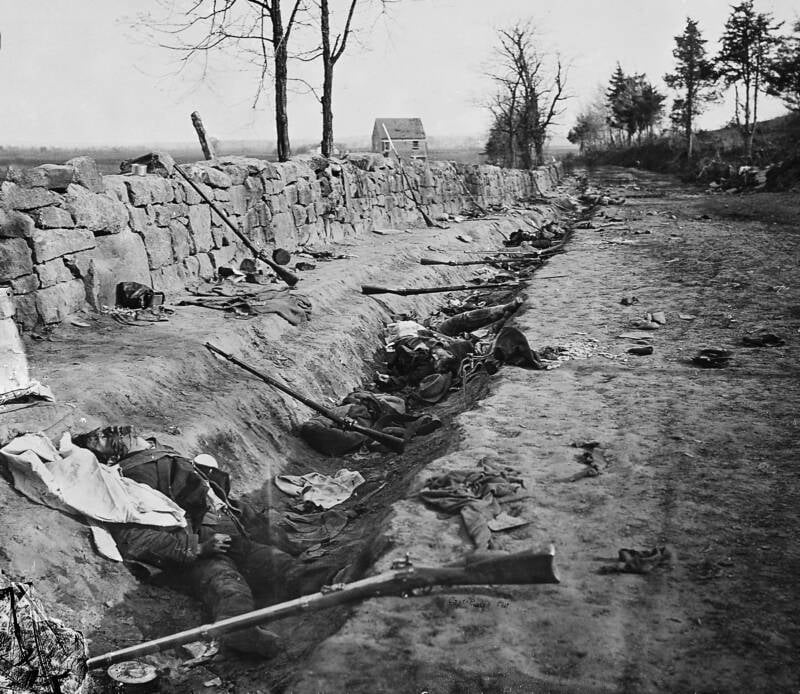
National ArchivesConfederate dead after the Battle of Chancellorsville, one of the bloodiest battles of the Civil war.
The Battle of Chancellorsville ended with a Confederate victory, but it was a bitter one. During the battle, the Confederates had suffered 13,460 casualties, including — crucially — Jackson, who was fatally wounded by friendly fire. And though the battle gave the Confederates the confidence to march north a few months later, they ultimately marched to their doom: Gettysburg.
Meanwhile, the Union forces also suffered 17,304 casualties, for a total of 30,764 casualties — including 3,418 deaths — on both sides, making the Battle of Chancellorsville one of the bloodiest engagements of the Civil War.